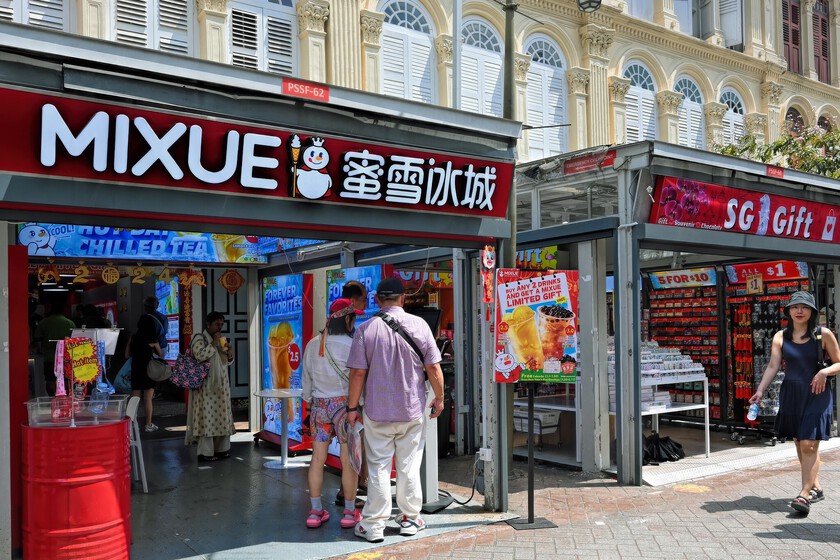
It’s hard to believe in a world dominated by big brands and multinationals, but there is a hospitality chain with more stores than McDonald’s and Starbucks that you’ve probably never heard of. Its name is Mixue (Mìxuě Bīngchéng), it was founded in the late 90s by a university student from Zhenghou, China, and today it is considered the largest food and beverage chain in the world. This is how it is recognized, for example, by the magazine TIMEwhich has included it in its list of the 100 most influential companies of 2025.
It is estimated that it has more than 46,000 stores spread throughout Asia, Australia, the Middle East and South America, a vast network of stores in which it offers a menu based on ice creams, smoothies, coffees, traditional teas and bubble teas.
Bigger than McDonald’s? Yes, if we talk about the number of establishments. The benefits are something else. While McDonald’s boasts of having more than 43,000 restaurants spread across more than a hundred countries and Starbucks managed 40,576 stores at the end of the first quarter of fiscal year 2025, Mixue exceeds (and quite comfortably) both figures. A few months ago the magazine TIME He assured that the chain has more than 45,000 distributed mainly in mainland China, although it also operates in other regions.
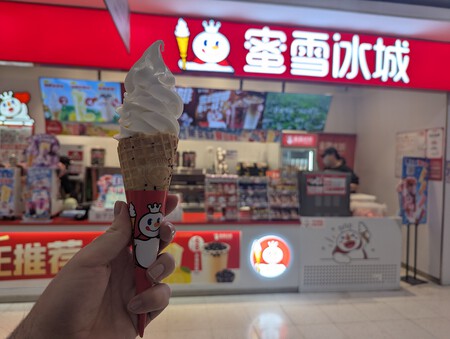

Do you have so many stores? Yeah. Fortune It is estimated that it has more than 46,000 points of sale throughout Asia, Austria, the Middle East and South America. Other sources speak of more stores, raising the total network to 53,000 points of sale. Beyond these dancing numbers, one thing is clear: Mixue is normally considered the food and beverage chain with the largest deployment of establishments in the world. In addition, its branch network continues to expand well.
If in the West its brand is less known to us than McDonald’s or Starbucks, it is because (despite the international leap it has made in recent years) the majority of Mixue stores are still concentrated in China. The firm also has another handicap that helps understand its global expansion: while in the case of Starbucks more than 50% of the stores are in the hands of the company itself, in Mixue practically all of them operate through franchises.
What is your story? Mixue’s is the typical story of improvement and accelerated growth that gives shine to the classes of coaching business. The company’s father is Zhang Hongchao, who laid its foundation almost 30 years ago from scratch. His story begins in 1997, in Zhengzhou, when Zhang, then a university student, managed to get his grandmother to lend him 3,000 yuan ($420) to set up a small slushie and soft drink stand.
Despite the challenges he encountered along the way (and the occasional business failure), Zhang moved forward, managed to adapt to the changes in Zhenghou, reinvested in machinery and found the key to creating a million-dollar business. Sam Tang says his first success came in 2006, when he launched ice cream for one yuan. In 2014, its brand already had 1,000 stores. In 2020 there were 10,000.

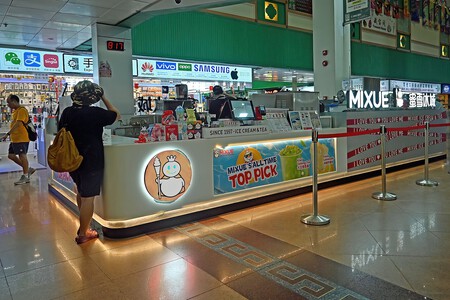

And how has it succeeded? The big question. Mixue’s business model has several clear characteristics. The first, its commercial approach. The chain basically sells ice cream. soft servesmoothies, tea soft drinks and bubble teas, although their menu also includes coffee and Fortune He assures that in the future he plans to expand his offer with beer. The other great features of their menu are the affordable prices, with ice creams for less than a euro.
Other peculiarities of the company are its efforts to dominate the supply chain, its commitment to a clearly identifiable brand thanks to symbols such as its mascot (Snow King) and, above all, expansion through franchises.
In a report from a few months ago, the company itself acknowledges that almost all of its stores (99%) are opened and operate through franchises. Mixue is in charge of supervising the businesses, choosing locations, decoration and assessing the capacity of the staff. For her, the business is not so much in the fee that those stores then pay as in the equipment, merchandise and packaging that she sells to them.
And the future? It doesn’t look bad. In spring, the company went public in Hong Kong and managed to raise nearly $450 million, starring in one of its best debuts of the first half of 2025. The company also seems willing to enter the powerful (and disputed) US market.
As required Fortuneduring the first half of the year the company reached a revenue volume of 2,000 million dollars (40% more than in 2024) with profits of 370 million. Despite its humble origins, its founder and his brother now manage a fortune of billions of dollars.
Images | Choo Yut Shing (Flickr) 1 and 2 and Jeremy Thompson (Flickr)
In WorldOfSoftware | One of the biggest wine critics is French and has toured China. There is no good news for French wine