![7 Best Remote Team Collaboration Tools 2026 [Free & Paid]](https://www.cloudwards.net/wp-content/uploads/2026/02/Best-Team-Collaboration-Tools.png "7 Best Remote Team Collaboration Tools 2026 [Free & Paid]")
Remote teams need collaboration tools that manage projects, tasks and communication across different time zones. The right team collaboration tools streamline workflows, keep everyone aligned and reduce the hassle of juggling multiple apps. If you want a deeper comparison, explore our detailed guide to the best project management software to find the right fit for your team.
Cloudwards’ Choice: monday.com


From my testing, monday.com emerged as the strongest collaboration tool. Its visual workflows, automation and dashboards work well for small and growing teams. It also has internal communication features. Try the free plan or test the Pro Plan with a 14-day tree trial.
| PM Tool: | Free Plan | Price per User | Best For | USP | Limitations |
|---|---|---|---|---|---|
 |
Yes, 2 users | $12 per month (one-year plan) | Small to midsize teams | Highly visual boards, strong automation for repetitive tasks | Limited free plan, advanced features locked behind higher-tier plans |
 |
Yes, 2 users | $10.99 per month (one-year plan) | Cross-functional & creative teams | Structured task tracking | Limited native time tracking |
 |
Yes, up to 10 collaborators per workspace | $5 per month (one-year plan) | Simple projects, kanban lovers | Ultimate simplicity, Butler automation | Not suited for complex projects, limited structure for large teams |
 |
Yes, for personal projects | $10 per month (one-year plan) | Startups, documentation-heavy teams | Flexible workspace — combines notes, databases & tasks | Steep learning curve, slow performance in large workspaces |
 |
Yes, up to 10 users | $9.05 per month (one-month plan) | Agile & software development teams | Advanced Agile/Scrum features, extensive integrations | Complex setup, overwhelming for non-devs |
 |
Yes, 1 user (Individual) | $4 per month, billed annually | Enterprise & business teams | Deep Microsoft Office integration | Can feel heavy for small teams |
 |
Yes, Google Essentials Starter plan | $7 per month (one-year plan) with 30GB | Cloud-first teams | Real-time document collaboration | Basic task management tools |


I tested each tool in real workflows using shared tasks and live collaboration. I focused on day-to-day usability and flexibility.
Feature Comparison Overview
| Tool: | View Types | Time Tracking | Custom Fields | Dashboards | Real-Time Collab |
|---|---|---|---|---|---|
|
7: Table, Gantt chart, calendar, kanban & more | Native, on paid plans | More than 15 field types | Advanced with widgets | |
|
9: List, board, calendar & more | Native, on paid plans | More than 15 field types | Customizable with widgets | |
|
5: Board, spreadsheet, calendar, timeline, map | No native time tracking — uses 3rd-party power-ups | Limited (via power-ups) | Basic reporting | |
|
6: Table, board, gallery, list, calendar, chart | Manual tracking | More than 20 | Custom with formulas | |
|
3: Kanban, list, calendar | Advanced (work logs) | Extensive | Advanced reporting | |
|
2: List, channel-based views | Via integrations (Microsoft Planner) |
Limited | Basic admin dashboards (usage & activity reports) | |
|
3: List, table, calendar | Via integrations | No | Basic admin dashboards |
Platform & Administration
| Tool: | Mobile App | File Storage | File Management | Permissions |
|---|---|---|---|---|
|
|
500MB – 1000GB (plan-based) | File previews, versioning, search | Account, board, task level |
|
|
100MB – unlimited (plan-based) | Version control & approvals | Workspace, project, task level |
|
|
10MB – 250MB | Basic attachment | Board, card level |
|
|
Unlimited | Embedded files & databases | Page, database level |
|
|
2GB – unlimited | Advanced with Confluence | Project, issue level |
|
|
Tied to OneDrive/SharePoint | Strong file versioning & co-authoring | Org, team, channel level |
|
|
15GB – unlimited | Real-time editing, version history | Org, drive, folder, file level |
Integrations & Automations
| Tool: | Integration Count | Top Integrations | Native vs 3rd-Party | Automation Features |
|---|---|---|---|---|
|
200+ | Slack, Google, Adobe, Salesforce | 70% native, 30% Zapier |
Rules engine & forms |
|
500+ | Zoom Workplace, Teams, HubSpot, Shopify | 60% native, 40% 3rd-party |
Advanced automations & apps |
|
100+ | Slack, Google Drive, Dropbox | 40% native, 60% power-ups |
Butler automation |
|
50+ | Slack, Google, Figma, GitHub | 30% native, 70% API/3rd-party |
Database automations |
|
3,000+ | Confluence, Bitbucket, Jenkins | 80% Atlassian, 20% 3rd-party |
Workflow automation |
|
500+ | Zoom, Trello, GitHub, Salesforce | 50% native, 50% 3rd-party |
Workflow automations, message rules |
|
1,000+ | Slack, Zoom, Asana, Trello | 80% native, 20% via add-ons |
App scripts, triggers, automated workflows |
Usability & Performance Assessment
| Tool: | Learning Curve | Interface Design | Mobile Experience | Customer Support |
|---|---|---|---|---|
|
Easy-intermediate | Clean, intuitive | Excellent (95% feature parity) | 24/7 chat, extensive docs |
|
Intermediate | Colorful, modern | Very good (90% parity) | Phone, chat, email support |
|
Easy | Minimalist, card-based | Excellent (95% parity) | Community, paid support |
|
Intermediate-difficult | Flexible but complex | Good (80% parity) | Email, community forum |
|
Difficult | Dense, enterprise-focused | Fair (70% parity) | Extensive docs, community |
|
Intermediate | Functional, integrates Office UI, desktop apps | Very good (90% parity) | Phone, chat, email, web support |
|
Easy-intermediate | Clean, consistent Google UI | Excellent (95% parity) | 24/7 for paid plans, extensive docs |
From my testing, the best tools for team collaboration include monday.com, Asana, Jira, Trello, Notion, Microsoft Teams and Google Workspace.
1. monday.com — Best for Visual Project Management and Automation

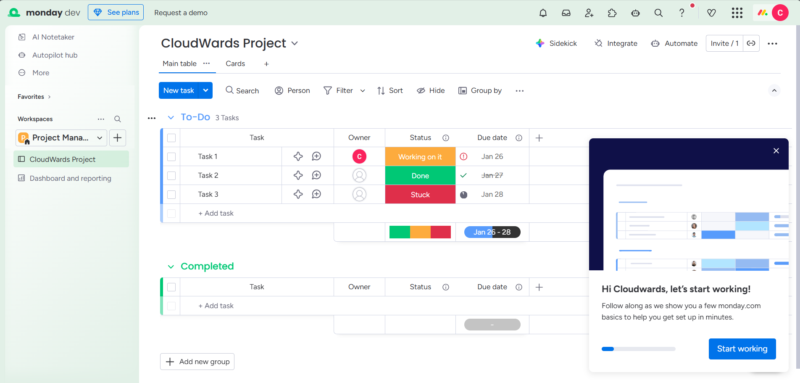
monday.com provides visual aids through boards for tracking
work and automating team workflows.
monday.com is my top choice because it gives distributed teams a clear, visual view of their work in one place. Shared boards and dashboards keep everyone aligned across locations and help reduce status meetings.
What Makes monday.com Special?
monday.com’s bright, intuitive interface makes it easy for remote teams to navigate shared boards and collaborate without endless check-ins. It also has internal communication features that improve team collaboration. See our monday.com review to learn more.
When to Choose monday.com
Choose monday.com if you want a tool with advanced automation and reporting that saves countless hours weekly. Try it with the Pro plans’ 14-day free trial to build smarter workflows.
Basic
- Minimum users: 3;
All prices per user
Standard
- Minimum users: 3;
All prices per user
More plans
Pro
- Minimum users: 3;
All prices per user
Enterprise
- Enterprise-level features.
2. Asana — Best for Task-Heavy Teams

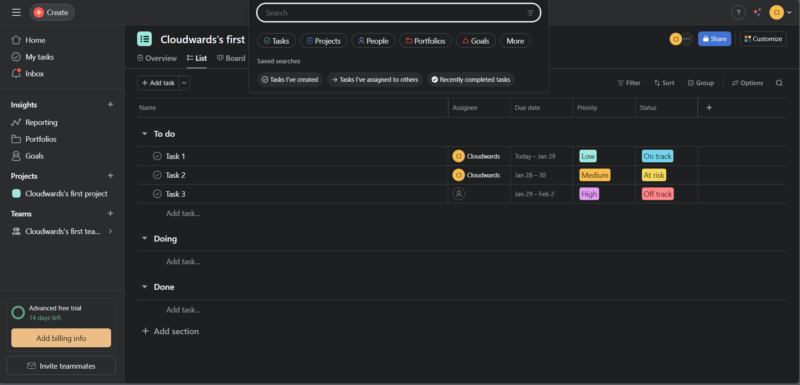
Asana gives structured task lists and project timelines for clear project planning.
Asana improves collaboration by organizing tasks, deadlines and ownership so distributed teams stay aligned and avoid delays.
What Makes Asana Special?
Asana stands out for visualizing how tasks, deadlines and dependencies connect across teams. Its timelines and shared views help remote teams understand priorities without constant updates. Asana has a good free plan that might be enough for some smaller teams, making it one of the best free project management tool options. Learn more in our Asana review.
When to Choose Asana
Choose Asana if your priority is clarity and accountability. It’s ideal for operations and product teams managing tasks across departments. You can also try the Starter plan for $10.99 per month, billed annually.
Starter
- Price is per user. unlimited users, expanded features
Advanced
- Price is per user. unlimited users, even more features
Enterprise
- Custom pricing, advanced security features
3. Jira — Best for Software Development Teams
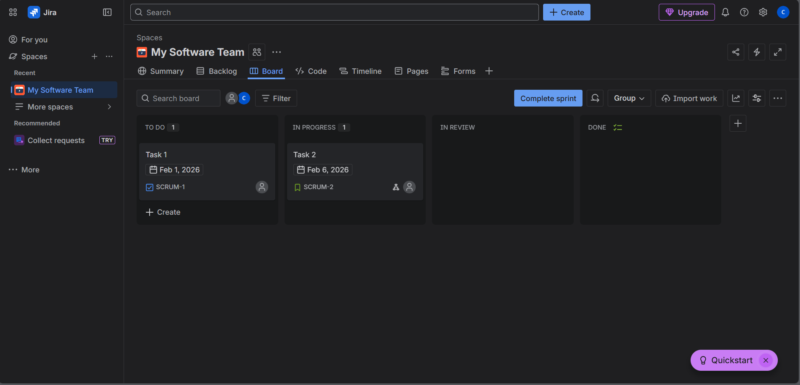
Jira provides Agile boards for sprint planning and issue tracking.
Jira helps technical teams collaborate by tracking issues, managing sprints and aligning releases in a single shared workspace.
What Makes Jira Special?
Jira is built for Agile collaboration, helping remote teams stay aligned across sprints and releases. Its structured workflows and detailed issue tracking make communication clear and even across time zones. Learn more in our Jira review, or explore our guide to the best Agile tools.
When to Choose Jira
Choose Jira if you are building software or managing a technical help desk. Try Jira’s free plan today and upgrade as needed — though you might need to read our Jira pricing guide to understand how much larger teams will pay.
Free
- Max. 10 users. unlimited boards, reports and insights; backlog; basic roadmaps; 2GB of storage; community support
Standard
- Monthly pricing starts from 11 users, pricing changes based on the number of users. Monthly pricing changes with teams over 110. Annual pricing shown is for 1-10 users
Premium
- Monthly pricing starts from 11 users, pricing changes based on the number of users. Monthly pricing changes with teams over 114. Annual pricing shown is for 1-10 users
Enterprise
- Enterprise plan pricing is available when you enter 801 or more users above; User tier: 801 – 1,000
4. Trello — Best for Simple, Visual Project Tracking
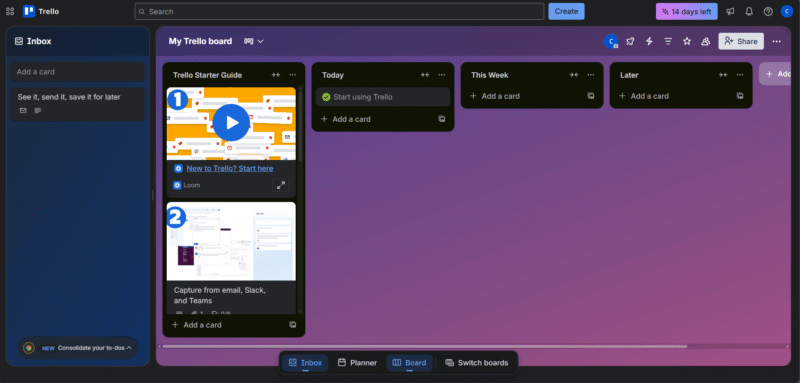
Trello offers simple card-based boards for fast task creation and visual tracking.
Trello makes collaboration straightforward with intuitive boards and task cards. Teams can assign work, comment and track progress in one shared space.
What Makes Trello Special?
Trello keeps communication attached to each task, which helps minimize updates scattered across emails and chats. Its lightweight workflow keeps remote teams aligned without adding unnecessary complexity. The free plan also allows unlimited power-ups, which significantly increases its functionality. Learn more in our Trello review.
When to Choose Trello
Choose Trello if your team wants a fast, affordable way to keep projects organized without complexity. Try Trello’s free plan or upgrade to the Standard plan for $5 per user per month, billed annually.
Free
- Unlimited users, 10 boards, Unlimited power-ups, Unlimited storage
Standard
- Price is per user, Unlimited boards, Custom fields, Invite guests
Premium
- Price is per user, Several new views
Enterprise
- Price is per user, Advanced admin & security settings. Discounts for larger teams.
5. Notion — Best All-in-One Workspace for Remote Teams

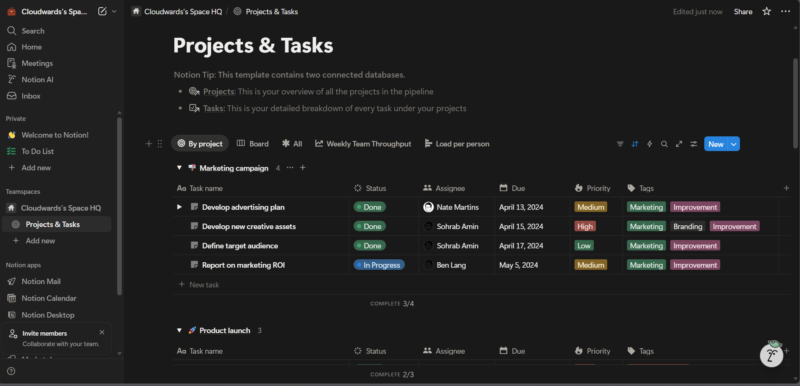
Notion provides a single workspace for docs, tasks and team knowledge.
Notion combines notes and tasks in one space where teams can edit together, leave comments and keep ideas organized.
What Makes Notion Special?
Notion stands out for how seamlessly it supports real-time team collaboration. Multiple team members can edit pages, leave comments and refine ideas together, making it especially effective for shared documents, brainstorming and feedback loops. Learn more in our Notion review.
When to Choose Notion
Choose Notion if you want one versatile workspace instead of multiple apps. Get started with Notion’s free plan, or opt for the Plus plan for $10 per seat per month.
Free
- 1 user only, Up to five guests, 5MB file upload limit
Plus
- 1 user only, Unlimited guests, Unlimited file uploads, Version history
Business
- Unlimited users, Unlocks workspace, User permission settings
Enterprise
- Advanced security features
6. Microsoft Teams — Best for Teams Already Using Microsoft 365

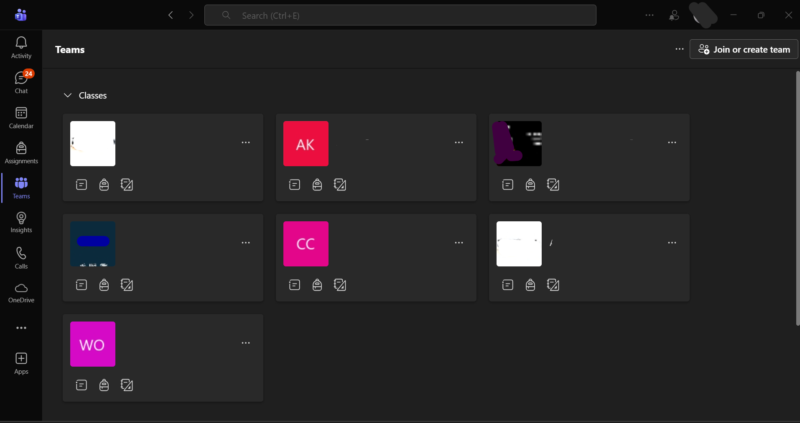
Unify video calls, chat and file sharing in a centralized hub with Microsoft Teams.
Microsoft Teams combines chat, video meetings and files in a single hub. Teams can communicate in real time without switching apps.
What Makes Microsoft Teams Special?
Microsoft Teams helps distributed teams communicate efficiently. Group channels, video calls and screen sharing keep everyone aligned, while integrations with Microsoft 365 apps ensure that your projects are organized and that work flows smoothly. Learn more about the platform in our detailed Microsoft Teams review.
When to Choose Microsoft Teams
Choose Microsoft Teams if your team already uses Microsoft Office and wants a central communication hub. Get Teams Essential for $4 per user per month.
|
Teams Essential | Business Basic |
|---|---|---|
| With Teams | $4 per user per month | $6 per user per month |
| Without Teams | $4.40 per user per month | $9.29 per user per month |
7. Google Workspace — Best for Real-Time Collaboration and Simplicity

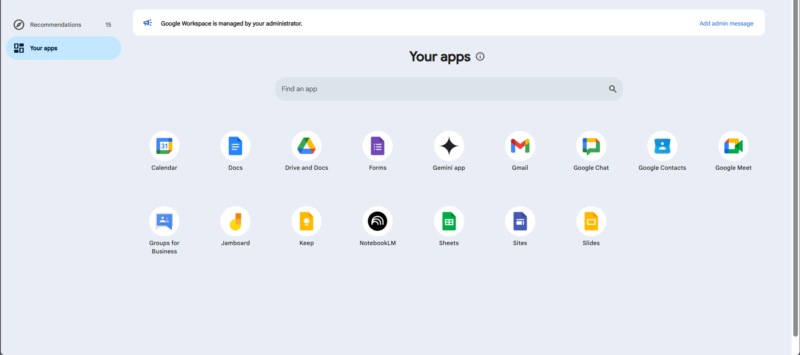
Google Workspace provides access to cloud-first productivity tools.
Google Workspace enables real-time collaboration across documents and spreadsheets, letting teams edit simultaneously and see updates instantly in a shared environment.
What Makes Google Workspace Special?
Google Workspace enables teams to work together in real time across documents, spreadsheets and Google Calendar, reducing delays and keeping everyone aligned on tasks and projects. Everything you do is live, instantly searchable and accessible from any device with a browser. Read more in our in-depth Google Workspace review.
When to Choose Google Workspace
Choose Google Workspace if your team wants a cloud-first environment for documents and scheduling. Plans start at $7 per user per month with 30GB. Start your 14-day Google Workspace trial today.
Business Starter
- per user / month, 1 year commitment
- 30GB
Business Standard
- per user / month, 1 year commitment
- 2TB
More plans
Google Workspace for Nonprofits
- *100TB shared across all users
- 100TB
Business Plus
- per user / month, 1 year commitment
- 5TB
Methodology: How I Tested and Chose the Best Collaboration Software for Remote Teams
I tested each tool as a real team would: creating projects, assigning tasks, sharing files and collaborating across users. I focused on practical, everyday use for small and growing businesses, evaluating how well each platform helps organize tasks and improve team communication.
Final Thoughts
Choosing the right collaboration software depends on how your team communicates, manages tasks and scales. monday.com stands out for its visual workflows, automation and flexibility. The monday.com Standard plan offers the best value, costing $12 per user per month.
Are you using any of the collaboration tools on this list? Which features matter most to your team? Share your thoughts in the comments, and thank you for reading.
FAQ: The Best Collaboration Apps
Sources:
- The Importance of Collaboration Software in Enhancing Remote Work Efficiency – MoldStud
- Team collaboration tools – TechTarget