




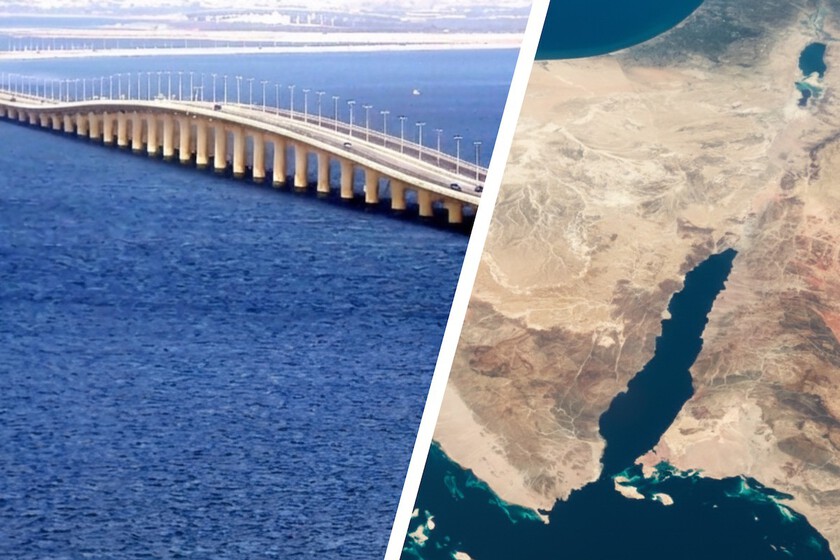
The Straits of Tiran are only 13 kilometers long, a distance so short that you can even see the people on the beach on the other side or take a walk to cross it. Well, if there was something to cross it. So in practice that very small distance between that tip of the Sinai Peninsula in Egypt to the other end in Saudi Arabia means driving 1,600 kilometers. The other option is to take a ferry and face a trip that would also take a few hours.
Saudi Arabia has a plan to link both countries in Africa and Asia: the “King Salman Causeway”, named after the Saudi monarch Salman bin Abdulaziz. An impressive mega infrastructure for crossing the Red Sea, evoking the biblical story of Moses. As? Combining a road and a railway with a length of 32 kilometers that links the straits from Ras El Sheikh Hamid (Saudi Arabia) to Sharm el-Sheikh (Egypt).
Also known as the “Moses Bridge” for obvious reasons, the 4,000 million estimated for its construction are provided entirely by Saudi Arabia. The winning company in charge of materializing it is China Civil Engineering Construction Corp., which has an enormous challenge on its hands. Because beyond the symbolism, this transcontinental land bridge has great strategic value for the economy of the parties involved. But it won’t be easy.
Why is it important. Integrated within Saudi Arabia’s Vision 2030 plan to promote tourism, infrastructure and economic diversification, this megastructure would completely change regional geopolitics: an enclave is an area that connects Asia, Africa and indirectly Europe. With its construction, a new corridor would be opened between Asia and Europe through North Africa that would turn Saudi Arabia into a logistics and goods transportation hub.
Tourism would also benefit: initial estimates point to a rise in Egyptian tourism, going from 300,000 people a year to 1.2 million. And the other way around: it would constitute an agile way to reach the northwest of Saudi Arabia where the futuristic $500 billion megacity called NEOM is located, with a constellation of resorts on the Red Sea to attract tourism. In addition, the “Bridge of Moses” would also be a passage area for the pilgrimage to Mecca.
So Saudi Arabia (for now) is working out: new income from tolls and businesses, development of regions and the generation of thousands of jobs. In fact, planning estimates a recovery of the investment in about 10 years, as reported by Global Business Outlook.
A technically pharaonic work. More than 30 kilometers long over the sea, the ends and the island of Tiran in the middle, it will have roads and a railway line that will allow both goods and people to be transported on high-speed trains. Thus, the King Salman Causeway will be one of the longest maritime crossings ever built in the form of a hybrid construction that combines a mixture of bridges and submerged tunnels, which will allow the passage of deeper areas and allow the passage of heavy air traffic.
For ships to pass underneath, it will have sections up to 75 meters high. For the bridge part, it will use a type of piles called caissons, huge steel tubes placed on the seabed. For its installation it will be necessary to pump the water, so that dry foundations can be built. For the tunnel, they will combine tunnel boring machines with the sinking of prefabricated segments with a technique similar to the Hong Kong-Zhuhai-Macao link. According to initial estimates, the work could last almost a decade.
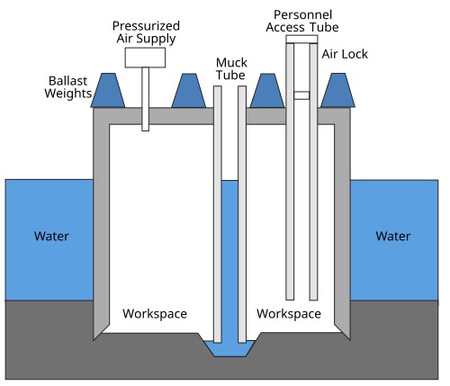


Scheme of a box. Yk Times- Wikimedia
Hellish engineering. As we will see later, the Red Sea is a sea with a particular ecosystem, but also a terrifying topography for a work of this magnitude insofar as it houses the Red Sea trench, a rift where the African and Arabian plates separate, generating sudden drops: the areas close to the thing are shallow, but according to the bathymetry, the passage area of the King Salman Causeway registers a depth that “only” only touches 300 meters (the “only” thing is because it has an average depth of 500 meters and maximum of 2,730 meters). At that depth, using traditional seabed-founded pillars is useless.
The use of the adjective infernal has not been coincidental: the temperature in the area comfortably exceeds 40°C. Working there is like being in an oven, but it also takes its toll on the materials: the water in the concrete evaporates before it sets properly, losing structural resistance, as explained by Dr. Victor Yepes, engineer of Roads, Canals and Ports and professor at the Polytechnic University of Valencia, in his blog. So the concrete must be cooled during setting to avoid cracks.
Steel also suffers: you have to deal with its thermal expansion, the accelerated corrosion of a high salinity environment and the thermal fatigue of day and night cycles. So we must resort to the use of high corrosion resistance alloys, a design of expansion joints capable of absorbing metric movements produced by thermal expansion in a structure more than 30 kilometers long, cathodic protection and even paints with reflective colors to reduce radiation absorption.
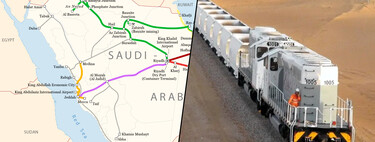

The natural challenges of the Red Sea. The sea that bathes the coasts of the Straits of Tiran is a true garden: it is home to coral reefs, a great marine diversity with endangered species such as the dugong and it is a nesting area for turtles and seabirds.
Obviously the construction of such a megastructure results in annoying noise pollution for fauna, but also the appearance of sediments, which are lethal for the coral as it suffocates it, modifying currents and affecting water quality. Egypt Independent echoes the warning of the environmental NGO HEPCA has approved the work, as long as there are rigorous environmental studies and the most sensitive reef area is avoided. Otherwise, he will take the project to court.
Nothing new diplomatic challenges. The first time a bridge between Egypt and Saudi Arabia was formally proposed dates back to 1988 at the Aqba Summit. After a first serious attempt in 2004 that ended up paralyzed by pressure from Israel, as Spiegel summarizes, in 2016 they resurrected the idea with the help of the current Saudi monarch.
Given the scope and duration of the work, there will be a need for political and diplomatic stability beyond 2030, something that is not easy in the general context in which we live, but even less so in a sadly classic area of turbulence. And it will be so not only because of the work itself, but because although Saudi Arabia finances the project, the two countries will assume the operation and maintenance costs.
In WorldOfSoftware | The construction of The Line, Saudi Arabia’s 170 km “skyscraper”, is advancing: a new video demonstrates it
In WorldOfSoftware | Nicaragua has a project to revolutionize global maritime trade: a canal that is almost four times that of Panama
Portada | Expedition 35 CrewImage courtesy of the NASA Johnson Space Center, Image Science & Analysis LaboratoryDerivative work including grading, noise reduction, lens distortion and vignetting correction and dust spot removal: Julian Herzog y Mohamed Ghuloom – Cool Photos 18 – Taken by AbulPhoto – Mohamed Ghuloom


