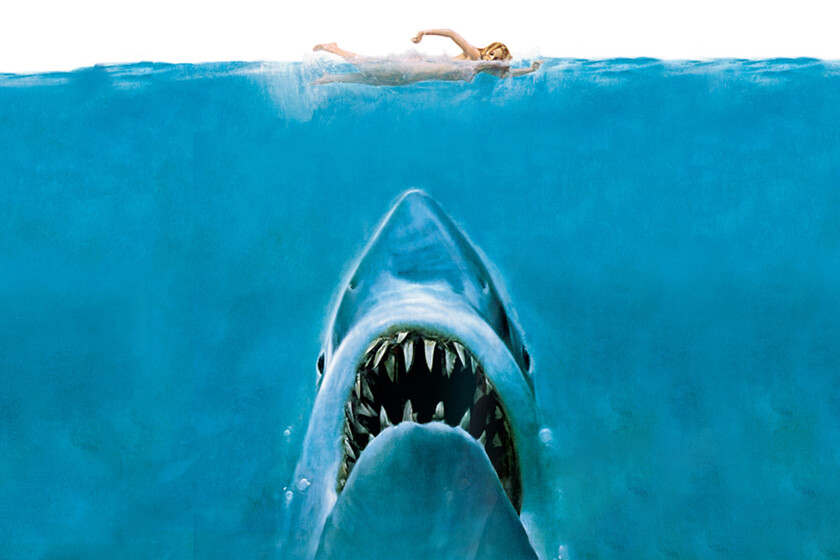
The story of ‘Jaws’ begins long before its monster appears on screen: it was born in a chaotic shoot, with a mechanical creature that did not work, a young director on the verge of dismissal and a climate of tension that threatened to sink not only the film, but also Steven Spielberg’s career.
Hence the most chilling scene has arisen from the most logical thing: a failure.
The technical failure and taking a bath. The story was told a long time ago by Spielberg himself. The entire team assumed that the film was doomed. Brucethe name given to the enormous robotic shark, constantly broke down as soon as it touched salt water, the days went by without being able to film anything usable and leaks from Hollywood ensured that the production was a disaster. However, from those limitations (and especially that useless shark) was born one of the most influential decisions in the history of cinema: not to show the threat, but to hint at it.
Technical necessity forced Spielberg to shoot the film as a suspense thriller, closer to a Hitchcock film than a giant creature spectacle, and he turned the series of mechanical problems into the greatest narrative success of his career. The result was a film where terror springs from the invisible, from calm water, from the ominous sound of two notes that advance like an unstoppable threat: a tension that would forever change the public’s relationship with the sea (for the worse).

The sequence. The iconic opening scene (a quiet beach, a party, and a girl who decides to bathe under the moon) is the perfect example of the way Spielberg transformed technical shortcomings into a cinematic virtue. We do not see the shark at any time, but we feel its presence from the first vibration of the water. Chrissie, played by Susan Backlinie, goes into the sea while the camera accompanies her slowly, without warning, until something grabs her from below, shakes her from side to side and ends up dragging her into the depths.
On the surface calm returns, but the audience can no longer recover it: they know that the unknown is there, lurking where it cannot be seen. The psychological impact was so immediate that many viewers, first in the United States and then in Europe, left the cinema with the same phrase in their heads: “I will never get into the water again in my life.” Spielberg built an invisible attack in which the viewer’s imagination becomes the real monster, and he did it because he simply had no other choice: Bruce I would never have been able to shoot that shot convincingly. The animal’s absence, paradoxically, created a presence more terrifying than any mechanical creature.

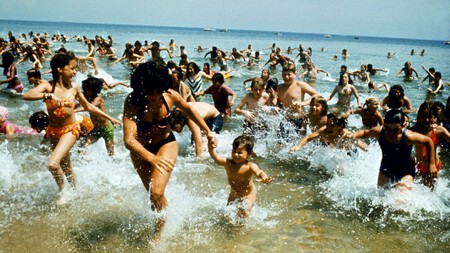

The failures that forged the tension. During filming, the mechanical shark turned out to be practically unusable. Engines corroded with salt, joints failed, and underwater operators spent hours trying to refloat a robot that was sinking rather than attacking. Spielberg confessed that the bug “looked silly” and that he was afraid the audience would laugh. But when something doesn’t work, cinema can reinvent itself.
Forced to film without showing the predator, the director and his team chose to work as if the camera were the shark itself: low-water shots, disturbing points of view, tense silences and, above all, the terrifying rhythm composed by John Williams, initially received as a joke and finally becoming one of the most recognizable leitmotifs in the history of cinema.

Simple ball. The failed machinery forced the narrative to focus on “less is more,” and that visual reduction transformed what was going to be a monster film into a piece of pure suspense, one in which the threat lurks beneath the surface like a collective trauma ready to emerge. Spielberg himself later admitted that, if the shark had worked well, ‘Jaws’ would have been a much worse film or, at the very least, much less scary.

From accident to cultural revolution. Thus, what began as a filming in crisis ended up unleashing an unprecedented phenomenon. ‘Jaws’ not only terrified millions of moviegoers (literally altering their relationship with the beach), but it redefined the film industry. The film also inaugurated the concept of “premiere-event”: massive campaigns, releases in hundreds of theaters and a summer strategy that demolished the old belief that no one went to the movies when the weather was good.
The audience came again and again to scream, to feel the shock, to immerse themselves again in that first scene that turned a nighttime swim into an act of pure recklessness. Spielberg’s film opened the door to a new economic model, inspired aggressive marketing strategies, generated an avalanche of imitators and consolidated the blockbuster as the central engine of Hollywood.
By the way, I recalled in a wonderful Guardian report for the film’s anniversary that its cultural impact gave rise to infinite interpretations: readings on masculinity, power, institutional crisis, post-Watergate paranoia and even debates about its moral content. However, when Spielberg was asked what ‘Jaws’ really meant, the answer was as simple as it was brilliant: “It’s a movie about a shark.” And what makes it even bigger is that, due to a technical failure, that shark almost never appears.
Image | Universal Pictures
In WorldOfSoftware | In the 80s they were already cloning faces without the need for AI: ‘Back to the Future’ replaced an actor with a mask and we didn’t realize it
In WorldOfSoftware | Stephen King threw away the first pages of the book. His wife rescued them and turned a scene into horror film history