




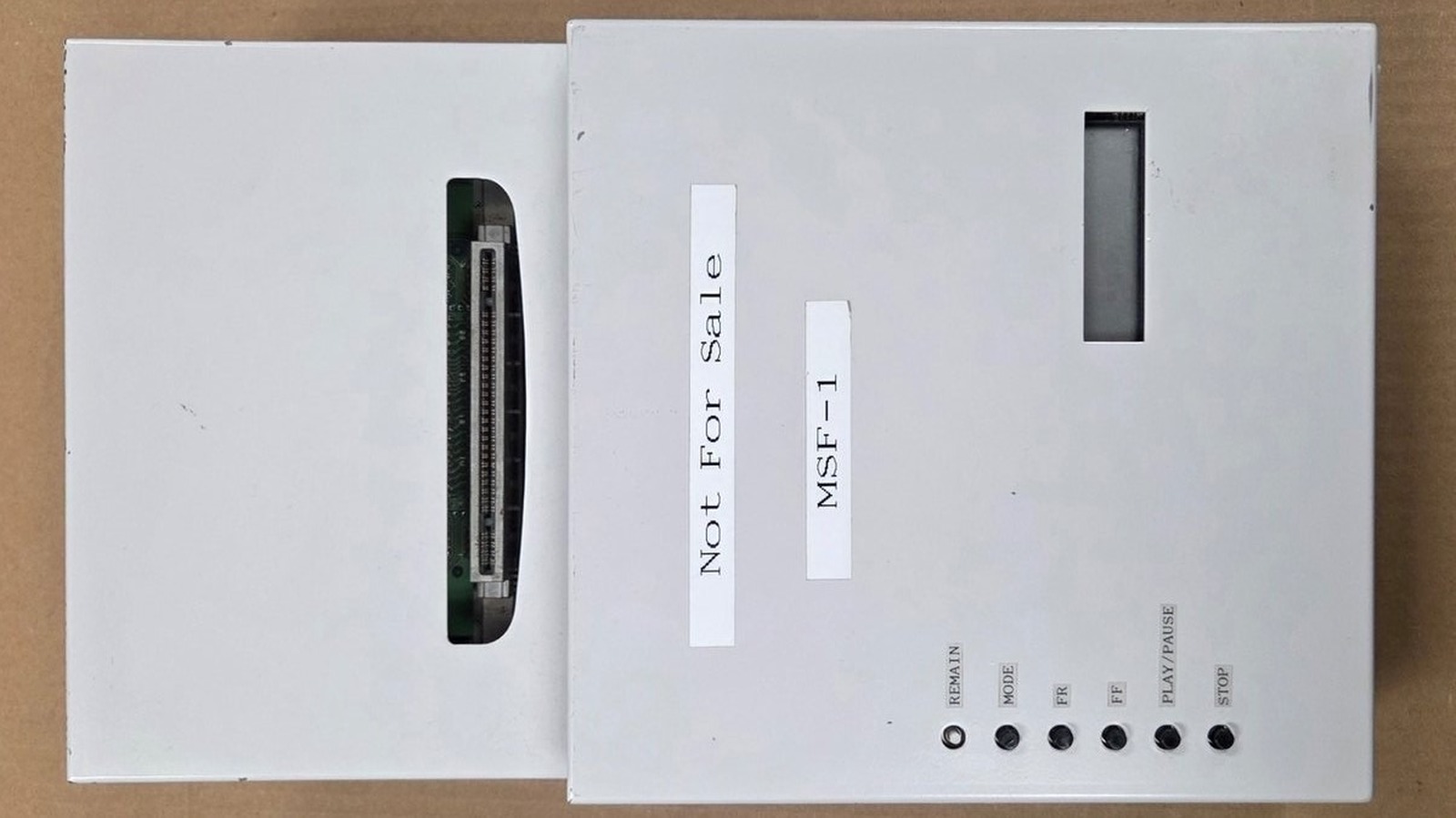
The National Videogame Museum has unveiled its acquisition of a long-discussed and legendary piece of video game history — the Nintendo PlayStation console, or the Sony MSF-1. It is the oldest known version of the joint console and, as of now, the only unit thought to exist. It’s a boxy, unattractive device that looks nothing like what you’d expect of a modern console. To understand what the heck is going on, we have to go back in time.
The original Sony PlayStation revolutionized the gaming industry in 1994-1995 and paved the way for modern games. It was the first to introduce real-time rendering of complex 3D experiences, and also swapped from cartridge-based game releases to compact discs. But a little-known fact about the early concepts of the console, or rather the earliest design, is that it was a collaboration between Nintendo and Sony. The industry back then was dominated by Nintendo and Sega, and so a partnership with Nintendo made a lot of sense. As part of the collaboration, the Sony console in development would have supported both the company’s soon-to-be signature CDs and cartridges, like Nintendo cartridges, while adding a significant processing power bump to the SNES. Nintendo backed out of the deal, and Sony went on to develop the console we know today as the PlayStation.
The Sony MSF-1 is an early prototype of the Super Nintendo CD attachment, which never made it to final production and never saw a more consumer-friendly visual overhaul. The National Videogame Museum now has it on display at its location in Texas where you can see it up close if you so desire. You’ll also find the super-rare Atari Cosmos console on display there, along with a huge collection of iconic video game exhibits.
The Sony MSF-1 is technically not a console
What you may immediately notice, especially from the side view, is that the MSF-1 suspiciously looks nothing like a console, though it could match the shape and design of a classic Nintendo console, such as the SNES. That’s because it was originally planned to be an attachment. You can see in the side view a connector that would have likely plugged into the cartridge port of the console itself. On top of the MSF-1 is another cartridge port, with a separate compact disc slot in the front. This unit would have been called the “Play Station,” or the SNES-CD.
Of course, it features a totally different design than the Nintendo PlayStation Superdisc, or the original prototype owned by the PlayStation co-creator, and one auctioned off for $200,000. Products like consumer electronics often go through various prototype iterations to build out and test designs before they are officially released. Interestingly, you can see various stages of this process in the Nintendo PlayStation’s early builds from the add-on for SNES to the working console prototypes that are just as rare. It does make you wonder how things would have turned out if the Sony and Nintendo collaboration had been successful. The partnership breakdown is often credited as the reason Norio Ohga, Sony President, and Ken Kutaragi, Sony’s head engineer, amplified development of the Sony PlayStation project. Especially given that the Sony PlayStation 5 has sold well over 50 million consoles today, and is wildly successful.


