




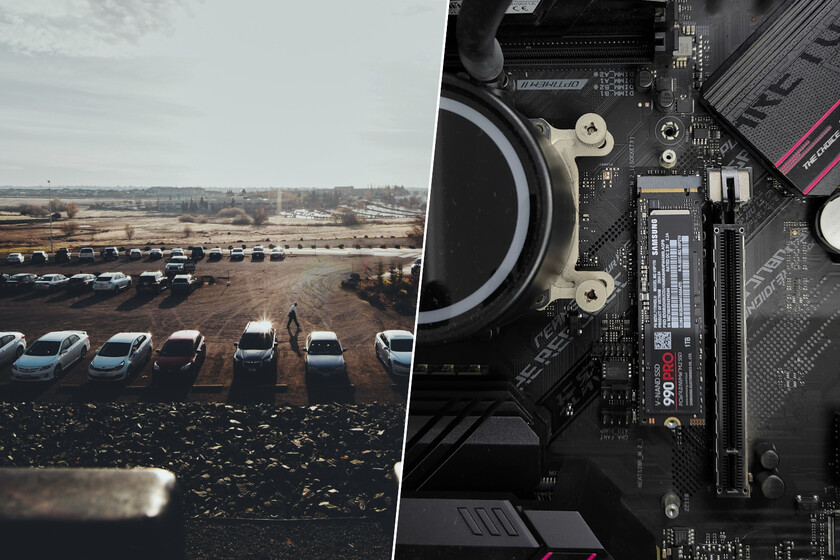
Waiting times of months to receive a car, manufacturers that packed their vehicles loaded with options to sell them at a higher Price with the promise that they would reach their customers sooner and a booming second-hand market, fueled by the eternal wait to get a new car.
They are echoes of a past that is around the corner, the chip shortage caused by factory shutdowns during the Covid-19 pandemic, the increase in demand for electronic products and the trade war between the United States and China.
The consequences were, as we say, diverse but above all harmful for who was waiting for a new car. From cars that arrived with hidden functions to vehicles that, directly, dispensed with digital instrument panels. Factories stopped or at half throttle that caused a 21% drop in global vehicle production.
But no information or data summarizes the situation as well as a photograph. The one in which it was seen visualized 45,000 Ford cars parked outdoors at the Kentucky Speedway’s waiting for the necessary chips to arrive to put them on the street.
Now, it is Ford that is already warning that a new crisis is on the horizon.
AI, of course.
We reported yesterday, January 17, that everything indicates that we can expect a long life from the latest generation consoles. Not because their hardware is about to explode or because intergenerational gaming continues to stretch to this day. The reason that will delay the arrival of the successors to the current consoles has a name and a surname: artificial intelligence.
The problem is that 90% of world production DRAM is controlled by Samsung, SK Hynix and Micron. Three companies that have in their hands a demand that far exceeds them and that anticipates a productive shortage as a result of data centers for artificial intelligence that are sweeping the market.
The problem is not only that the companies most interested in promoting artificial intelligence are securing components, the problem is that they pay better than anyone else. And that affects both manufacturers and consumers, who have seen a price escalation in components that seems to have no end.


The latest alarm comes from Ford. Sherry House, CFO of the company, pointed out that, for the moment, they have enough components to carry out their production but that they are aware of the pressure on their price in the market. “And that is already part of our future plan,” House said in words reported by The Drive.
The situation is dangerous. As happened years ago, market analysts already assure Bloomberg who are registering “panic buying”that is, mass purchases to guarantee stock before the component rises rapidly in price. These panic purchases have two obvious problems. The first is that the production of components is compromised. The second is the future price increase.
At the beginning of the decade, we discovered the hard way how dependent the automotive sector is on chip production. In December 2023, Micron already pointed out that in just three years the presence of components such as RAM memories was going to triple, going from about 90 GB of memory on average to 278 GB in 2026.
It must be taken into account that from May 2024 all cars sold as new in the European Union must have a powerful load of ADAS driving assistance systems. In China, the share of vehicles equipped with this type of aid has skyrocketed, partly due to the boost that BYD has given to the market by guaranteeing advanced driving assistance services in lower-priced vehicles.
My colleague Javier Pastor explained just a few weeks ago that infotainment systems have needed between 1 and 2 GB of DRAM in recent years to move the graphics own and support Android Auto and Apple CarPlay. But the requirements have doubled in recent releases.
And the proliferation of ADAS systems, increasingly complex in the most modern cars, does not help either. Only the Hardware 4 system (the one currently used by Tesla) uses 16 GB of RAM. The BMW iX3, the company’s most advanced vehicle at the moment, boasted four “superbrains” inside, with chips dedicated exclusively to the vehicle’s dynamic functions, the ADAS systems and the management of the infotainment system.

“A modern car makes use of so-called ECUs (Electronic Control Units) for issues such as controlling the transmission, the airbag system or the engine itself. It is normal for them to have between 50 and 150 of these control units or microcontrollers, and almost all of them contain RAM for temporary data and a ROM for the firmware and software.”
The problem is deep because it affects all types of components. In October, the Nexperia crisis already showed the wolf’s ears. And it is not only a question of advanced infotainment or driving assistance systems for the most expensive vehicles on the market. The most basic functions of a car, such as rolling up the windows, also require these types of components, which leaves a vehicle unusable for the slightest problem.
Photo | Ephrain Mairena and Aakash Malik
In WorldOfSoftware | The RAM crisis is so big that even companies that had nothing to do with it are considering manufacturing them. Like Tesla


