




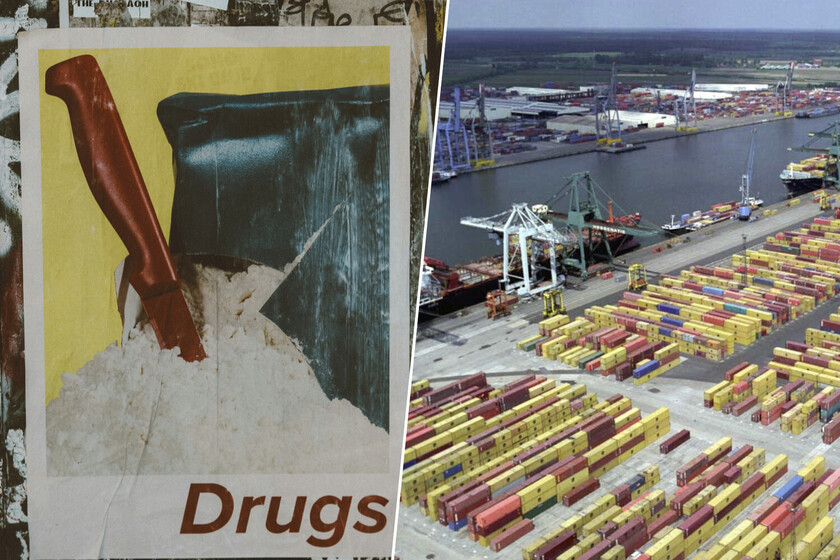
Belgium is the heart of Europe, home to the main community institutions, part of one of the most industrialized regions on the planet… and also a ‘narco-state’ in the making. It may sound exaggerated, but that is the warning that a judge from Antwerp has issued. In an open letter released by the city’s own court at the end of 2025, a magistrate puts his finger on the issue by denouncing the high cost for Belgium that the Flemish port has become one of the great gateways for coca into Europe.
In fact, its author does not hesitate to use the cursed word: ‘narco-state’.
Message for Belgium. It is not usual for a magistrate to publicly denounce that his country is succumbing to drug trafficking networks. Even less so that this happens in the heart of Europe, in the nation that hosts the headquarters of the EU Council and Commission. However, that is exactly what happened on October 27, when Belgian Justice published a letter from an Antwerp judge warning of the extent to which the mafias are “undermining” the institutions.
The letter, anonymous and addressed to the Justice Committee, was launched a few months ago, but its tone is so emphatic that it has continued to stir up the debate. In fact, a few days ago the president of the Antwerp Court of Appeal and the attorney general of Antwerp and Limburg sat down with The Guardian to insist on the same idea: the drug trafficking that is channeled through Belgium poses a real danger to both the judicial system and the rule of law.
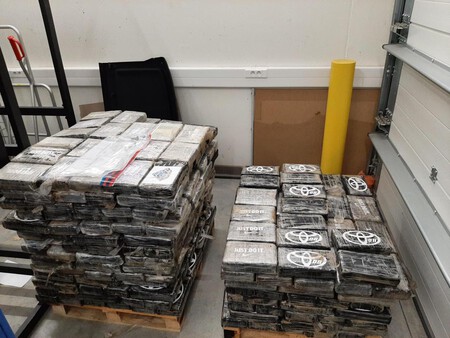

What does the letter say? “Large mafia structures have been consolidated that have become a parallel power that challenges not only the police, but also the judiciary. The consequences are serious: Are we becoming a narco-state? Don’t you think it’s possible? Does it seem exaggerated? According to our anti-drug commissioner, that evolution has already begun. My colleagues and I share that feeling,” the writing begins before recalling that narco-states are defined by their reliance on an illegal economy and its levels of corruption and violence.
Does Antwerp meet those requirements? And Belgium? The magistrate begins by recalling what the authorities discovered when accessing Sky ECC, a messaging network used for smuggling. “The investigation has uncovered a parallel economy in our port, a multi-million dollar economy that operates outside official channels,” insists the Flemish magistrate. His investigations, he recalls, have discovered money laundering networks and a flow of black money that (among other consequences) raises prices in the real estate sector.
Corruption and violence. That is just one of the criticisms contained in the letter. Its author denounces that corruption has managed to infiltrate the port and “permeates” the institutions “from the base”, reaching customs officials, judicial officials, prisons, city councils and even the police. The gangs, alert, operate through blackmail, coercion and large bribes. “Moving a container, a 10-minute job, generates income of 100,000 euros, and a bag costs 50,000.”
The mafias also do not hesitate to resort to violence, including kidnappings, torture and murder. “An attack on a house with bombs or weapons, a raid or a kidnapping can be easily ordered. You don’t even need to resort to the dark web. Just use Snapchat. Plus, it’s not expensive.” The author of the letter goes further and states that several investigating judges have had no choice but to live for long periods with an escort or even move house.
The risk? Let this intimidation work and fewer and fewer judges and prosecutors in Antwerp are willing to hand down sentences in these cases.


“A danger to stability”. The October letter focused the focus on drug trafficking in the heart of Europe, but despite its forcefulness (and the fact that the letter ended with a series of ‘duties’ for the Government) the problem is still far from being resolved. This was confirmed a few days ago by Bart Willocx, president of the Antwerp Court of Appeal, in an interview with The Guardian.
“The amount of money involved is so large that it poses a danger to the stability of our society,” he says. “We are becoming a state with a lot of corruption and threats,” agrees Guido Vermeiren, attorney general.
250,000 euros for an order. The magnitude of the challenge is better understood by knowing certain data. For example, how mafias operate to gain influence in ports. Vermeiren cites a case in which criminals paid more than 250,000 euros to a worker in exchange for moving a single container.
When the checkbook doesn’t work, gangs can resort to coercion, sending letters with photos of relatives or even launching attacks with homemade explosives. The Antwerp prosecutor recalls another incident from two years ago, when police thwarted an attempt to steal 1,500 tons of confiscated cocaine. There are even suspicions that in 2022 a criminal network tried to kidnap a Belgian minister.
Do you move so many drugs? Yes. Although it is not the only border on the continent plagued by drug trafficking, The Guardian He assures (citing Europol) that more than 70% of the coca that entered Europe in 2024 passed through Antwerp and Rotterdam. It’s nothing new. For years Antwerp has been identified by more than just its diamond trade: it is often noted as the favorite port of Latin American drug traffickers when they want to send drugs to Europe.
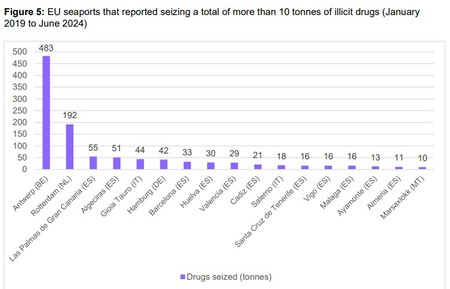
Police control would be leading the gangs to go to smaller ports, but even so the data is compelling. In the June 2025 report on surveillance of seaports and drug trafficking, the European Union Drugs Agency reports on the importance of the Flemish terminal: “Seventeen EU ports seized more than 10 tons of drugs in this period (2019-2024), with Antwerp seizing the largest amount, 483 tons.”
What the data reveals. The same report recalls that in 2023 the authorities intercepted around 121 tons of cocaine in Antwerp, a figure that dropped to 44 tons the following year. A similar trend was experienced in Rotterdam: from 45 t in 2023 to 26 t the following year. The decrease could be due, however, to something more than simple police zeal: the transfer of operations to other terminals or greater skill in hiding cargo.
Images | Openbaar Ministerie, Wikipedia, Jon Tyson (Unsplash) of EUDA
In WorldOfSoftware | The cost of living does not stop growing in Spain, but there is something that has never been so cheap: a kilo of coca


