





On the surface, Apple’s announcement on Tuesday of a subscription service called Apple Creator Studio does not demand a whole lot of explanation or analysis. The Mac/iPad/iPhone offering, which bundles the Final Cut Pro video editor, Logic Pro audio editor, Pixelmator Pro image editor, and other apps for making and manipulating media for $13 a month or $129 a year, is exactly the sort of thing you’d expect the company to get around to introducing.
After all, its strategy of expanding the portion of its revenue that comes from services has already resulted in offerings such as Apple TV, Apple Music, Apple Arcade, and Apple News+. It would have been weird if Apple hadn’t pushed its creativity apps in a service-y direction—a process that began a couple of years ago when the first iPad versions of Final Cut Pro and Logic Pro carried subscription pricing.
But Creator Studio, which arrives in the App Store on January 28, also ties together several other ongoing plot lines relating to Apple’s business. Its very existence helps answer questions about how the company sees AI as a creative tool. The company has the opportunity to address others as it builds out the product in the coming years. I spoke with Apple’s VP of Worldwide Product Marketing Bob Borchers, and senior director of Worldwide Product Marketing Brent Chiu-Watson, about the new service—starting with the fundamental question of what sort of people they envision using it.
Apple’s history in creativity software is long: For example, Final Cut Pro and Logic Pro both date to the previous century. Yet at times, it hasn’t been entirely clear whether the company saw the customer base for such tools as consisting literally of professionals, prosumers who’d outgrown products such as iMovie and GarageBand, or some combination thereof. Even now, Creator Studio does not add up to a full-blooded rival to Adobe’s Creative Cloud, which offers many more apps in various editions at much higher prices, up to $70 a month for the full shebang.
Still, Borchers offered me a reasonably crisp definition of Creator Studio’s intended audience: creators who, increasingly, do a little bit of everything. “A musician isn’t just songwriting,” he told me. “They’re producing the tracks, they’re creating album artwork, they’re editing music videos, they’re designing merch. They’re doing all of those things, and they’re inherently working across some of those traditional boundaries.”
With that in mind, Apple is spreading useful functionality between Creator Studio’s apps in ways that share the wealth and reduce the learning curve. For example, Pixelmator Pro—a much-loved indie app whose developer Apple acquired last year—already had AI-infused features that can intelligently auto-crop images and scale them up without losing detail. Now, Creator Studio subscribers will find the same tools in Keynote, Pages, and Numbers. Similarly, Logic Pro’s Beat Detection feature, which uses AI to visualize an audio track’s tempo, will be available in Final Cut Pro as well, where it will help creators edit video to stay in sync with what audiences hear.

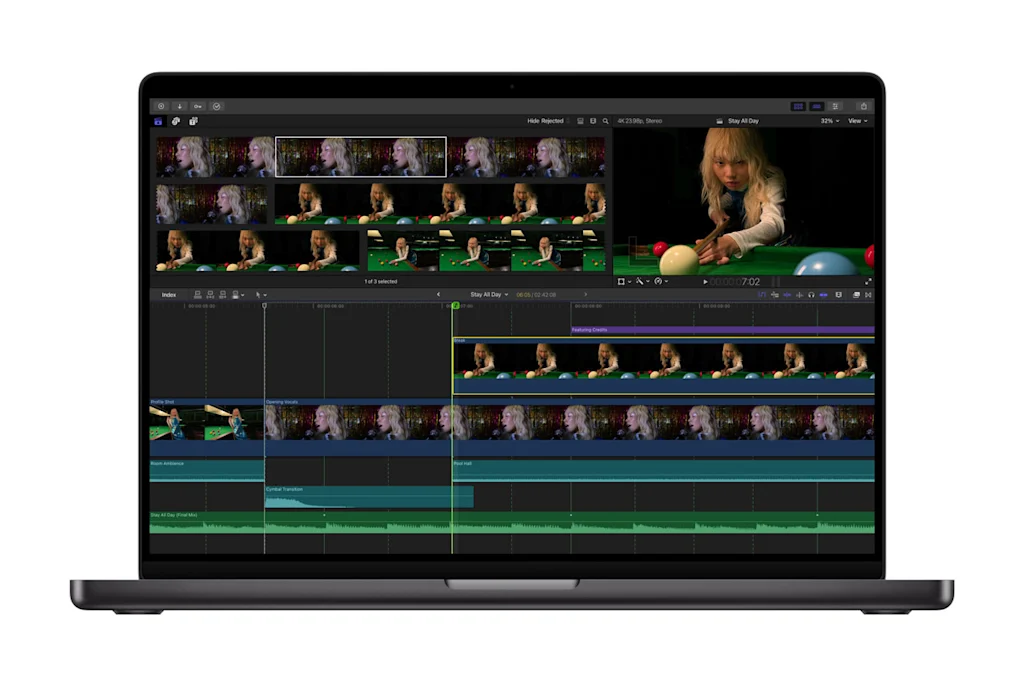
The more features that show up in multiple apps, the more Creator Studio should feel like a coherent suite with a unified personality. “That sort of consistency, we think, is really, really valuable, and we’re going to find more connection points over time,” says Chiu-Watson.


