




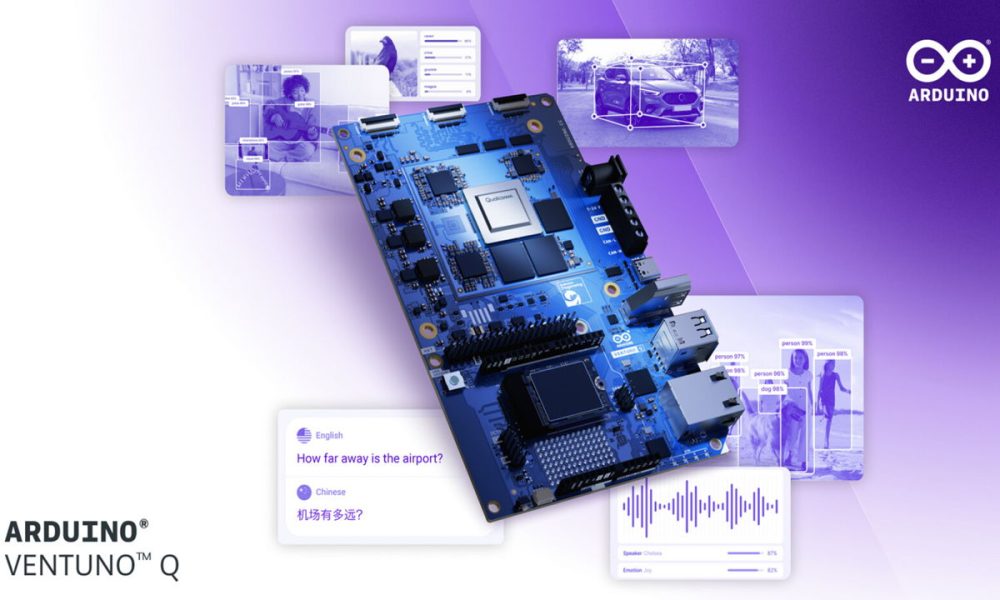
Arduino VENTUNO Q is the new board that Qualcomm has presented at the Embedded World 2026 conference. It is designed for “democratize” the development of artificial intelligence at the edge and take it to the physical world.
The VENTUNO Q takes its name from the Italian word for twenty-one and from the popular Arduino UNO family. Say that the provider specialized in open source hardware celebrates its twenty-first anniversary at the end of this month.
Arduino VENTUNO Q, en the limit of intelligence: where AI acts
The new board unites high-performance AI computing with real-time deterministic control, enabling systems that not only interpret the world, but interact with it.
The board is based on a dual-brain architecture similar to the Arduino UNO Q, but significantly improves its capabilities by taking advantage of the chip series. Qualcomm Dragonwing IQ8 for traditional and generative AI workloads. Additionally, it features NPU acceleration offering up to 40 TOPS, as well as a dedicated STM32H5 microcontroller for low-latency drive and motor control. It includes 16 Gbytes of RAM (capable of handling concurrent inference and complex multitasking) and 64 Gbytes of expandable internal storage.
With VENTUNO Q, users will be able to prototype and develop solutions for various fields, running fully autonomous AI agents offline. For example:
- AI-powered systems– Completely offline AI voice assistants running local LLM models; smart mirrors that respond to gestures; tourist kiosks, healthcare counters or transportation hubs that leverage automatic speech recognition (ASR) and text-to-speech (TTS) at the edge.
- Robotics and motion control– Precise vision-guided pick and place robotic arms; service robots that recognize and follow their owners in dynamic environments; Autonomous robots that navigate complex environments independently using Visual SLAM and path optimization.
- Edge AI Sensing and Vision Systems: proactive security systems that detect dangerous behavior; traffic monitoring devices that process complex data at the edge; Automated quality inspection that uses local VLMs to detect tiny defects or missing components.
- Education and Research: VENTUNO Q can serve as a key tool for teaching anything from computer vision to generative AI at the edge, and is the ideal platform to quickly and easily develop functional prototypes in record time.
Designed to “democratize innovation”
TWENTY-ONE Q can be connected to a PC or used as a single board computer (SBC). Unlike general-purpose AI SBCs, it is designed from the ground up for machines that move, react, and manipulate. In addition to tightly integrating a real-time MCU and an NPU-accelerated MPU, on the hardware side it features:
- Industrial I/O including native CAN-FD, PWM and high-speed GPIO for precise physical control.
- ROS 2-ready workflows and robotics use cases are built directly into the platform.
- High-speed connectors for multiple MIPI-CSI cameras (capable of processing multiple streams with AI), advanced audio, displays, and 2.5GbE Ethernet.


Combined with unmatched hardware compatibility (VENTUNO Q works out of the box with UNO shields and carriers, Arduino Modulino nodes and Qwiic sensors, as well as Raspberry Pi Hats), these features make it one of the most flexible and developer-friendly edge AI ecosystems. Arduino VENTUNO Q will be available in the second quarter of 2026 in the manufacturer’s official store and in its network of official distributors.


