




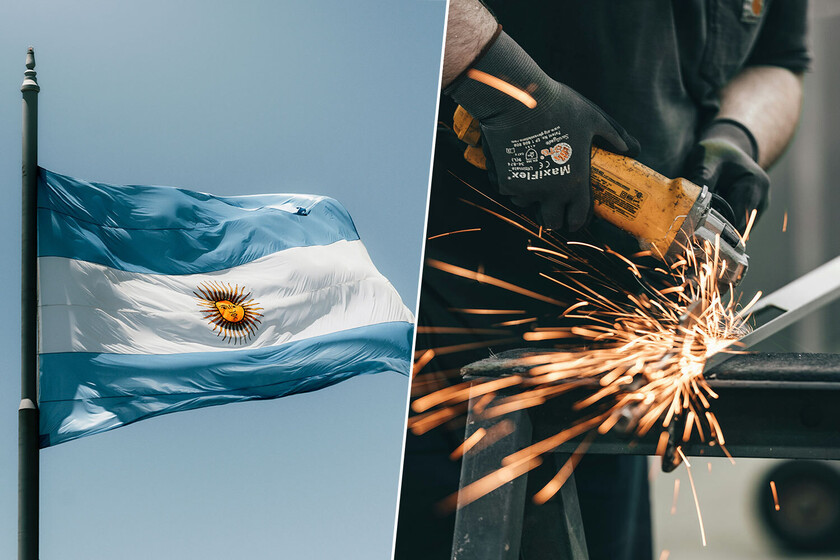
After a session of more than 13 hours, the senators of Argentina have given their approval to the processing of the labor reform proposed by the government of Javier Milei. The so-called Labor Modernization Law is Milei’s first major legislative victory in 2026 and rewrites pillars of the current labor system in force since the 1970s.
In parallel, the union centers are preparing new strikes and legal actions to try to stop a rule that, in their opinion, makes dismissal cheaper, lengthens the working day and empties the right to strike of any content, while the Executive insists that without this type of reforms Argentina will continue trapped in a rigid labor market, with a lot of underground economy and little investment.
The Senate approves it, the street does not. The labor reform project in Argentina has overcome its main obstacle, obtaining the necessary majority in the Senate, after more than 13 hours of session that ended with 42 votes in favor and 30 against, with no abstentions. The measure was approved while tear gas and police charges in the streets quelled the discontent of workers and union organizations. The balance of these protests is at least 15 injured and several dozen protesters detained.
With the approval of the Senate, the Government is already maneuvering so that the labor regulations pass without major changes their approval by the Deputies, which is considered a mere procedure with supports already closed.
Cheaper layoffs. The economic heart of the reform is in the calculation of severance pay. The law modifies what parameters are taken into account to calculate the settlement after dismissal. The bonus (annual supplementary salary), vacations and non-monthly bonuses are excluded from the compensation calculation, concepts that today many judges do take into account when calculating compensation.
The practical result is that, in the event of an unfair dismissal, the worker will receive a lower compensation than with the current scheme, although the rule incorporates a minimum limit of 67% of the usual salary. In addition, large companies can divide the payment of compensation to dismissed employees into up to six monthly installments, and up to 12 installments for SMEs.
A common fund for compensation. To cushion the impact of compensation on companies, the new regulations contemplate the creation of the Labor Assistance Fund (FAL), a kind of common “piggy bank” for companies that is filled with mandatory monthly contributions. Large companies will contribute 1% monthly and SMEs 2.5% on the same basis that is used today for Social Security contributions.
Therefore, Social Security will no longer have these resources and they will be administered under state supervision. When a worker is fired, a good part of the compensation that corresponds to him will not be assumed by the company, but will come largely from that fund.
Day up to 12 hours and bank of hours. The reform does not increase the working hours, which continue to be a maximum of 48 hours per week, but it does change how they are distributed. The key is in the “hour bank”. Company and worker may agree that, instead of paying for all hours worked beyond the eight hours per day established by law, they are counted as overtime hours and are later compensated with days off or reductions in working hours.
This measure opens the door to some days that the day can be extended up to 12 hours, as long as it is then balanced within the agreed period. For the Executive, this new model gives flexibility to sectors with peaks of activity. For the unions, it gives rise to the continuation of the days without the economic bonus that today protects the worker.
Unregulated overtime. Another of the changes approved in the new Argentine labor regulations is that compensation for overtime is no longer regulated almost exclusively by collective agreements, and is now negotiated individually between the employee and the company.
Added to this is another relevant novelty in terms of salaries: the salary can be paid both in pesos and in foreign currency, or even in kind, food or accommodation. Salary payment must be made through a bank transaction, thus reducing the underground economy that encourages cash payments, and increasing fiscal control.

Medical leave and vacations. Medical leaves due to illness or accidents other than work are limited in some cases. If the cause of the leave is considered a voluntary act or a health risk behavior, the employee will receive 50% of the basic salary for three months, as long as he or she does not have dependents, or six months if he or she has dependents. In other cases, the percentage may reach up to 75% of the salary. The company also gains weight in the medical and control boards, which the unions interpret as a lack of protection for sick workers.
Vacations also change logic. The new law allows vacation days to be divided into blocks of no less than seven consecutive days, which may be rotated throughout the year. In this way, it is no longer guaranteed that all vacations will be available in summer, and it is only ensured that the worker will have at least a few days of vacation in summer coinciding with school vacations once every three years.
In practice, companies gain margin to organize the vacation calendar according to productive needs and distribute staff in different batches during the year without the employee having the power to decide on it.
Limits on the right to strike. One of the most sensitive points for the labor movement are the restrictions on the right to strike and union organization. The reform significantly expands the list of “essential services” in which, even during a legal strike, at least 75% of the activity must be maintained. For the worker, this means that many stoppages will result in almost normal services and that the pressure capacity of strikes is significantly reduced.
Union meetings during working hours will require prior authorization from the companies and will not be able to alter the operation of the service, while plant blockades, access cuts or takeovers of establishments by employees are classified as serious infractions, with the risk of dismissal.
In WorldOfSoftware | The United States has come to the rescue of Argentina after the failure of Milei. The problem for Argentina is the small print
Image | Unsplash (Nicolás Flor, Spencer Davis)


