




In early 2024, Air Canada had to pay a customer because its AI chatbot “hallucinated” and created a policy that didn’t exist. The AI chatbot promised a discount that was not available after booking the ticket. It was one of the most significant cases in which artificial intelligence hallucinations cost the airline $812 in damages. But what exactly are AI hallucinations and why do they occur? To understand this problem, let’s take our deep dive.
What are Artificial Intelligence Hallucinations?
Artificial intelligence hallucinations occur when the AI system generates false, misleading, or entirely fabricated information with complete confidence. It is a challenging problem in the field of AI, where AI chatbots confidently give incorrect answer as verified facts. What makes AI hallucinations dangerous is that they sound very plausible and convincing.
Please note that AI hallucinations are not grammar errors or typos. The facts presented appear factual at first glance and are grammatically correct. In fact, a recent study shows that when AI models hallucinate, they use more confident language than when they provide factual information.
And artificial intelligence hallucinations aren’t just limited to text output. AI hallucinations also occur in AI-generated images and videos, where you notice multiple fingers or strange human features. These are all examples of AI hallucinations where the AI system makes up facts that do not exist.
Why do AI chatbots hallucinate?
To understand why AI chatbots hallucinate, we need to understand how large language models (LLMs) work. Unlike humans, LLMs do not understand words and information and lack a true understanding of the world. They are trained on a huge amount of text and LLMs identify patterns from the training dataset. Now LLMs try to predict which word should come next in a sequence using statistical probabilities.
So if there is limited data in the training dataset, which means if the AI model is small, there is a high chance of AI hallucinations. Basically, when the AI model doesn’t have accurate information about a specific topic, it tries to guess the answer, often giving incorrect answers.
In addition, AI models are trained on an enormous amount of text from the internet. Now, if there is false information on the internet or bias in the text, the AI chatbot learns to mimic that information without understanding the text. So data cleaning is an important way to reduce hallucinations.
OpenAI recently published an article stating that the language models are hallucinating because they are trained to predict the next word and not to distinguish truth from falsehood. Second, they are rewarded for guessing and providing an answer, rather than saying “I don’t know” when the facts are uncertain.
So during post-training, AI models should not be penalized for saying “I’m not sure” or “I don’t know.” Instead, they should be rewarded and that will change the model’s behavior when they are unsure and reduce the hallucinations.
Which AI models have the lowest hallucination rates?

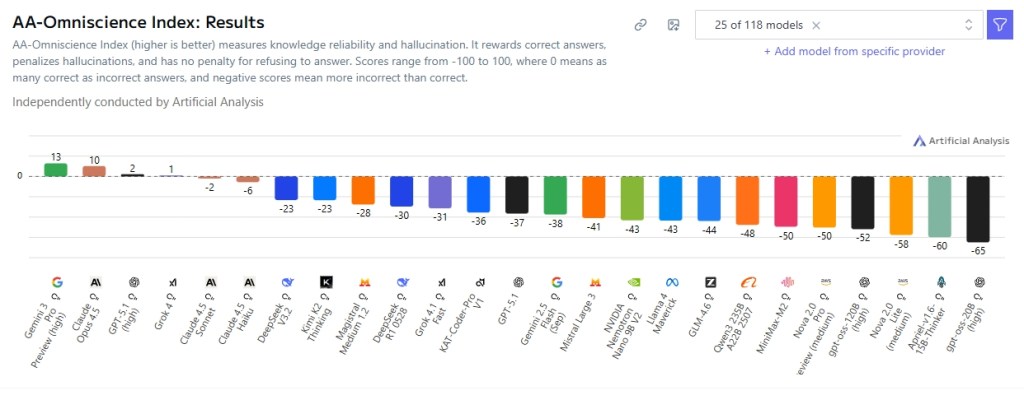
Artificial Analysis recently introduced a new Omniscience Index that measures knowledge and hallucinations across different domains. In this benchmark, Google’s Gemini 3 Pro, Anthropic’s Claude Opus 4.5, and OpenAI’s GPT-5.1 High showed lower hallucination rates. So if you’re looking for an AI model that’s less hallucinating, you can try one of these AI chatbots.
Real-world consequences of artificial intelligence hallucinations
Following the launch of ChatGPT in late 2022, artificial intelligence hallucinations have wreaked havoc across the world. In 2023, a lawyer used ChatGPT to draft court papers without realizing that most of the cases cited are fake. ChatGPT made up non-existent lawsuits with realistic names.
In 2023, Google’s first AI chatbot Bard gave an incorrect answer in a promotional video, claiming that the James Webb Space Telescope had captured the first images of a planet outside the solar system. This mistake or ‘hallucination’ caused Google to lose $100 billion in market value.
In 2025, the Chicago Sun-Times published a summer reading list using AI, but 10 of the 15 titles turned out to be fake. The newspaper later removed the online edition of the article. And recently, Deloitte provided a report to the Australian government for $440,000, but it was found that the report was created using AI and contained multiple fabricated quotes and errors.


