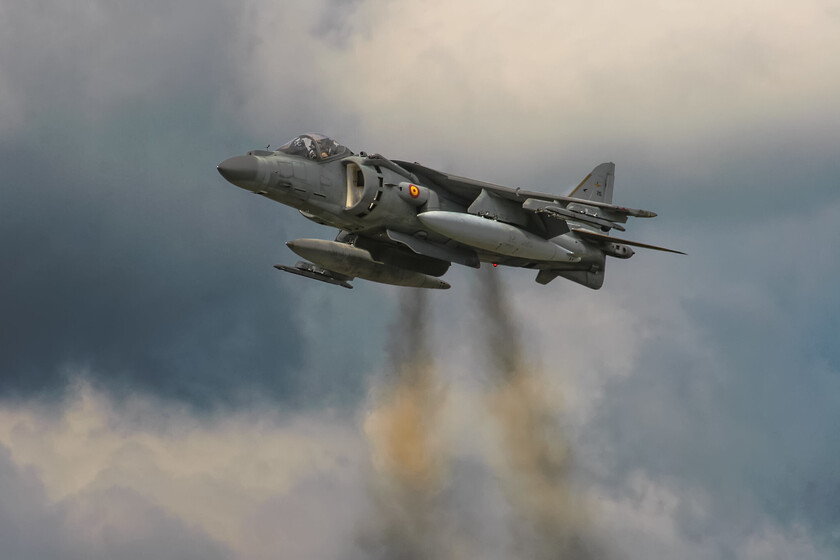
There was a time when Spain decided that it did not need the large aircraft carriers of the superpowers to have combat aviation at sea. Then he opted for a bold, almost experimental solution that fit his geography, his naval ambition and his resources, and that would end up becoming a hallmark for decades. Since then, that unique aircraft has been linked to the Navy in such a profound way that it is difficult to understand its history separately.
And now you are faced with a dilemma.
Pioneer in stoppage time. Yes, for approximately half a century, the Spanish Navy built a singular identity in Europe by operating fixed-wing fighters from the sea without the need for large aircraft carriers, relying on the Harrier as a central tool of deterrence, projection and expeditionary support.
This strategic advantage, which made Spain an international reference since the 1970s and allowed it to operate in real scenarios such as the Balkans, now reaches a critical point: the aircraft that made it possible enters its final phase of useful life just when the rest of the operators leave the platform and the technological and doctrinal environment of naval air combat has completely changed.
The isolation of the Spanish Harrier. To understand it, two facts are fundamental: the imminent withdrawal of the AV-8B Harrier from the United States Marine Corps and the Italian transition to the F-35B, movements that leave Spain on track to become the last world operator of the model.
This scenario is not only symbolic, but deeply practical: it implies being left alone with a logistics chain that is shutting down, with production stopped for more than two decades and with a growing dependence on specific agreements, cannibalization of cells and increasingly scarce spare parts.
Extra ball. Although the Navy hopes to extend operations until 2032 through agreements with the United States and extremely careful management of the fleet, the truth is that each year that passes reduces safety margins, increases risks and increases the cost of a capacity that no longer has a medium-term future.

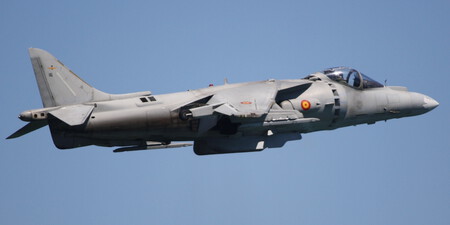

Harrier of the Spanish Navy
The technological abyss in front of the network. Beyond sustainment, the dilemma is operational. Of course, the Harrier is still a valid aircraft for certain missions, but it belongs to another era of aerial combat, one where information was concentrated in the cockpit and survival depended largely on the pilot and limited sensors.
Faced with it, we have to talk again about an “old acquaintance”, because the F-35B represents a qualitative leap that does not allow gradual comparisons: it is not just a fighter, but an intelligence node capable of detecting, merging and distributing information in real time to ships, aircraft and allies. For a ship like the Juan Carlos I, this difference marks the border between conditioning the adversary or limiting itself to reacting with increasingly exposed means. We have already discussed the problem in this case: Spain, a priori, does not seem willing to do so.
FCAS and the lack of enthusiasm. We also told it last week. The FCAS program often appears in the debate as a European industrial and political lifeline, but it does not solve the problem embarked Spanish not even in its most optimistic scenarios.
If we ignore that at the moment the project is more outside than inside, it is a system designed for air superiority from land bases, without STOVL design or compatibility with ships like the Juan Carlos I. In fact, converting it into a naval solution would require building a conventional aircraft carrier, redesigning doctrines, assuming colossal investments and waiting decades. In real terms, FCAS does not replace the Harrier or avoid the vacuum that will open if decisions are not made in the short term.
The F-35B and realism. In 2026, the F-35B is not a perfect or cheap option, but it does aim to be the only existing platform capable of directly replacing the Harrier and keeping the Spanish embarked fixed wing alive. With more than a thousand operational units and a growing community of naval operators, it offers continuity, interoperability and a military relevance that the Harrier can no longer guarantee alone.
From that perspective and although Spain does not seem to be in favor of the effort, giving up this fighter does not mean saving so much as accepting a decade or perhaps more without an embarked combat aircraft, which in the long run could degrade the Juan Carlos I to a helicopter and drone ship with limited capabilities in the face of an increasingly disputed environment. Maybe not, but that idea flies if there is no replacement for the Harrier.


A strategic dilemma. This being the case, the underlying or “nuclear” problem is not choosing between aircraft, but rather deciding what role Spain wants to play in the naval and expeditionary field. Maintaining the Harriers to the limit without a clear replacement leads to a loss of capacity that is difficult to reverse, while recovering that capacity in the future would require much higher costs and efforts.
Meanwhile, the clock is ticking, partners are moving forward, and the Navy is facing a decision that will define its operational relevance for decades: whether to remain an embarked fixed-wing player or accept, through inaction, the silent end of one of its most emblematic capabilities.
Image | sagesolar, David Fierro Iglesias
In WorldOfSoftware | France and Germany have agreed to give Spain the worst news: one in which the F-35 and its “button” are the winners
In WorldOfSoftware | Spain agreed with Germany and France to bypass the US. And it will end with a fleet of F-35s because of a French name