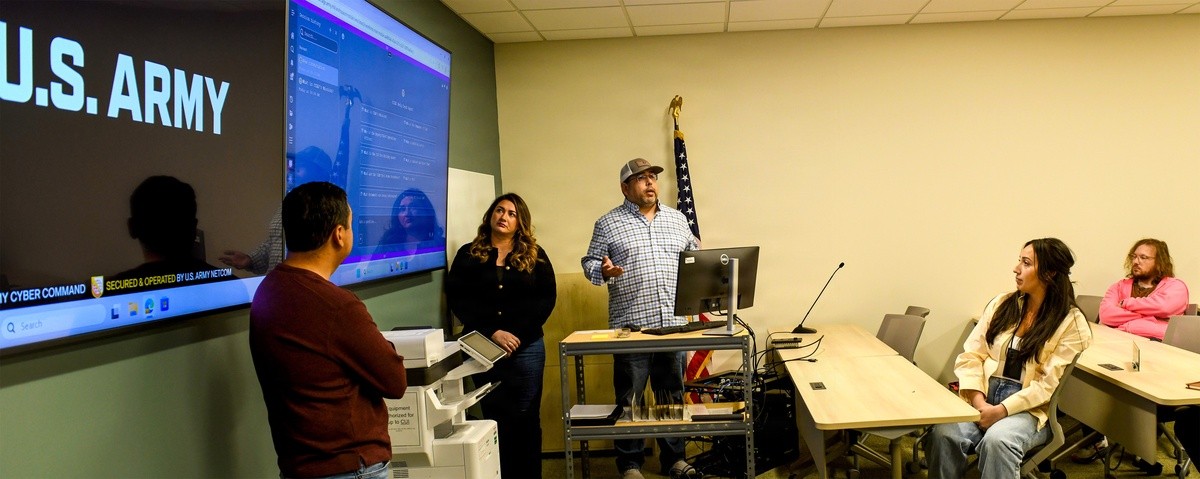
The collaborative structure of the training allowed the teams to strengthen their projects.
VIEW ORIGINAL


The judges for the Artificial Intelligence Process Improvement Talent Competition were Deputy and Chief Operations Officer Roderick Benson, IT Business Management Division Chief Marc Carter, and Depot Operations and Integration Division Chief Joshua Wigley.
VIEW ORIGINAL
by Cheryl Green, Deputy Director of the Resource Inventory and Information Management Directorate,
Corpus Christi Army Depot, Texas – Corpus Christi Army Depot recently hosted an inaugural Artificial Intelligence Process Improvement Talent Competition. This event was transformational and designed to unite CCAD’s top talent, using creative, sustainable analytical methods to amplify the depot’s mission.
The competition required teams to submit capstone presentations demonstrating how AI integration could solve specific operational shortcomings. The judges were: Deputy and Chief Operations Officer Roderick Benson, Head of IT Business Management Marc Carter, and Head of Depot Operations and Integration Joshua Wigley. These esteemed judges were given the difficult task of scoring the capstone presentations.
“This training evolution was instrumental in bringing the AI knowledge base of depot talent up to par,” says Wigley. “The collaborative structure of the training enabled the team to cohesively create and adapt three distinct AI models that strategically positioned CCAD for the modernized future.”
Each capstone presentation placed a strong emphasis on integrating AI tools into daily operations, using real-world data from the Army Enterprise Resource Planning system and Army Vantage.
“Continuing these efforts is critical to workforce development,” said Manuel Vasquez Jr., program analyst at CCAD. “As we introduce more smart automation and AI tools, we need to ensure that staff feel comfortable and confident using them. This kind of hands-on collaboration builds a culture where staff feel empowered to use technology to improve their own daily processes.”
“The AI solutions this team is developing based on their experience and business intelligence will help us address the uncertainty that naturally accompanies such a transformation,” said Benson.
Topics were selected based on specific operational deficiencies identified within the depot. The judges used a Rubric Evaluation Scoring tool to determine the final rankings. The results are as follows:
In first place was Kitting. Which highlighted the production delays that often occur when component kits are incomplete or inefficiently staged, leading to work-in-progress bottlenecks. This project optimized the kitting process by using AI to predict part shortages and streamline the delivery of materials to the floor exactly when needed. Team members were Matthew Lapointe, Jay Smith, Michael Benavides and Thomas Beggin.
Second place was the Property Readiness Analytics and Intelligent Search Engine project, also known as PRAISE. This project focused on real estate book items. Manually tracking real estate ledger entries can lead to “ghost inventory” or gaps in visibility, complicating audits and resource allocation. By applying AI-driven analytics to ownership data, the depot can provide real-time asset visibility and predictive maintenance planning for high-value equipment. Team members included Manuel Vasquez Jr, Jacob Beckmann and Carla Bolton.
Finally, in third place was the Complex Assembly Manufacturing Solution Assistant. Technicians faced “information overload,” or delays, in sifting through vast amounts of technical manuals and historical maintenance data. This large language model acted as a digital bridge, allowing rapid natural language queries to instantly retrieve complex assembly instructions, reducing downtime and errors. Team members included Oscar Davila Jr, Marcial Reza and Chloe Perez.
The competition emphasized the distinction between ‘quick wins’ and sustainable controls. This means that while AI provided quick solutions, the focus remains on long-term stability. Furthermore, CCAD has a strict technology philosophy: AI is a tool intended to augment management decision-making, not as a substitute for human judgment.
“This will guide our talented workforce as we build on existing business solutions,” Carter said. “By doing this we can ensure these new capabilities are integrated, secure and aligned with our broader strategic objectives.”
What encourages me most is the character of this team, their willingness to innovate, take initiative and lead in a way that ensures “their” depot is positioned for success today and well into the future.” Benson said
It’s a transformative time at Corpus Christi Army Depot, where innovative methods are being developed using artificial intelligence to deliver critical data in logistics, maintenance and material readiness for the future operating environment.