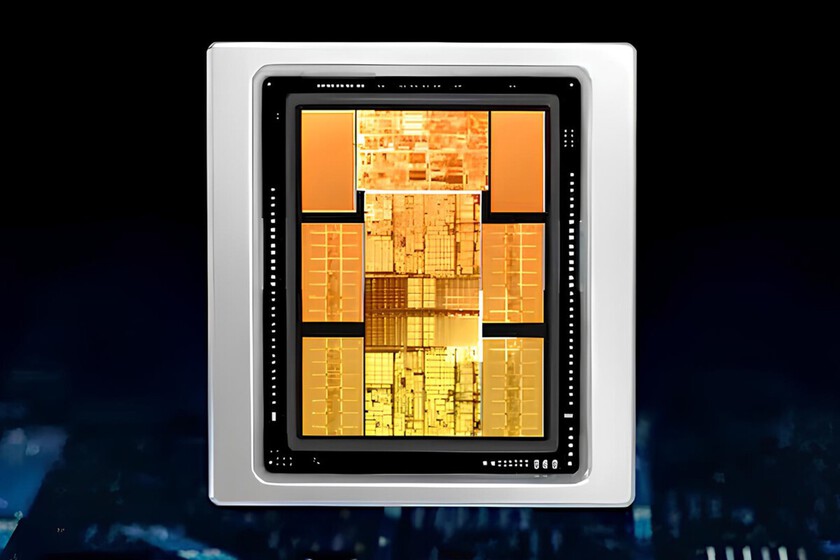
China has just turned on its new technological pride in Shenzhen: an AI cluster with 14,000 petaflops built entirely with Huawei Ascend 910C chips.
The city has presented it as the first scale computing center with 10,000 cards with completely national technology. It is an undeniable milestone, but if we give it context, an alarm signal and a dose of reality.
Why is it important. The Shenzhen cluster, with all its rhetoric of technological sovereignty, represents about 1% of the capacity of the largest US data center in operation today.
In other words: China has built, with a great institutional effort, what OpenAI already had available to train GPT-4 in 2022. The gap is not a question of ambition (China has it) or capital (it also has it) or energy (of course, it also has it). It’s a chip issue. What are they capable of manufacturing and in what volume today.
Between the lines. The Shenzhen government statement highlights energy efficiency metrics and occupancy rates of 92%. It’s really good data. But the selection of indicators (the cherry picking) says a lot for what’s left out: there are no direct comparisons to the NVIDIA H100 clusters colonizing Microsoft, Google, or Amazon data centers.
Posting only what you have is also a way of not publishing what you lack.
The context. At this point, no one doubts that China does not lack electricity, engineers, or money to build large-scale AI infrastructure. What is still missing, despite the advances, are the chips.
Trump’s export restrictions have cut off access to advanced semiconductors from NVIDIA and TSMC, forcing China to accelerate its own ecosystem.
- Huawei has responded with the Ascend 910C, a capable chip but that still has performance limitations and, above all, volume production.
- If wafers were not in short supply, this data center would be a hundred times larger.
Yes, but. Can China close that four-year gap before it gets even bigger? The answer depends almost entirely on how much its domestic semiconductor industry manages to scale, and whether or not Western sanctions manage to stifle that process.
At the moment, in Shenzhen they are celebrating an achievement as undeniable as it turns out that in the eyes of Silicon Valley they are still in 2022.
Featured image | Huawei
In WorldOfSoftware | Memory prices have started to fall in some markets. There is still a long way to go to close the AI crisis