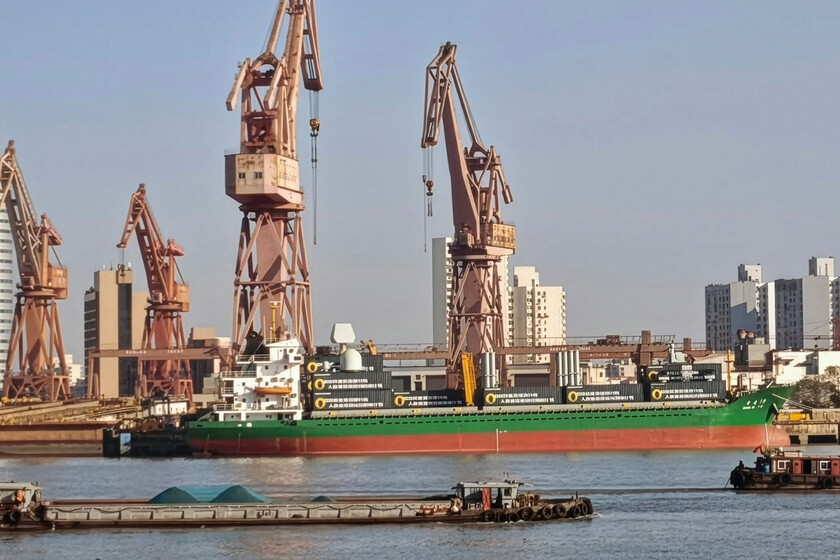
For decades, large freighters have been the most recognizable symbol of globalization, platforms designed to move goods and not much else. In recent years, however, some images are beginning to suggest that this separation between civil transport and military capacity is no longer as clear as it seemed. Photographs are circulating of a merchant ship modified in an unusual way, with containers that do not seem intended for consumer goods.
The images come from Weibo, the equivalent of X in China. They show a medium-sized freighter that does not respond to a standard configuration, with containers placed in an unusual way and equipment visible on deck. There is no official confirmation about the vessel or the exact time the photographs were taken. The entire analysis is based, therefore, on what can be directly observed in these images.
Sensors and defense on deck. On the freighter, containers used as supports to install equipment can be seen, as noted by Newsweek. On the front there is a rotating phased-array radar placed on three containers, and on the opposite side there is a second installation covered by a dome, attributable to communications or another sensor. Also noteworthy is the presence of visible self-defense elements in the bow, such as a point defense system and decoy launchers, which reinforces the idea of a setup designed to operate exposed.
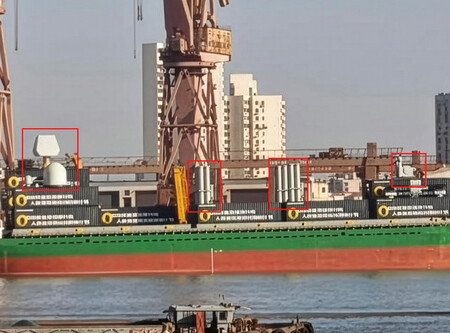

Beyond the sensors, the element that completely redefines the ship is the presence of vertical launchers integrated into containers. There are several modules installed in a regular arrangement, five wide by three deep, and each with four launch tubes. On paper, that adds up to a total of 60 vertical cells.
How far does what we know go? Beyond what is visible, the practical scope of this configuration is unknown. The robustness of the mounts, the possible coverage limitations due to the ship’s own superstructure and the absence of information on an integrated combat system limit any conclusion. Just because something can be physically installed does not mean that it can be used effectively in an operational environment.
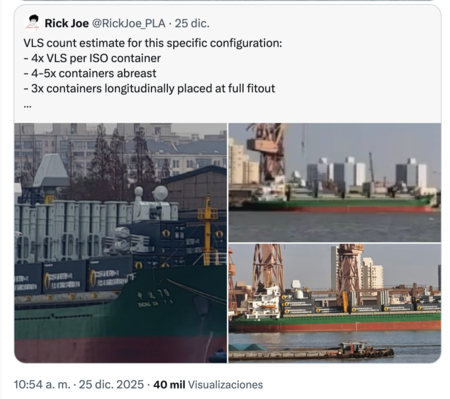


Click to see the original publication in X
A sign within a broader modernization. These images fit with a context in which China has been expanding and diversifying its military capabilities in multiple ways. In aviation, it has officially incorporated the J-20S, the two-seat variant of the J-20 with drone control capabilities, and prototypes attributed to the J-36 and J-50 programs have appeared.
In the naval sphere, the commissioning of the Fujian aircraft carrier (Type 003), the advance of the Type 055 destroyers and the appearance of new amphibious classes such as the Type 076 draw a coherent background. None of this makes the freighter a definitive test of strategy, but it helps to understand why such a solution is not foreign to the general direction that Beijing follows.

The unknowns surrounding this freighter remain open and will probably not be resolved in the short term. Regardless of whether it is an experiment, a model or something more advanced, these images put a concrete possibility on the table: that civil platforms can be adapted to concentrate launch capacity and operate with their own sensors.
Images | Screenshot Weibo and X
In WorldOfSoftware | Satellite images have revealed that China has gathered its most important aircraft carriers. And that can only mean one thing