It is hard to think of a more modern entertainment format than the open-world video game. These sprawling technological endeavours, which mix narrative, social connectivity and the complete freedom to explore, are uniquely immersive and potentially endless. But do they represent a whole new idea of storytelling?
This week I met Dan Houser, the co-founder of Rockstar and lead writer on Grand Theft Auto and Red Dead Redemption, who has been in London to talk about his new company, Absurd Ventures. He’s working on a range of intriguing projects, including the novel and podcast series A Better Paradise (about a vast online game that goes tragically wrong), and a comedy-adventure set in an online world named Absurdaverse. He told me that, 15 years ago, he was doing press interviews for the Grand Theft Auto IV expansion packs when he had something of a revelation about the series.
“I was talking to a journalist from Paris Match, a very cultured French guy – and he said, ‘Well, the Grand Theft Auto games are just like Dickens’. And I was like, God bless you for saying that! But I thought about it afterwards and, well, they’re not as good as Dickens, but they are similar in that he’s world-building. If you look at Dickens, Zola, Tolstoy or any of those authors, there’s that feeling of all the world is here – that’s what you’re trying to get in open world games. It’s a twisted prism, looking at a society that’s interesting in one way or another.”
It was fun to talk about this idea with Houser, because I share his view that there are striking similarities between Victorian literature and modern narrative video games. The vast amount of descriptive detail in those works was intended as a form of virtual reality, conjuring an exact image into the mind of the readers years before the invention of cinema. There is also that sense of complete immersion. The first time I read Jane Eyre a decade ago, I was amazed by the interiority of the writing, how much information we were given about the lead character’s thought processes and how much freedom we were given to explore them.
Houser also saw a structural similarity in Grand Theft Auto. “There’s that same sense of slightly spread out storytelling that you get in those big 19th-century novels from Thackeray onwards,” he says. “They are kind of shaggy dog stories that come together at a point. Those books are also very realist, in a way. They’re not leaping backwards and forwards in time. They are quite physical in that sense, and games are very physical.”
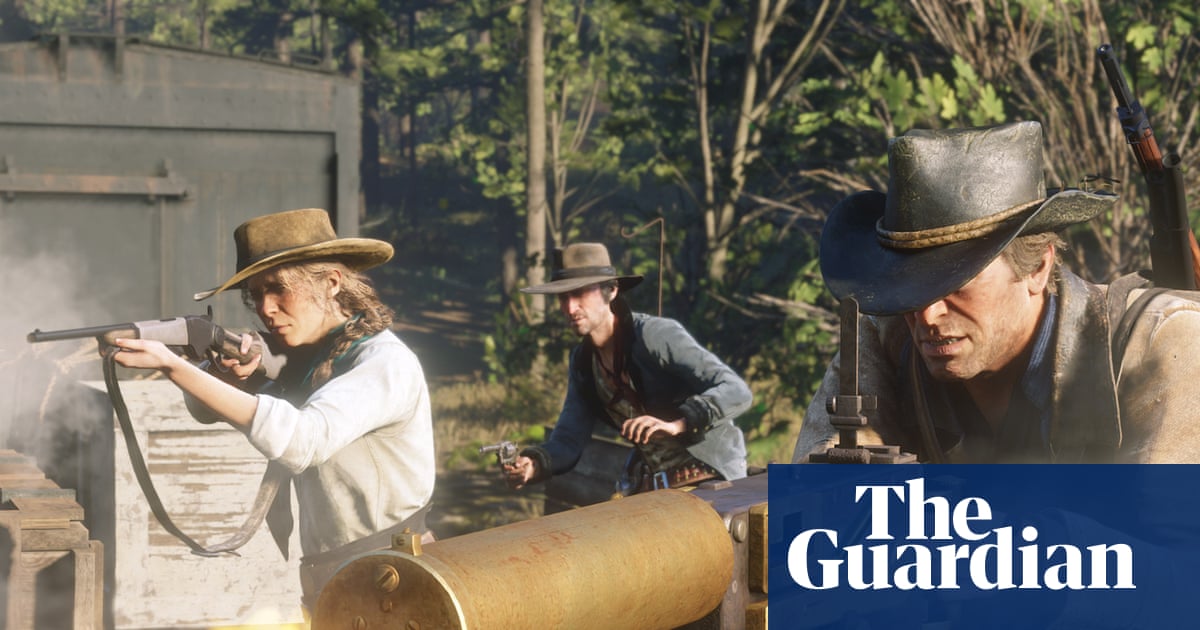
For Houser, this interplay between Victorian literature and game design came to a head with the production of Red Dead Redemption 2, Rockstar’s masterful, elegiac tale of revenge and redemption in the late 19th-century US. “I binged on Victorian novels for that,” he says. “I listened to the audiobook of Middlemarch walking to and from the office every day. I loved it.” He’d had trouble finding the correct tone for the dialogue in the game, but by merging Middlemarch, Sherlock Holmes and cowboy pulp fiction, he found it.
“I wanted it to feel from the writing perspective, slightly more novelistic,” he told me. “I thought that was a way of doing something new on the story side – and the game was going to look so pretty, the art was so strong, I thought the story had better really set it up. We were trying to fill out the three-dimensional lives of the characters, and also to capture that 19th-century feeling of life and death, which was very different from ours.”
I found it so pleasing that Victorian literature has had such a profound effect on Rockstar’s hugely successful adventures. The games industry can be so inward-looking, each new game a slight variation on a successful predecessor, each narrative a combination of the same fantasy and sci-fi set texts. There’s nothing wrong with drawing on Tolkien or Akira or Blade Runner, but it’s always worthwhile extending that literary gaze. I’m looking forward to seeing how Houser’s new ventures redefine the notion of open-world games for the second quarter of the 21st century, but part of me wishes he was going all out with a sprawling Victorian novel adventure.
Forget Pride and Prejudice and Zombies, maybe it’s time for Middlemarch and Machine Guns?
What to play
It has been 18 years since the last Metroid Prime game. People have been born, started school, done their exams, and had their first hangovers in the time since I last viewed a mysterious planet through the visor of Samus Aran. So there’s quite a lot riding on Metroid Prime 4: Beyond for fans of Nintendo’s most badass (and neglected) hero. I reviewed it this week and am happy to say that it’s not a disaster. It’s uneven, old-fashioned and a bit awkward, but also gorgeously atmospheric, beautiful to look at and listen to, and very entertaining. It’s almost fascinatingly unconcerned with the conventions of modern game design, and I found it very charming. Keza MacDonald
Available on: Nintendo Switch/Switch 2
Estimated playtime: 15-20 hours
after newsletter promotion
What to read
-
Sega fans rejoice: Paramount Pictures has announced a Sonic the Hedgehog movie spin-off (or should that be spin-dash-off). According to Variety, the project currently titled “Sonic Universe Event Film” will arrive on 22 December 2028 – a year and a bit after Sonic the Hedgehog 4, which is scheduled for release in March 2027. Could it be a new adventure for Sonic’s rival Shadow the Hedgehog? Maybe I’m alone, but I’m hoping for a Big the Cat fishing quest.
-
The Information Commissioner’s Office, the UK’s independent regulator for data protection and information rights, is investigating the 10 most popular mobile games, focusing on children’s privacy. According to the organisation’s blog, “84% of parents are concerned about their children’s potential exposure to strangers or harmful content through mobile games”. This follows recent controversy over Roblox.
-
As someone who receives approximately 200 press releases a week about this genre, I appreciated Rock, Paper, Shotgun’s deep dive into the seemingly unstoppable rise of the roguelike. Edwin Evans-Thirlwell talks to developers about why people love games based around the three Ps: procedural generation, (character) progression and permadeath.
What to click
Question Block
Keza answers this week’s question from reader Tom:
“I was reading the recent Question Block about violence-free games and it got me thinking: do any games keep violence on the table but give you other options to complete them? While I adored Red Dead Redemption 2, it frustrated me that the only option to resolve most situations was with a firearm. I’ve seen plenty of amusing videos where players try to complete innately violent titles without bloodshed, so there seems to be an appetite for pacifism.”
I have vivid memories of playing the original Splinter Cell on Xbox as a pacifist: only knocking enemies out and hiding them, never killing them. It took me forever, but it was a legitimate option offered by the game. Steampunk masterpiece Dishonored and its sequel also famously let you finish the whole thing without killing anyone. You can use your supernatural powers to sneak around and manipulate people instead; if I recall correctly, though, the game is significantly harder if you shun violence.
Most stealth games offer pacifist playthroughs, actually, though few specifically reward you for sparing lives. One exception to this is the superb comic adventure Undertale, the game that finally let you talk to the monsters. I’m also fairly sure that it was possible, if very challenging, to play both the original Fallout games (and possibly Fallout: New Vegas, too) without killing people, only mutants – if you’ve got a high enough charisma stat to talk your way out of every sticky situation.
We’re still looking for your game of the year nominations for an end of year special – let us know yours by emailing us on pushingbuttons@.com.