





Over years of steady improvements to the batteries that power electric cars, solid-state batteries have looked like the EV equivalent of fusion power: the technological advance that will cure everybody’s concerns but also remains reserved for some frustratingly distant time in the future.
But at CES 2026, an Estonian startup named Donut Lab announced that it had not only solved solid-state batteries, which replace the usual liquid or gel electrolyte between a battery’s cathode and anode with a solid material, but had them in production. And it brought along a high-end electric motorcycle from its partner firm Verge powered by that battery technology, on sale now with deliveries set for Q1.
Donut touts a head-spinning set of features for its solid-state design: a high-energy density of 400 watt-hours per kilogram (by comparison, in 2025 researchers who took apart a Tesla 4680 battery found an energy density of 241Wh/kg), costs below lithium-ion batteries, a five-minute charge time to reach 100%, tolerance of temperatures from -30 to 100 degrees Celsius, no “thermal runaway” fire risk, and an extraordinary lifespan of 100,000 charge cycles.
“It’s going to transform the industry,” CEO Marko Lehtimäki bragged in a 24-minute video. “Once you see what it enables, combustion doesn’t just look outdated, it looks unnecessary.”
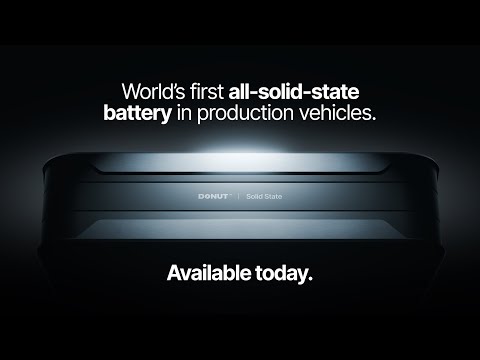
This is as much detail as you can get from Donut Lab about its solid-state technology.
(Credit: Donut Lab)
In a conversation at CES, Lehtimäki expanded on those claims. “We are cheaper than lithium-ion from the very beginning,” he said, adding that this architecture can be used in battery sizes ranging “from tiny to massive” and that one representative of an unidentified train manufacturer had stopped by to inquire further.
What’s the Catch?
Donut is cagey on how exactly it’s cracked the code on solid-state batteries, a feat that’s so far eluded even China’s booming and inventive electric-vehicle industry.
“I would say it’s a combination of materials science and production innovation,” Lehtimäki said. Asked about the minerals involved, he said they are not from supply chains in countries with problematic labor or environmental records, a longstanding problem with lithium-ion batteries in particular.
At its CES exhibit, Ian Digman, business development director at Donut, offered barely more detail about the battery’s ingredients: “This is made out of generally available materials that are not geopolitically constrained.”
Asked what’s the catch, he simply replied “There isn’t.”
He did allow that Donut will have manufacturing constraints at its initial factory in Finland that will limit it to 1-gigawatt-hour of capacity in 2026: “This year is going to be tight.”
Verge Motorcycles’ TS Pro in poppy-orange California Edition trim. (Credit: Rob Pegoraro)
Donut’s space in the West Hall of the Las Vegas Convention Center featured its solid state battery-powered motorcycle, the Verge TS Pro.
This progress comes at a steep price compared to such older electric motorcycles as Harley-Davidson’s LiveWire series: $29,900 for a model with a 20.2kWh battery and a 217-mile range, $34,900 for a configuration with a 33.3kWh battery rated for 370 miles, plus a $1,000 premium for an optional “California Edition” trim.


(Credit: Donut Labs)
Verge’s advertised charging times via the bike’s Tesla Supercharger-compatible NACS port are slower than Donut’s claims for the battery design: 10 minutes to add up to 124 miles to the smaller battery, up to 186 miles for the larger one. It’s also quoting fewer charge cycles, “just” 10,000–still far more than the 1,500 or so cycles often estimated for EV batteries.
Donut’s exhibit also included a two-seat-roadster “skateboard” platform for EVs from the British firm Watt Electric Vehicle Company, illustrations of a battery-electric truck trailer from Cova Power, a joint venture between Donut and the Finnish logistics firm Ahola Group, and mockups of Donut battery cases.
It drew a steady stream of visitors curious about the technology and its potential. Joel Honeyman, vice president of global innovation at Donut’s CES-show-floor neighbor Doosan Bobcat, voiced his interest in what a solid-state battery could do for that firm’s construction and industrial equipment in a quick chat on the floor: “I’m so excited about that.”


Get Our Best Stories!
Your Daily Dose of Our Top Tech News


By clicking Sign Me Up, you confirm you are 16+ and agree to our Terms of Use and Privacy
Policy.
Thanks for signing up!
Your subscription has been confirmed. Keep an eye on your inbox!


The future of electric-vehicle batteries could be inside this plastic housing. (Credit: Rob Pegoraro)
Boulevard of Broken Battery Dreams
But no part of Donut’s presentation offered further clarity about the inner workings of its battery. And since the company has not published any research, it’s hard to judge the potential of its design and whether it can break a long losing streak of promised solutions to solid-state EV batteries.
For example, in 2017, Fisker revealed details of a solid-state battery design that it would have commercialized by 2023. That never happened, and in 2024, the company went bankrupt.
“Everyone’s always said it’s been three to five years away, and they’ve been saying it for the last 10 years,” Nathan Niese, global lead for EVs and energy storage at Boston Consulting Group (BCG) and a managing director and partner at its Chicago office, said in a conversation at CES.
One of the bigger challenges in solid-state battery design has been stopping the formation of dendrites, metal filaments that can develop within the electrolyte and eventually cause the battery to short out. Donut says it’s solved that…somehow.
Many previously proposed solutions to this problem have involved applying pressure to the battery, but Niese observed that they can further complicate the design problem: “You’re adding a different failure mode.”
He did not offer a take about Donut’s chances but did list a wide variety of questions he had, such as its breakdown between manufacturing and operating costs for a battery and its charging performance at different temperatures. BCG continues to estimate that what Niese called “real commercialization” of solid state batteries won’t happen until the 2030s, although he allowed that 2032 might see significant scaling up.
Recommended by Our Editors
Theories Abound
In the absence of specifics from Donut, LinkedIn and YouTube lit up during CES with attempts to decipher what little the company has said, exploring Donut’s ties to such firms as a Helsinki-based research firm named Nordid Nano and zooming in on details of Donut’s battery-introduction video.
Some of this has been exceedingly skeptical, taking aim at Lehtimäki’s resume and his role in such other startups as Asilab, which claimed in May to have developed “the world’s first true artificial superintelligence.” Lehtimäki has offered responses along the lines of “just watch” in LinkedIn comments but did not answer an email requesting a comment on those criticisms.
Other takes on Donut have explored ways the company might square this apparent circle, with one common theory suggesting its design contains elements of a supercapacitor, a much shorter-term form of electrical storage.
For example, engineer Ryan Inis Hughes devoted a 14-minute clip on his widely viewed ZirothTech channel to Donut in which he put forth the supercapacitor thesis but admitted that he still wasn’t sure how it could work. He also commented that he knew good friends and good engineers working at Donut: “They would not be part of something that is false.”
In a post-CES email, Hughes said he remained confident in the supercapacitator idea but said that was not based on hearing anything new from his Donut contacts.


Electrical engineers have been eyeballing this part of Donut Lab’s video. (Credit: Donut Lab)
Not Long to Wait
The strongest point in Donut’s favor: The short wait for the Verge electric motorcycle to ship, after which competitors and researchers alike can tear it apart and find out just what’s inside the battery. The conclusion of automotive journalist Tim Stevens in a post at The Verge: “That alone gives me reason for optimism, but at the very least I won’t have to wait long to be disappointed.”


(Credit: Donut Labs)
Meanwhile, surging demand for electric vehicles worldwide—which the Trump administration’s anti-electrification policies will do nothing to stop—has researchers and manufacturers worldwide racing to bring their own idea of the next battery breakthrough to market.
Industry giants like Samsung and Toyota as well as startups like QuantumScape and Flint are working on their own solid-state battery designs, while chemistry improvements to more traditional architectures such as Group14’s silicon-based concept could match many of solid state’s promised virtues.
And even today’s EVs already work great for most driving patterns. “We have no shortage of vehicles in the market today that can offer 200, 300 miles,” said BCG’s Niese. “It’s not that we are not meeting a majority of the use cases.”
About Our Expert


Experience
Rob Pegoraro writes about interesting problems and possibilities in computers, gadgets, apps, services, telecom, and other things that beep or blink. He’s covered such developments as the evolution of the cell phone from 1G to 5G, the fall and rise of Apple, Google’s growth from obscure Yahoo rival to verb status, and the transformation of social media from CompuServe forums to Facebook’s billions of users. Pegoraro has met most of the founders of the internet and once received a single-word email reply from Steve Jobs.
Read Full Bio


