




Tesla CEO Elon Musk today reposted a video of a Chinese concert performance on social media platform X, captioning it “Impressive,” a move that quickly drew widespread attention across the global technology community.
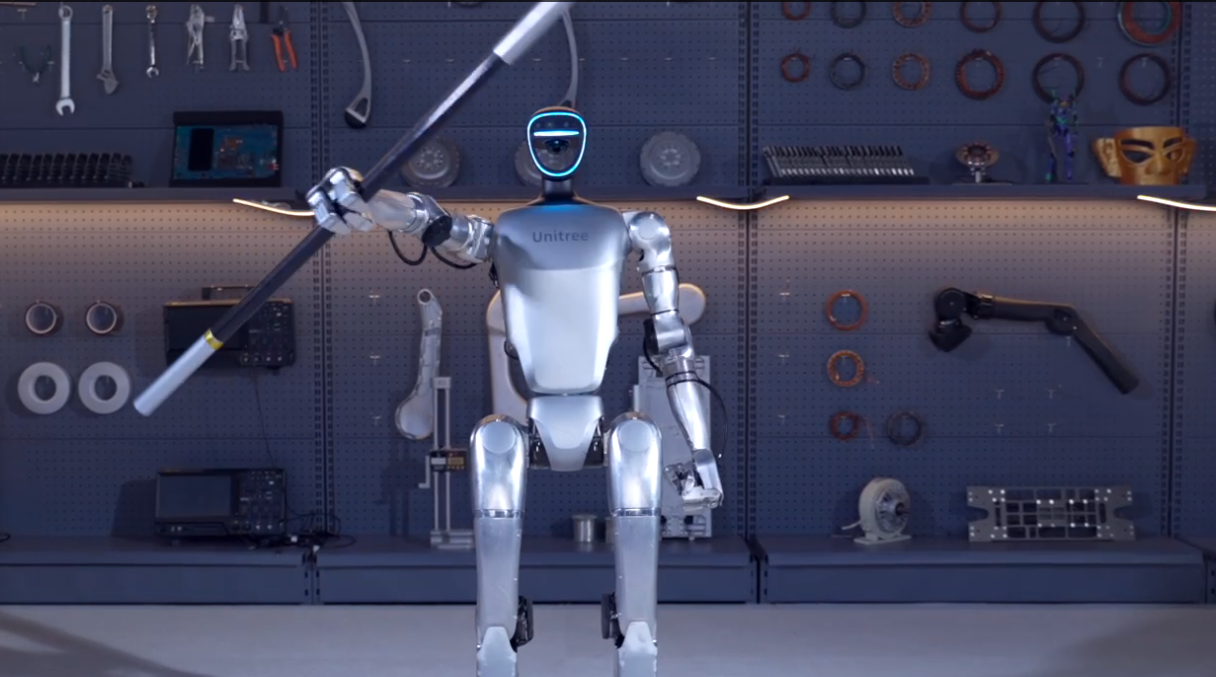
The video showed six G1 humanoid robots developed by Hangzhou-based Unitree Robotics performing alongside human dancers at a Wang Leehom concert in China’s Chengdu. Dressed in silver sequin outfits, the robots moved in tight sync with the music during Firepower, performing crisp, beat-matched dance routines before pulling off a high-difficulty Webster flip together and landing smoothly on the stage.
Unitree G1 exhibits rapid, human-like motion control
Industry observers widely view the performance as a progress in robotic dynamic balance and power systems. Unitree’s G1 humanoid robot is equipped with 3D LiDAR and multi-agent coordination algorithms, which enable second-level response times and joint flexibility approaching that of human dancers.
Compared with the more cautious movements displayed by robots at China’s Spring Festival Gala just eleven months ago, the stability and smoothness of the backflip in this performance marked a major leap forward. The advancement is seen as a key step in moving China’s humanoid robotics technology from laboratory demonstrations toward real-world commercial applications.
“At the Spring Festival Gala earlier this year, the robots still looked like toddlers learning to walk. Now they’re doing backflips — the pace of evolution feels straight out of science fiction,” a Chinese social media user told TechNode.


Unitree G1 humanoid robot — overview and price
The Unitree G1 is a compact bipedal humanoid developed by Chinese tech firm Unitree Robotics, unveiled in May 2024 as part of the company’s push to bring advanced robotics into broader research, demonstration, and commercial use.
Standing roughly 1.30 meters tall and weighing about 35 kg, the G1 combines agile mechanical design with AI-driven control. It features a large range of motion across 23–43 joint motors, giving it flexibility for dynamic movements such as running, coordinated balancing, and complex poses. Onboard perception is enabled by 3D LiDAR and depth cameras, supporting real-time spatial awareness and navigation.
A key part of the robot’s design philosophy is the integration of AI learning. G1 uses imitation learning and reinforcement learning frameworks to adapt and improve its motion repertoire over time, while force-controlled dexterous hands give it the potential to interact with objects in the environment with fine manipulation capabilities.
Unitree lists the G1 at roughly RMB 85,000–RMB 99,000 ($12,000–$16,000) for the base model, making it one of the most affordable humanoid robots with advanced locomotion and sensing capabilities.


