




For months, the memory shortage has been established in the technological debate as one of those phenomena that do not seem to need too many explanations. If RAM is lacking and prices rise, the immediate conclusion is that someone is privileging AI and leaving the consumer aside. That idea has resonated strongly, especially after visible decisions that have affected the domestic channel and have reinforced the feeling of abandonment. But when you get down to how memory is manufactured and kept stable today, the diagnosis becomes less obvious: the bottleneck doesn’t seem as obvious as it seems.
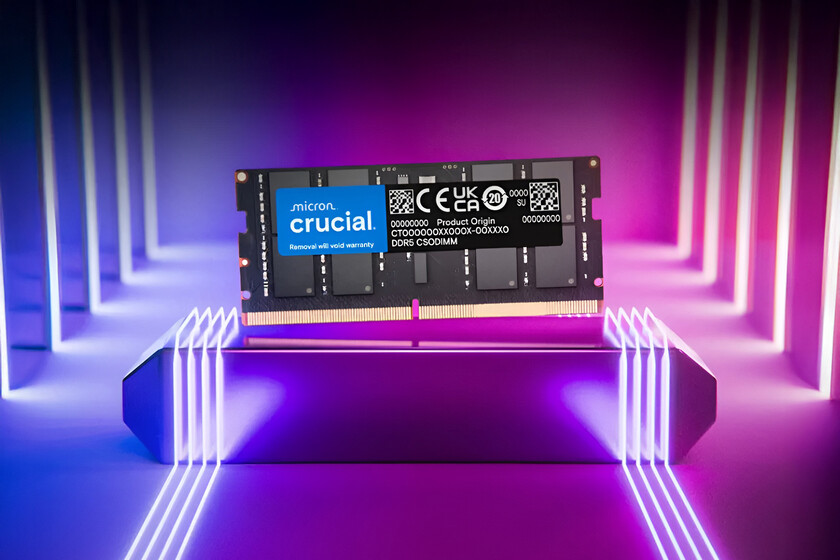
A controversial decision. In this climate of widespread suspicion, Micron has become a preferred target, shared with other large manufacturers, but for a very specific and recent decision: the announcement of the end of Crucial consumer products. The company recently announced that it will stop selling RAM and storage under that historic brand, with shipments expected until February 2026. For many users, that move was interpreted as a direct consumer recall just when memory is in short supply. Micron justified that decision by noting that AI-driven growth in data centers has skyrocketed demand and that Crucial’s exit seeks to improve supply and support to its strategic customers in higher-growth segments.
The market has changed size. From Micron’s perspective, the problem is not a renunciation of consumption, but an abrupt change in the scale of the market. Christopher Moore, vice president of marketing for the client and mobile business, said in an interview with Wccftech that the company continues to have a relevant presence in PCs and mobile devices, while serving data centers. What has altered the balance is the growth of the data center business, driven by AI, which has gone from representing around 30% of the market to approaching, according to its figures, 50% or even 60%. That leap, he defends, has left the entire industry without sufficient margin.
Variety also creates scarcity. For Micron, the bottleneck is not so much the lack of factories as how the existing ones are used. Moore explains that producing memory is not about making a single type of chip seamlessly, but rather about switching between multiple densities and configurations depending on what customers ask for. Each change, for example going from 12 GB to 16 GB modules or from 16 GB to 24 GB, forces lines to be readjusted and reduces the total output volume. In a context of skyrocketing demand, this variety, which was previously acceptable, becomes a direct brake on production.


Micron’s new Idaho factory under construction
Faced with the temptation to think that new factories will solve the problem, the manufacturer asks for patience. Moore explains that expanding memory capacity is not an immediate process, because it requires not only building facilities, but equipping them, validating them and certifying each product with customers. The company laid the first stone three years ago at its ID1 plant in Idaho, United States, which is scheduled to come into operation in mid-2027. Even so, it warns that there will be no significant impact on supply until the entire qualification process is complete, which it places in 2028.
Crucial is gone, the channel is not. Moore assures that, although Crucial has disappeared from the consumer showcase, the company continues to provide memory to major PC and mobile device brands through channels less visible to the end user. This OEM channel, in which Micron supplies memory directly to integrators and manufacturers, concentrates a very relevant part of the market and ends up being incorporated into commercial designs and equipment. From their point of view, the consumer continues to receive Micron memory, even if it no longer does so under a recognizable label.


With this panorama, the lack of memory ceases to be a problem of isolated decisions and is revealed as the result of several overlapping tensions. AI-driven demand for data centers that has changed the scale of the market, operational limits on production and long lead times to expand capacity explain why supply will remain tight for years. Micron places the relief horizon no earlier than 2028 and, until then, the consumer will live with fewer options and pressured prices. The bottleneck, the company insists, is not only in who buys the memory, but in how it is manufactured.
Images | Micron
In WorldOfSoftware | The situation with RAM prices is so desperate that there are already those who build their own memory at home


