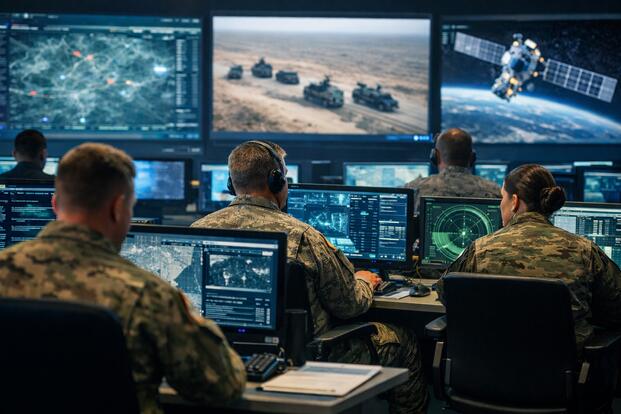
In 2025, the US military was treating artificial intelligence less like a laboratory experiment and more like an everyday tool. The biggest change wasn’t a single new robot or an ‘autonomous’ breakthrough. It was an ongoing effort to turn data into speed so units can plan faster, repair equipment faster and make decisions based on clearer information.
That shift has been reflected in work at the Pentagon level to accelerate fieldwork and determine how AI is used, plus industry-specific efforts focused on real-world problems such as maintenance backlogs, contentious communications and overloaded operations centers.
What ‘military AI’ would look like in 2025
Most of the AI work that mattered in 2025 fell into four directions:
- Decision support: Help employees create options faster by sorting data and uncovering patterns.
- Intel and Consciousness: accelerating the way sensor and information feeds are processed and shared.
- Maintenance and logistics: predicting disruptions, identifying delivery risks and reducing downtime.
- Training and personnel: building AI literacy and testing more secure, approved tools.
That aligns with the Pentagon’s “rapid adoption” posture through the Chief Digital and Artificial Intelligence Office’s AI Rapid Capabilities Cell, which was created to accelerate advanced AI capabilities across the department.
Military: AI moves closer to the tactical edge
The 2025 Army story was about getting AI into the hands of units that can’t rely on perfect networks.
One of the clearest examples was a large contract to scale AI-based “edge” tools. The Wall Street Journal reported that the Army awarded TurbineOne a $98.9 million deal to help soldiers process battlefield data on their devices even when cloud connections aren’t reliable. The goal was faster threat recognition and decision-making in high-interference environments.
At the same time, the Army continued to shape its sustainability approach around predictive analytics. An article from Army.mil describes “predictive logistics” as a shift toward proactive, data-driven sustainability that anticipates needs and positions supplies before shortages arise.
What it meant for soldiers in 2025: less time waiting for analysis, more ability to act on local data, and more pressure to train people to question AI output rather than blindly trust it.
Navy: Smarter submarine capabilities and push to repair ships faster
The Navy’s AI story in 2025 had two tracks.
Submarine power. In November, the Naval Sea Systems Command said the Navy accepted delivery of the future USS Massachusetts (SSN 798)a Virginia-class attack submarine. The Navy has framed it as adding stealth and surveillance capabilities, and the article confirms that it completed sea trials in 2025 and was handed over to the Navy on November 21.
Ready and repair. The Navy is also at the center of a growing battle over how quickly units can repair equipment without contractor bottlenecks. A one-page summary of the proposed Warrior Right to Repair Act notes instances in which the Navy had to fly contractors to ships at sea for simple repairs, and points to restrictions on technical data and intellectual property that could prevent service members from making repairs themselves.
These two threads are connected in a simple way: the fleet can add high-performance capabilities, but still needs to keep the platforms running and deployable.
What it meant for sailors in 2025: more focus on condition-based maintenance and access to repairs, and more urgency around data rights that impact readiness.
Marine Corps: Project Dynamis and “AI-powered Decision Advantage”
For the Marine Corps, 2025 was a year in which AI deployment was formalized in a service level plan.
The Marine Corps announced this in September Project Dynamisdescribing it as a modernization effort associated with Combined Joint All-Domain Command and Control (CJADC2) and the Navy’s Project Overmatch. The press release states that the assistant commander signed a memo to establish the project and establish a high management council to govern it.
The Marine Corps’ own Project Dynamis page is blunt about the core problem: command and control in contested environments are at risk. It calls the ability to “collect, orchestrate, analyze and share fused data” at machine speeds a warfighting necessity, with pillars including assured command and control, battlespace awareness and AI-enabled battle management.
What it meant for the Marines in 2025: more structured work to connect sensors, shooters and data streams, with a heavy emphasis on speed on the tactical side and joint interoperability.
Air Force: AI as a teammate in battle management
The Air Force’s AI headline in 2025 was human-machine collaboration in command and control.
In September, the Air Force published the results of DASH 2, a Decision Advantage Sprint for Human-Machine Teaming. An Air Force press release quoted an ABMS leader as saying the event proved that human-machine teaming “is no longer theoretical,” and emphasized combining operator judgment with AI speed to increase decision advantage in joint and coalition operations.
This matters because battle management is one of the most difficult “data problems” in war. The Air Force is trying to help crews move from “more data” to “better options” without skipping human judgment.
What it meant for pilots in 2025: more experiments where AI plays a role in planning and coordination, with the clear message that AI is support and not authority.
Space Force: Governance and culture, not just tools
The Space Force followed a more formal, plan-driven path.
In March 2025, the agency published its Strategic Action Plan for Data and Artificial Intelligence FY 2025, describing it as a roadmap to become more data-driven and AI-enabled. The plan emphasizes direction in governance, culture, rapid technology adoption and partnerships.
Space operations are data-heavy, time-sensitive and contentious. That makes governance and standardization more than paperwork. This is how you keep AI tools safe, consistent and trusted.
What it meant for Guardians in 2025: more focus on “how we do AI” across the enterprise, including training and guardrails, not just for new software.
Coast Guard: inventory, policy and controlled use
The Coast Guard, under the Department of Homeland Security, had its own AI reality check in 2025: Before you scale AI, you need to know what you already have, and determine what people can use.
DHS is publishing an inventory of AI use cases, including a Coast Guard section summarizing the AI use cases.
In March 2025, a Coast Guard-wide notice (ALCOAST) established an AI inventory requirement for commands and programs using AI, including contractor-supported uses.
In June 2025, Coast Guard guidelines also tightened the rules for commercial generative AI tools, pointing users to approved federal tools rather than open commercial systems.
What it meant for Coast Guard members in 2025: clearer policies, more reporting on AI use, and a push toward approved tools that better protect sensitive data.
The big misconception: “AI means autonomous war”
Many people hear “military AI” and assume the Pentagon is handing over combat decisions to machines. That’s not what most of the 2025 rollout was about.
The pattern for 2025 was decision support, predictive maintenance, logistics forecasting and faster analytics. Even in human-machine teaming experiments, the Air Force’s message focused on combining operator judgment with the speed of AI, not replacing humans.
What changed for the troops, in clear terms
Within the force, the practical promise of AI in 2025 looked like this:
- Fewer surprising disruptions through predictive maintenance and better delivery planning.
- Faster planning and coordination in operating centers and staff work.
- New rules and training expectations so people know when to use AI and when not.
The risk is also simple: if people take AI output as truth, errors can spread quickly. That is why 2025 also brought more governance, inventory and limits.
Sources
- DoD CDAO: AI Rapid Capabilities Cell fact sheet and launch coverage.
- US Air Force: DASH 2 battle management results.
- US Space Force: Data and AI FY2025 Strategic Action Plan and Announcement.
- US Marine Corps: Project Dynamis page and press release.
- US Navy (NAVSEA): Delivery of future USS Massachusetts (SSN 798).
- Warrior Right to Repair Act, one-pager (Warren-Sheehy).
- Army AI at the Edge: Reporting and Contract Coverage (TurbineOne).
- DHS and Coast Guard AI inventory and policy communications
Story continues