Adidas overhauled its data platform infrastructure delivery, moving from a centralized Infrastructure as Code (IaC) model to a decentralized approach. The change shifts ownership of infrastructure definitions from a central platform team to domain-aligned teams, reflecting a broader industry move toward product-oriented platform engineering.The transition aims to balance governance with autonomy, addressing scaling challenges that emerged as the company’s data platform expanded across multiple teams and use cases.
Under the original model, a single platform engineering team owned IaC repositories, managed deployment pipelines, and enforced standards across the organization. This centralized structure ensured consistency and compliance during early growth. As adoption expanded across multiple domain teams, however, request volumes increased, backlogs grew, and coordination between teams introduced additional overhead. The engineers characterize this limitation as inherent to the delivery model rather than the underlying tooling.
Jose Moreno emphasized,
The core issue is the delivery model itself — one that no longer supports the pace and autonomy the organization needs.
To address these constraints, adidas’s data platform team redefined how infrastructure was delivered and who could deliver it. The new operating model distributes responsibility to domain teams, enabling them to provision and manage infrastructure within predefined boundaries and standardized patterns. Platform engineers shifted away from executing individual infrastructure changes, instead maintaining reusable building blocks, tooling frameworks, and policies that support autonomous delivery.
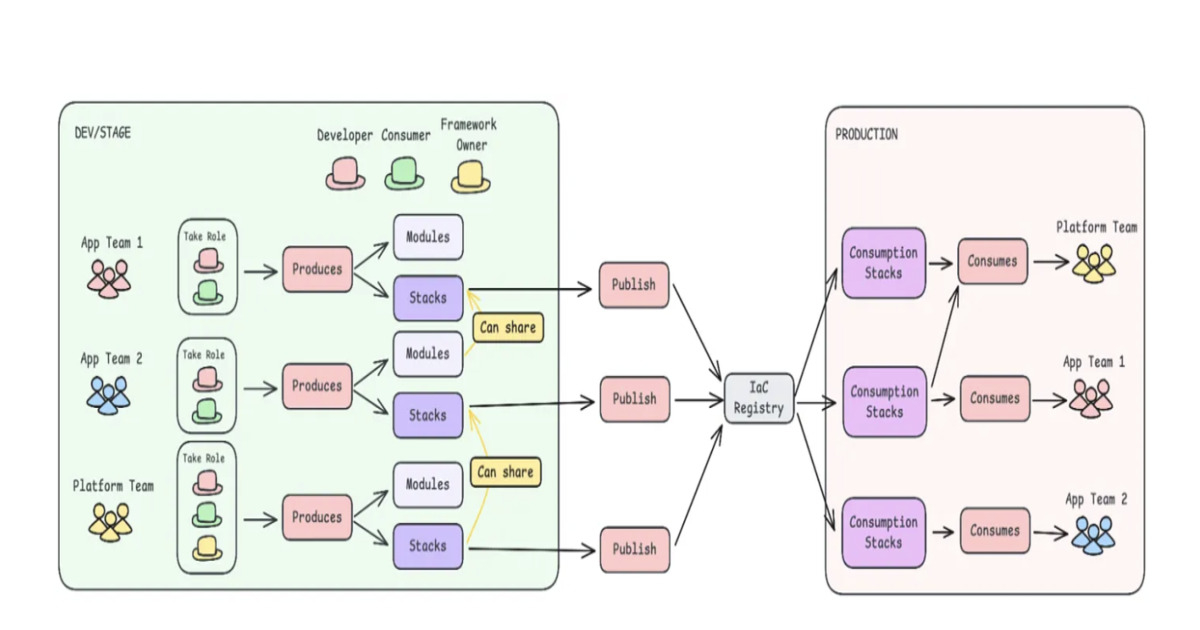
The redesign introduced a layered IaC structure: reusable modules encapsulate resource definitions, stacks combine modules into deployable units, and consumption configurations reference approved stacks for production deployment. This separation restricts direct modification of foundational components while allowing experimentation in non‑production environments. In a decentralized environment, clarity on what can be changed, by whom, and where is critical for scaling safely.
Infrastructure component types with developer requirements and responsibilities (Source: Adidas Blog Post)
A custom command‑line interface abstracts complexity and embeds governance into everyday workflows. By standardizing state handling, enforcing naming and tagging conventions, and integrating with continuous integration/continuous delivery (CI/CD) pipelines, the tooling ensures consistency without requiring a centralized review process. Automated pipelines orchestrate deployments, enforcing traceability and reproducibility across environments.
The reorganization also formalized roles and responsibilities. Framework owners are responsible for maintaining shared tooling and standards. Developers within domain teams compose infrastructure using approved patterns. Consumers deploy production configurations through automated pipelines. This delineation of duties reinforces accountability and reduces dependency on a single centralized team for delivery.


Working model around decentralized infrastructure delivery (Source: Adidas Blog Post)
Engineers report that decentralization reduced pressure on central backlogs and enabled multiple teams to deliver infrastructure independently. The shift illustrates that decentralizing IaC delivery is as much a cultural and organizational transformation as a technical one, requiring shared tooling, automation-first governance, and clear ownership boundaries.
The experience aligns with broader platform engineering trends. Enterprises increasingly enable self-service infrastructure while maintaining operational safety through standardized abstractions and automated policies. By reorganizing around autonomous teams supported by shared frameworks and CI/CD orchestration, the Adidas data platform demonstrates a model for scaling infrastructure delivery in complex environments.