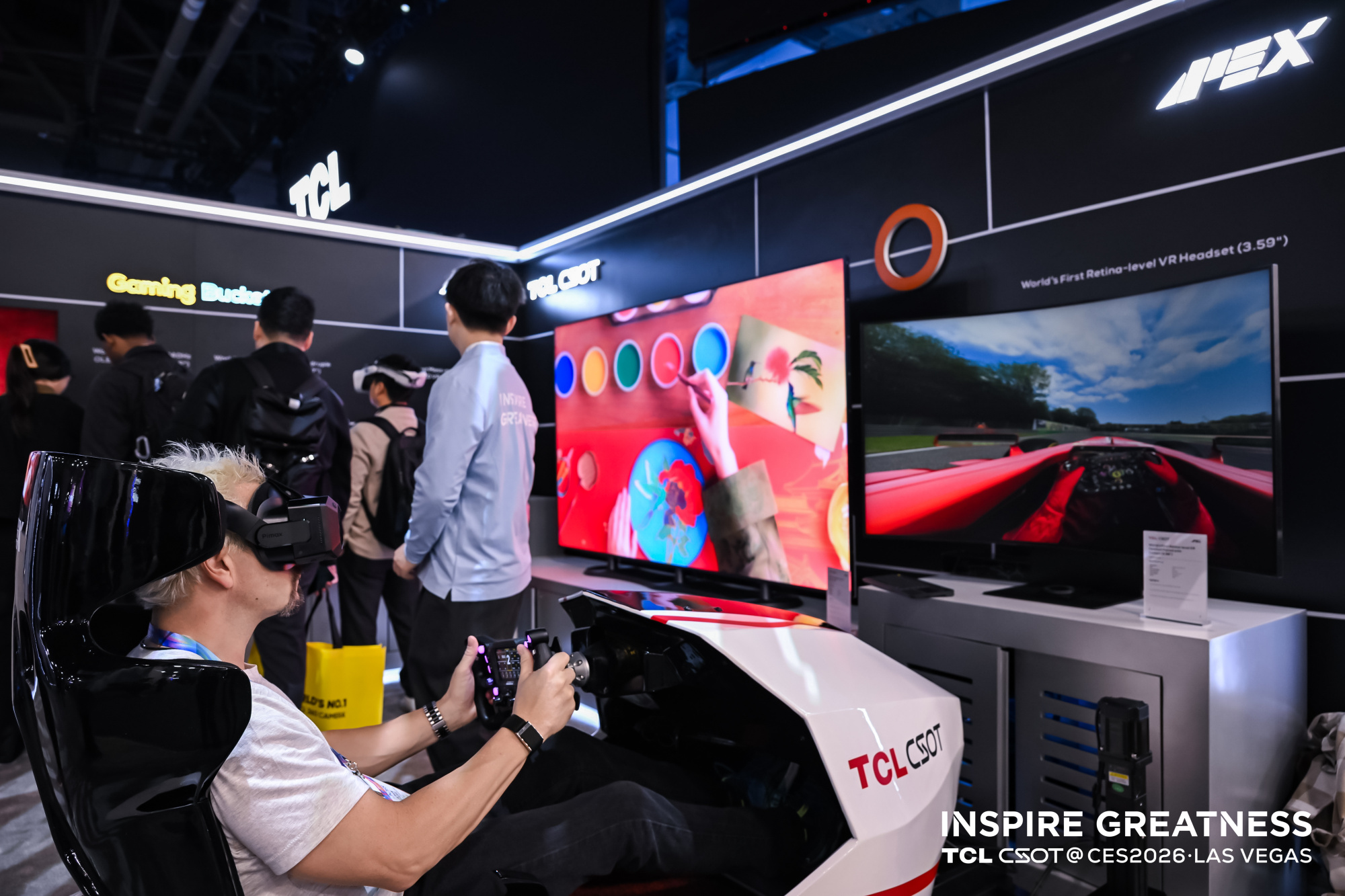
As consumer electronics and smart devices become more common, display technology plays an increasingly important role in electronic devices. Chinese company TCL China Star Optoelectronics Technology (CSOT) has conducted research in LCD, OLED, and emerging display technologies, making notable advancements across these areas.
Today, we’re going to take a closer look at CSOT’s innovations in display technology, exploring how the company is pushing the limits of LCD, OLED, and next-generation screens, and turning lab research into products that power the devices we use every day.
Enhancing LCD and OLED performance for clarity and flexibility
In traditional liquid crystal displays (LCDs), CSOT has improved the performance of large screens through enhancements in backlighting, resolution, and color processing. Quantum dot backlight technology, for example, expands the color gamut and increases brightness uniformity and contrast for clearer and more accurate images.
In organic light-emitting diode (OLED) technology, CSOT has developed flexible panels for smartphones, tablets, and foldable devices. These panels have self-emission and high contrast, with low power consumption and high refresh rates for better image quality and energy efficiency. CSOT has also developed manufacturing processes, including material selection, thin-film encapsulation, and process control, providing a foundation for mass production of wearable and foldable screens.


Advancing Mini LED and Micro LED for precise high-end displays
CSOT has also been developing Mini LED and Micro LED display technologies. In Mini LED, smaller backlight units allow precise local dimming, which improves contrast and makes brightness more uniform. Micro LED is considered a next-generation display technology. It features self-emission, high color saturation, and a long lifespan, making it suitable for large, high-end screens. CSOT conducts research on material development, pixel design, and manufacturing processes. The work provides data and insights that help assess the feasibility of these new display devices.
In combining research and industry, CSOT has developed a closed-loop process that connects laboratory research with small-scale production. By refining materials, manufacturing processes, and encapsulation techniques, the company has increased panel yield and stabilized production. This approach allows technological developments to be converted into functional products more efficiently, supporting the use of display technologies in both consumer electronics and professional displays.


Exploring QD‑EL technology for next-generation self-emissive screens
CSOT is also exploring quantum dot electroluminescent (QD‑EL) technology, a next-generation display approach that combines the advantages of OLED and quantum dots. Unlike traditional LCDs that require backlight or standard OLED panels, QD‑EL uses quantum dots themselves as self-emissive pixels, offering higher color purity, brightness, and energy efficiency.
CSOT has been developing QD‑EL through printed OLED techniques, where the quantum dot emission layer is applied using advanced printing processes. While still in the prototype stage, these developments demonstrate CSOT’s ambition to expand beyond conventional OLED and Mini/Micro LED screens, paving the way for potentially higher-performance, large-format, and flexible displays in the future.


Turning research into real-world next-generation display solutions
On the whole, CSOT has carried out extensive research in both fundamental and applied areas of display technology. Its work has provided experimental data and engineering insights that support the development of new display technologies and help guide future innovations.
Looking ahead, these advances point to a broader range of possibilities for displays, including higher image quality, improved energy efficiency, greater flexibility, and large high-end screens. They also suggest a shift in the industry toward more complex, multi-functional display formats, moving beyond traditional flat panels to meet the evolving demands of consumer electronics and professional applications.