




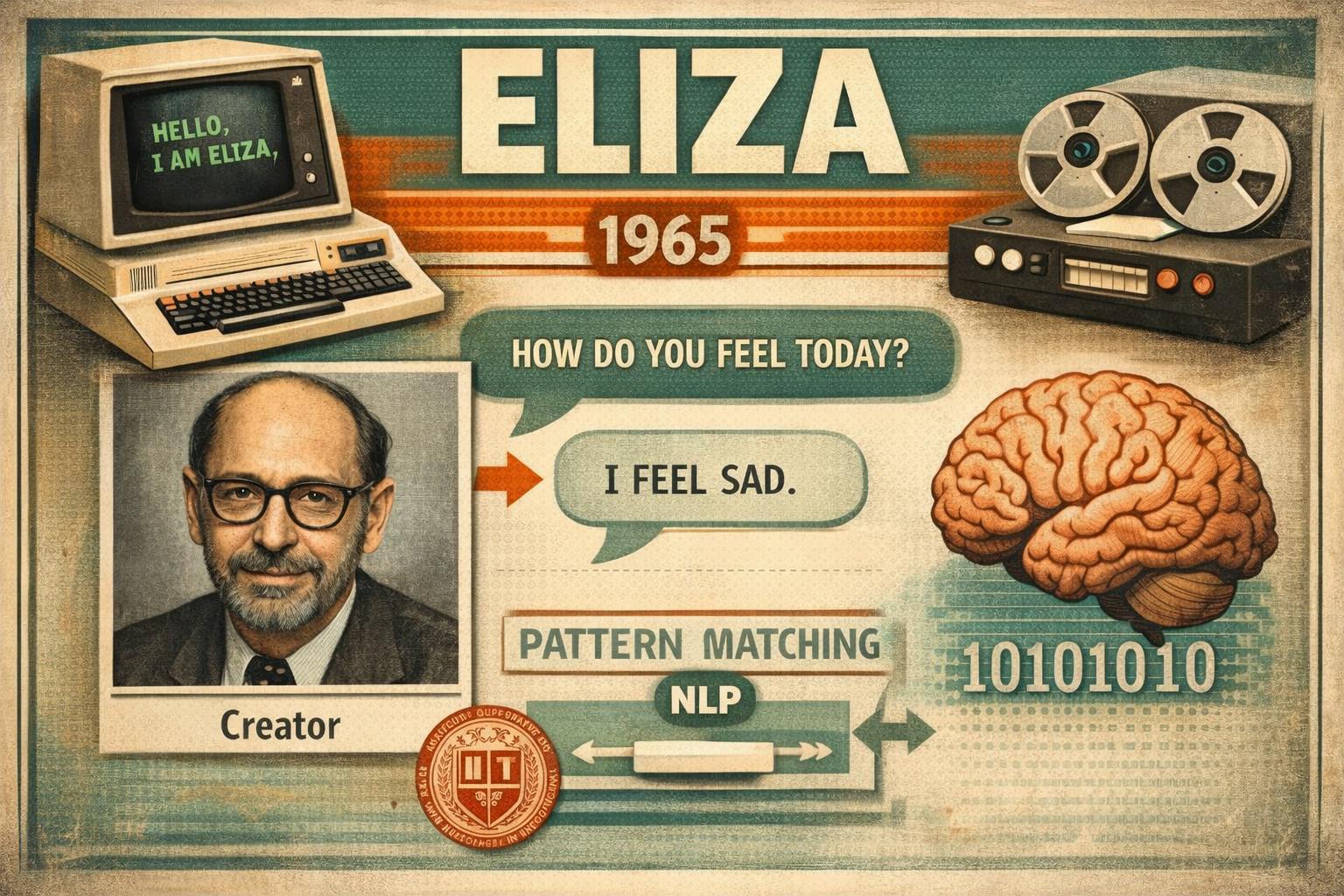
What is ELIZA?
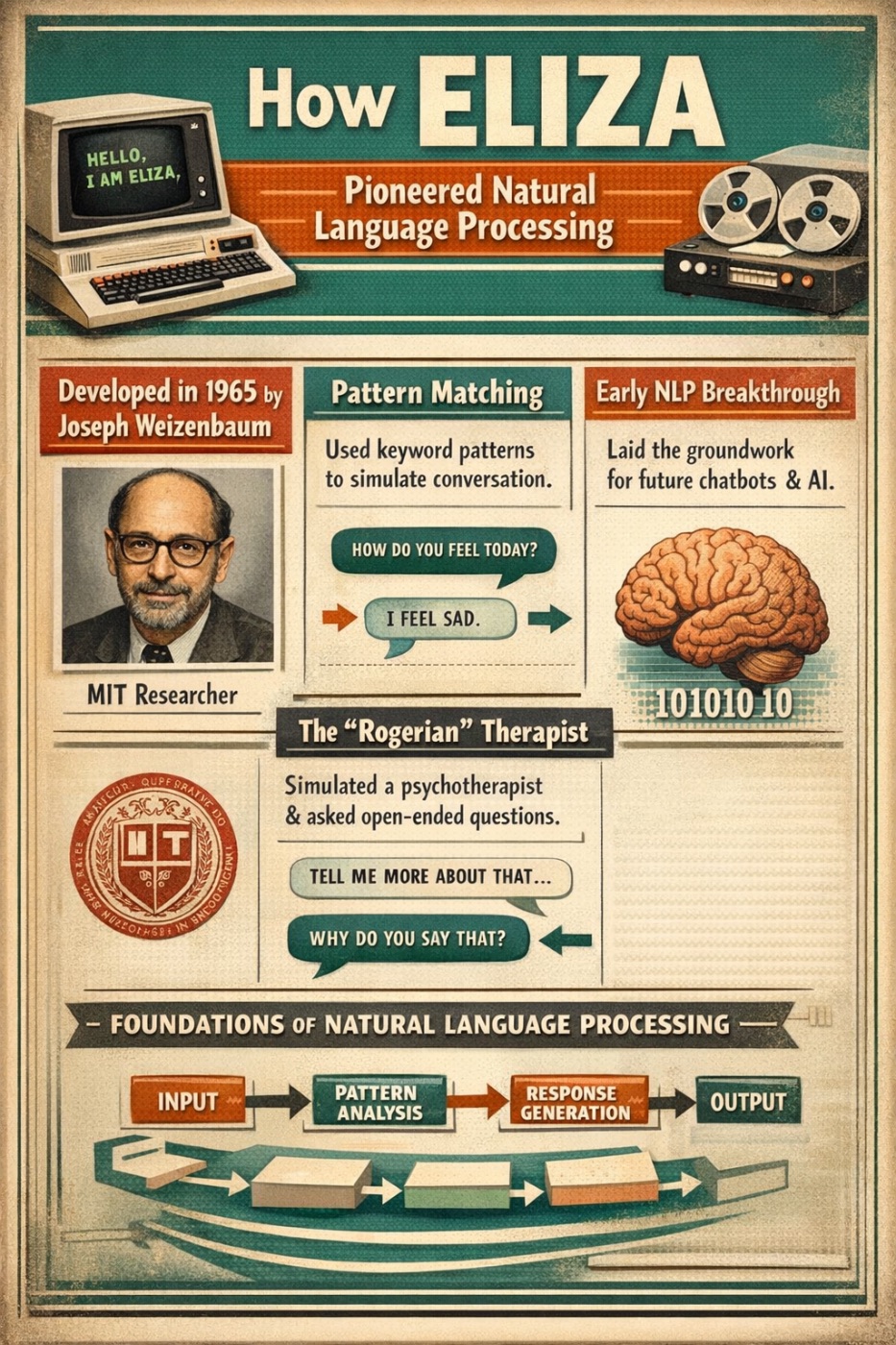
ELIZA was a program created by Joseph Weizenbaum to mimic a conversation between a user and a therapist using text chat. Weizenbaum chose Rogerian psychotherapy techniques as it would provide the most realistic experience for the end user.
Language, NLP, and AI Patterns
Mostly, it would choose predefined responses or call back the person’s same language to show understanding. This machine and human ‘empathy’ is called the ELIZA effect. In terms of tools, ELIZA would use pattern matching and substitution rules under Natural Language Processing (NLP).
:::info
What is the ELIZA effect?
This is when humans attribute understanding to robots, machines, or computers in the same way they think a human feels. This usually occurs in chatbots, and can be used to understand how some people may form relationships to AI chatbots like ChatGPT in current times.
:::
A Typical ELIZA Conversation
Men are all alike.
IN WHAT WAY?
They're always bugging us about something or other.
CAN YOU THINK OF A SPECIFIC EXAMPLE?
Well, my boyfriend made me come here.
YOUR BOYFRIEND MADE YOU COME HERE?
He says I'm depressed much of the time.
I AM SORRY TO HEAR YOU ARE DEPRESSED.
It's true.
I am unhappy.
DO YOU THINK COMING HERE WILL HELP YOU NOT TO BE UNHAPPY.
I need some help, that much seems certain.
…”
Source: ELIZA — A Computer Program For the Study of Natural Language Communication Between Man And Machine (https://web.stanford.edu/class/cs124/p36-weizenabaum.pdf)
What’s in a Name?
The name ELIZA is derived from Eliza Doolittle, a character in George Bernard Shaw’s play Pygmalion, who is taught to speak like a member of high society. The creator, Joseph Weizenbaum, chose this name to reflect the program’s ability to mimic human conversation.
ELIZA and AI’s Programmatic Origins
AI’s origins began in the 1950s with the creation of the first AI program, Logic Theorist in 1955, and further iterations of AI programs that could learn include Perceptron from 1957. ELIZA was created between 1964 and 1967 as the first AI chatbot developed.
Artificial Intelligence was given its name at the Dartmouth Conference or Summer Research Project on Artificial Intelligence in 1956. At this point in the field, it was ideated that intelligence could be detailed enough by humans that computers could mimic it.

Do Modern AI Chatbots differ from ELIZA?
Modern AIs are significantly more advanced than ELIZA, using tools like modern Natural Language Processing (NLP), Machine Learning (ML), and Natural Language Generation, or Natural Language Understanding, whereas ELIZA relied on simple pattern matching and keyword recognition.
| Natural Language Processing (NLP) | This helps programs understand what is inputted into a system. By using algorithms to look into the meaning of text, chatbots can then process input and output. This is also where text is transformed into tokens, intent, etc. |
|—-|—-|
| Machine Learning (ML) | Machine learning helps chatbots to adapt from previous conversations. This helps a chatbot to improve overtime. This is also where a chatbot can be trained on. While this can help refine the chatbot, depending on the size of the data it is parsing, in can require heavy processing in model training. |
| Natural Language Generation | This is where the program replies to human input, or the creation of text from structured date. It allows for the chatbot to reply in more natural human-like language. |
| Natural Language Understanding | Natural Language Understanding (a subset of NLP) allows for chatbots to understand text, more specifically called machine reading comprehension. |
Cognitive Psychology, AI, and Language
The way information is processed changes depending on other nodes whether mental or social. When studying cognitive psychology and language, it is important to look at the relationship between language and thought. In this case for AI chatbots, how does information inputted by text change the reply of the ELIZA furthermore? Databases as storage systems for information should be included for consideration in modern chatbots.
GenAI as a Possible Therapist?
This study looks into considerations of using Gen AI tools like ChatGPT for mental health settings, discussing “… the initial potential for GenAI, with more training, data, and ongoing close supervision, to be integrated into mental health settings.”
https://dx.plos.org/10.1371/journal.pmen.0000145?embedable=true
:::tip
Want to chat with ELIZA? https://sites.google.com/view/elizaarchaeology/try-eliza
:::


