Facebook Groups are a powerful marketing tool, helping you attract new customers and engage current ones with exclusive content, community, and support.
The math is simple: organic reach on Facebook is declining. At the same time, 1.8 billion people say they use Facebook Groups every month.
If you want to stay connected with your audience, Facebook Groups are an attractive option. Here’s what Facebook Groups can do for your business, plus how to scale one into a thriving community.
Key takeaways
- Facebook Groups give you a direct line to your audience. Instead of relying on social media algorithms to decide who sees your posts, Groups let you engage with your customers directly.
- Facebook Groups can be public or private. That choice affects who can find your group, who can join it, and how much moderation it needs.
- Exclusive perks give people a reason to join (and stick around). Early product access, live events, and member-only content can turn a Facebook Group into a real community.
- A healthy Facebook Group doesn’t run itself. Setting clear rules, assigning moderators, and outlining escalation paths can protect both your members and your brand.
What are the benefits of Facebook Groups for business?
A Facebook Group can become one of your most valuable community channels. It keeps customers engaged, encourages advocacy, and creates a direct line to your audience, all in one place.
Here’s what that looks like in practice.
1. Higher retention
A Facebook Group gives customers a reason to engage between launches, renewals, or buying cycles. It keeps your brand top-of-mind and part of their routine.
Plus, the more someone contributes and builds relationships inside your community, the harder it is to walk away.
2. Customer advocacy
Facebook Groups are powerful because people choose to be there.
No one accidentally joins a brand community. No one opts in to notifications, discussions, and updates for a company they don’t like.
Chances are, members of your Facebook group are already brand advocates. If you’re still unsure, look for people who:
- Share wins
- Answer questions before your team even sees them
- Create user-generated content (UGC) without being asked
That kind of advocacy is way more convincing than a polished ad.
Pro tip 💡: Check your Facebook Group Insights to see your top contributors. Consider inviting them into your affiliate program, offering them early access as beta testers, or featuring their content in your marketing (with permission).
3. Peer-to-peer support
One of the most underrated benefits of a Facebook Group? Your customers start helping each other.
That means less pressure on your support team and faster answers. Even a small reduction in ticket volume can have a big impact, especially for enterprise teams.
It also gives you visibility into recurring issues. If the same confusion pops up again and again, that’s not a coincidence.
4. Real-time customer insights
Facebook Groups are like an ongoing focus group.
Just think: outside of a pricey marketing study, where else can you have direct access to a group of people who share an interest in your brand? Or get your questions answered by real customers?
Facebook Groups are a great place to collect feature requests, spot common friction points, and see how new messaging is landing — all in real time.
As a bonus, your super fans will appreciate being “in the know.”
5. Scalable customer education
Instead of answering the same question in support tickets, you can answer it once in your Group, and then let it live there.
Facebook Groups are ideal for:
- Live AMAs
- Product updates
- Feature teasers or walkthroughs
- “Did you know you could do this?” posts
It’s customer education without having to build an entire LMS.
6. Stronger brand trust
When customers see your team responding transparently — answering questions, responding to feedback, sharing updates — it builds credibility.
Because nothing builds loyalty faster than feeling heard.
A well-managed Facebook Group shows your audience that you’re not just broadcasting at them — you’re also listening. Over time, that visibility builds trust in a way one-way marketing never can.
Bonus: Start crafting your own Facebook group policy with one of our 3 customizable templates. Save time on admin tasks today by providing your group members with clear instructions.
Types of Facebook Groups (and which one you should pick)
Before launching your community, you need to decide if your Group will be public or private.
Here’s a quick summary of each:
| Group Type | Who can find it? | Who can see posts? | Level of brand risk |
| Public | Anyone (shows in search and may appear in search engines) | Anyone, even non-members | High – content is public and requires active moderation |
| Private + Visible | Anyone on Facebook can find it via search | Members only | Moderate – requires moderation, but offers control over membership |
| Private + Hidden | Only people with a direct invite/link | Members only | Low – less discoverability and tighter control over membership |
1. Public
Public groups are wide open. Posts, comments, and member lists are visible to anyone, whether they’ve joined or not.
People can usually join a public Facebook group without approval, which makes them easy to grow but harder to manage. They require active moderation to keep spam, off-topic posts, or risky content in check.
If you start a public group, you can change it to a private one later on. But you can only do this once, no switching back.
For most brands, especially larger ones, starting private is the safer play.
2. Private
There are two types of private Facebook groups: visible and hidden. Let’s go over both.
Private + Visible
Private + Visible groups show up in Facebook search, but the conversations inside the group stay private.
Non-members can see the group’s name and description, but not what’s being discussed inside. Users can request to join the group, and moderators decide whether to approve them. Once accepted, they can view and post content.
This option allows you to control membership while still being discoverable in Facebook search.
Private + Hidden
Private + Hidden groups don’t appear in search at all.
The only way to find one is through a direct invite, or a link. Everything stays behind closed doors — posts, comments, member lists, all of it.
This setup works well for:
- Paid communities
- VIP customers
- Beta testers
- Internal or partner groups
If your group is tied to a purchase or exclusive program, a hidden group keeps things controlled.
TL;DR: Choosing the right group privacy level is critical. After all, your privacy setting determines who can discover your group, see discussions, and participate.
How do Facebook Groups compare to Discord, Slack, and LinkedIn Groups?
Not sure whether a Facebook Group is the right move? Here’s how it stacks up against Discord, Slack, and LinkedIn Groups.
| Platform | What It Is | Best For | Strengths | Limitations |
| Facebook Group | A public or private community within Facebook | Customer communities, brand advocacy | Solid moderation tools, high discoverability (when public), built-in audiences | Requires active moderation |
| Facebook Page | A public brand profile | Announcements + running ads | High visibility, strong brand control | Mostly one-way communication, limited community feel |
| Discord | A real-time chat platform | Highly engaged or niche communities | Quick + casual conversations | Can feel chaotic without moderation, users can be anonymous |
| Slack | A channel-based messaging platform | Professional or paid communities | Organized + focused conversations | Not discoverable, invite-only, hands-on moderation |
| LinkedIn Groups | A public or private community within LinkedIn | Networking + professional conversations | Built-in professional audiences | Engagement is inconsistent, limited community tools |
How to create a group on Facebook
You can create a Facebook Group by following the steps below.
- Log into Facebook with an admin account for your company’s Facebook Page.
- From your Feed, click the Menu icon (three horizontal lines) in the top left corner.
- Click Groups (tap See more if you don’t see it).
- Select the Create a Group (+) button.
- Add a name for your group and choose the privacy and visibility level.
- Hit Create group.
- From here, you have the option to add a cover photo and invite people to join.
Now your group is officially up and running!

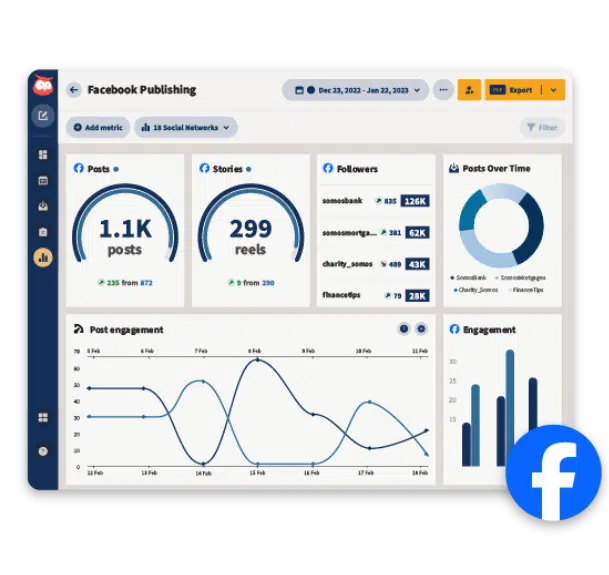
#1 for Facebook marketing
Schedule posts, answer messages, and manage ads from one place. Then, show off your results in beautiful reports. It’s so easy.
Start your free trial
How to add an admin or moderator to your Facebook Group
To add another person as a Facebook Group admin or moderator, follow these steps:
- From your Feed, click the Menu icon (three horizontal lines) in the top left corner.
- Click Groups (tap See more if you don’t see it).
- Select the group you want to add an admin or moderator to.
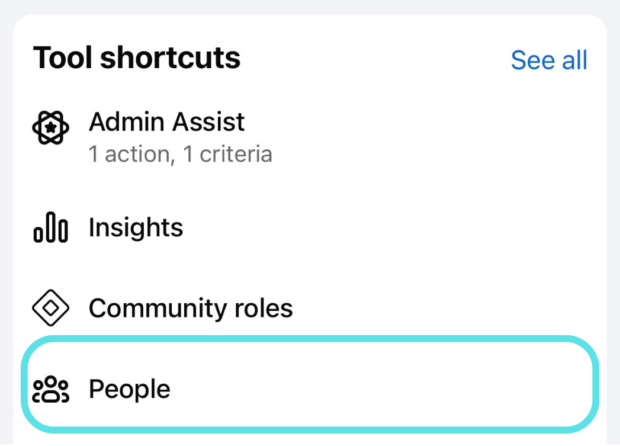
- Click Manage, then People under Tool Shortcuts.

- Find the member you want to promote and click Add as admin or Add as moderator.
- Click Confirm.
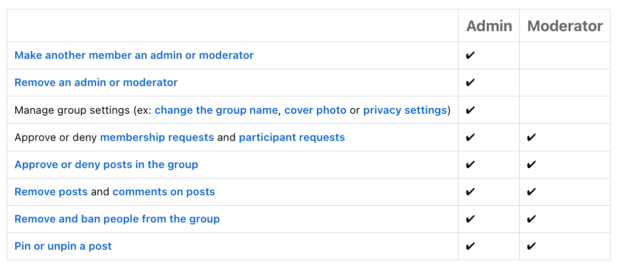
Keep in mind that admins can remove other admins, so it’s important to assign that role carefully. In some cases, it makes more sense to give additional team members moderator access instead.
It’s also worth noting that some actions — like changing the group name, cover photo, or privacy settings — require admin approval.
Here’s a quick overview of what each role can do:

Source: Facebook
How to change the name of your Group on Facebook
Here’s how to change the name of your Facebook Group:
- From your Feed, click the Menu icon (three horizontal lines) in the top left corner.
- Click Groups (tap See more if you don’t see it).
- Select the group you want to edit.
- Click Manage, then Group Settings.

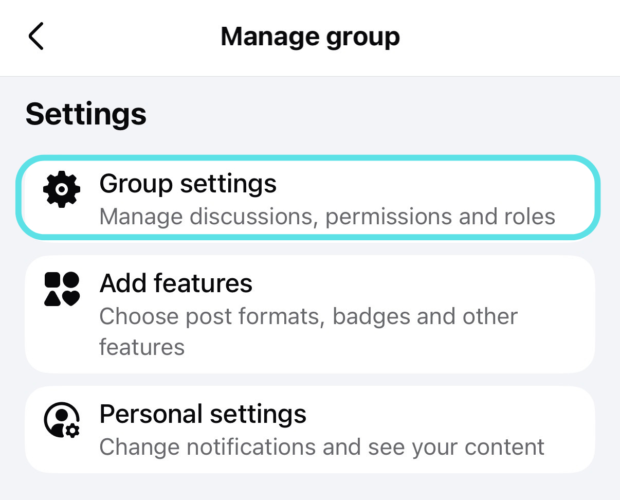
- Tap Name and Description.
- Enter your new name and click Save.
Only administrators can change the group name, and it can be updated once every 28 days.
How to post in a Facebook Group
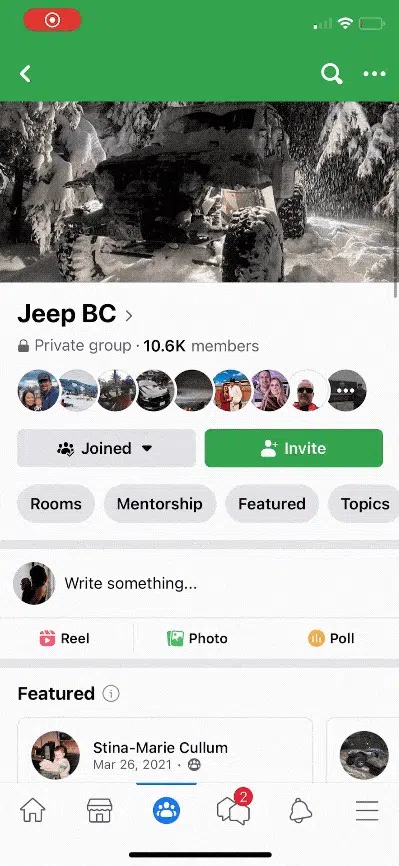
Posting in a Facebook group is similar to posting anywhere else on Facebook. Simply go to the group, type out your post in the post section, then click Post.

How to delete a Facebook Group
To delete a Facebook Group, an admin must remove all members and then leave the group.
Here are the steps to delete a group:
- From your Feed, click the Menu icon (three horizontal lines) in the top left corner.
- Click Groups in the left menu (tap See more if you don’t see it).
- Select the group you want to delete.
- Tap Manage, then People.
- Tap each member’s name and select Remove [name] from group (for private groups) or Ban [name] (for public groups).
- Tap Next, then Confirm to continue.
- Once you’re the last group member, return to the main group page and tap Manage, then Delete Group.

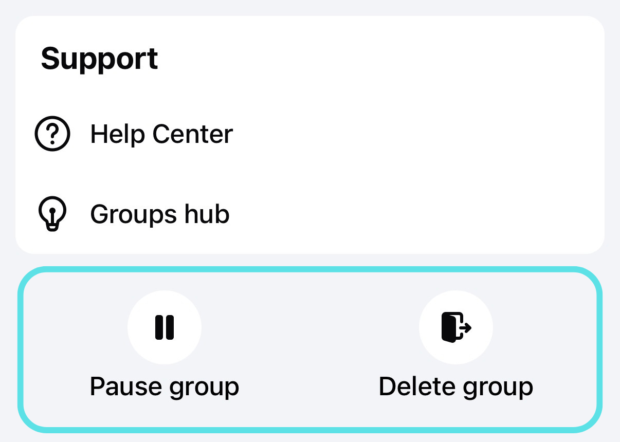
Note: The creator of the group must have already left, or you must be the original creator to complete this process.
How to pause a Facebook Group
To pause a Facebook Group, follow these steps:
- From your Feed, click the Menu icon (three horizontal lines) in the top left corner.
- Click Groups (tap See more if you don’t see it).
- Select the group you want to pause.
- Tap Manage, then Pause group.
- Select a reason for pausing the group, then click Continue.
- From here, you can write a group announcement about the pause and set a date and time for when it will resume.
- Click Pause Group.
What’s the difference between pausing and deleting a Facebook Group?
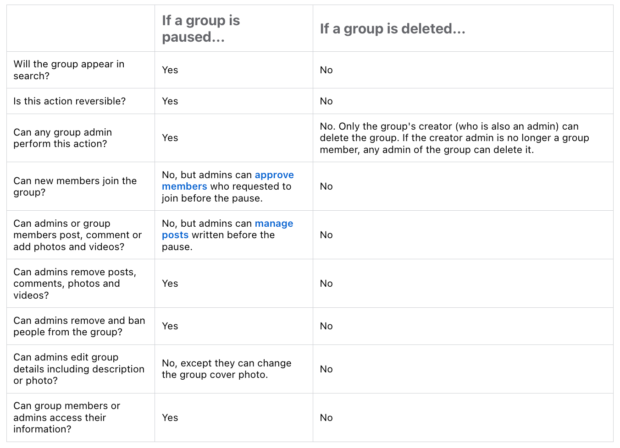
If you’re no longer actively managing your Facebook Group, you can either pause it or delete it. Pausing keeps the group and all of its content in place, but stops members from posting new content. Deleting removes the group entirely.
In most cases, pausing a Facebook Group is the safer option if you need to step away temporarily while keeping the community (and all its content) intact.
Here’s how the two options compare:

Source: Facebook
6 tips for Facebook Group marketing success
Successful Facebook Group marketing relies on clear rules, active moderation, and valuable member-only content.
Here are six tips to make it happen:
- Create a clear code of conduct
- Develop a moderation plan
- Post welcome messages and announcements
- Engage with members, but let them lead
- Ask admittance questions to filter bots
- Offer high-value, exclusive content to members
1. Create a clear code of conduct
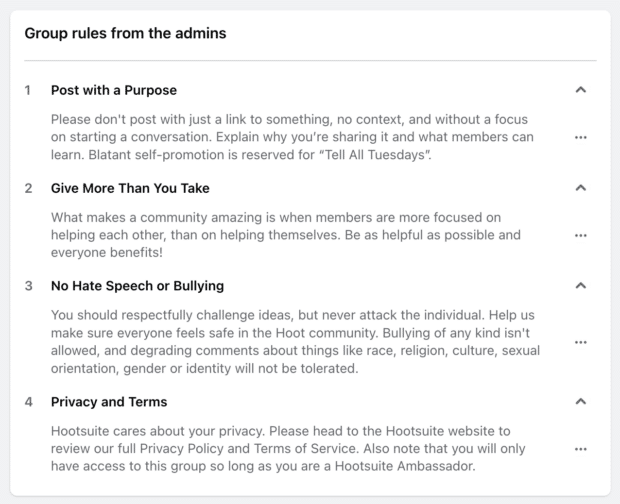
Every successful Facebook Group starts with clear rules. By stating them up front, you set the tone for how members should interact with each other and your brand.
In your Group settings, you can add up to 10 rules. These often cover things like respectful conversation, self-promotion, and whether members can share external links.
It’s also smart to think through privacy and boundaries. For example:
- Will you collect email addresses through membership questions?
- Are screenshots from the Group allowed to be shared publicly?
- Can members promote their own products or services?
- If a member shares a testimonial or photo, how will you ask for permission to feature it in your marketing?
Setting these expectations early protects both your members and your brand. And if problems do come up later, having rules in place makes moderation a lot easier.

Source: Facebook
2. Develop a moderation plan
As your Facebook Group grows, moderation becomes about more than just deleting spam.
To build a moderation plan that scales, start by defining roles and responsibilities for the community. For example:
- Admins manage settings, rules, and overall strategy.
- Moderators review group posts, answer questions, and keep discussions on track.
- Community managers post brand-approved content and escalate customer issues.
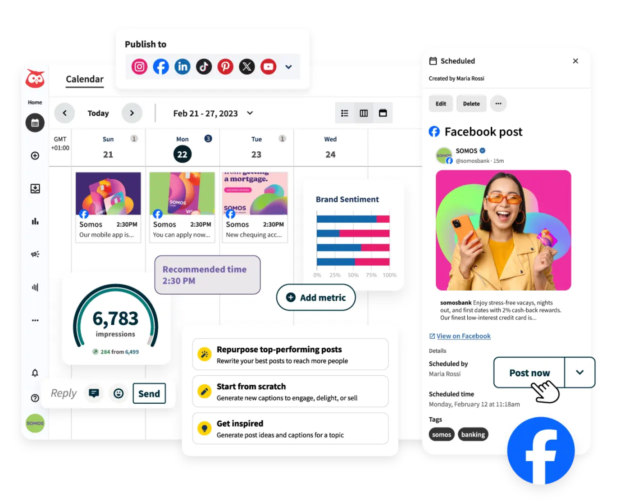
If your team schedules Facebook content using Hootsuite, you can set role-based permissions to control who drafts, reviews, and publishes posts. It’s a simple way to keep content on-brand and properly approved.

It’s also helpful to create a simple escalation path.
If a post raises a serious complaint, legal concern, or sensitive customer issue, moderators should know who to loop in internally, whether that’s customer support, legal, or communications.
Most communities won’t face a crisis. But having a plan in place ensures your team can respond quickly and confidently if something comes up.
3. Post welcome messages and announcements
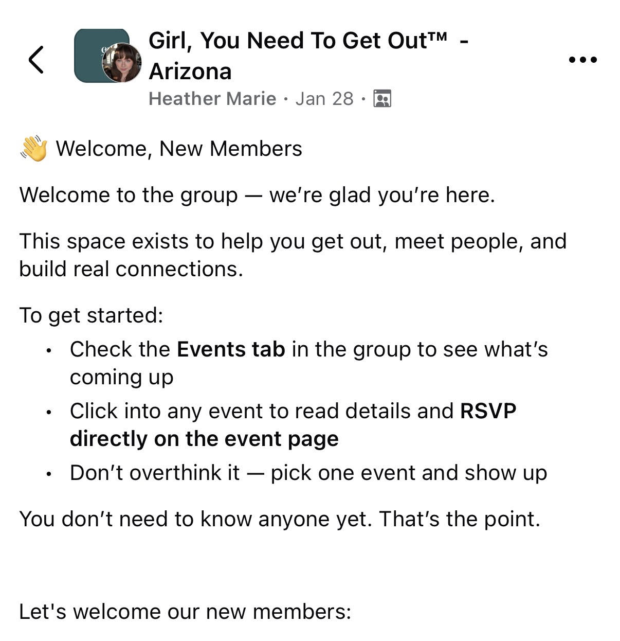
As much as it may be tempting to let people talk amongst themselves, make sure to butt in fairly often. Make new members feel at home with a weekly welcome message.
Welcome messages — like the one below — are also a great place to point new members to helpful resources, encourage introductions, or remind everyone about the group rules.

Source: Girl, You Need To Get Out Arizona
Announcements are equally valuable. Use them to share product launches, upcoming events, or important updates. Scheduling these posts ahead of time helps you keep a steady rhythm of communication without needing to post manually every day.
4. Engage with members, but let them lead
It’s your job to keep the group productive, on topic, and respectful. But don’t try to control too much. Encourage members to start conversations and feel comfortable enough to share.
Instead of policing negative opinions and keeping the group as a positive echo chamber, welcome the feedback. Allow users to share their true opinions of what went wrong, thank them for it, and keep the conversation going.
You don’t want your members to go rogue and bash you all the time, but seeking to control people’s speech will only backfire in the long run.
5. Ask admittance questions to filter bots
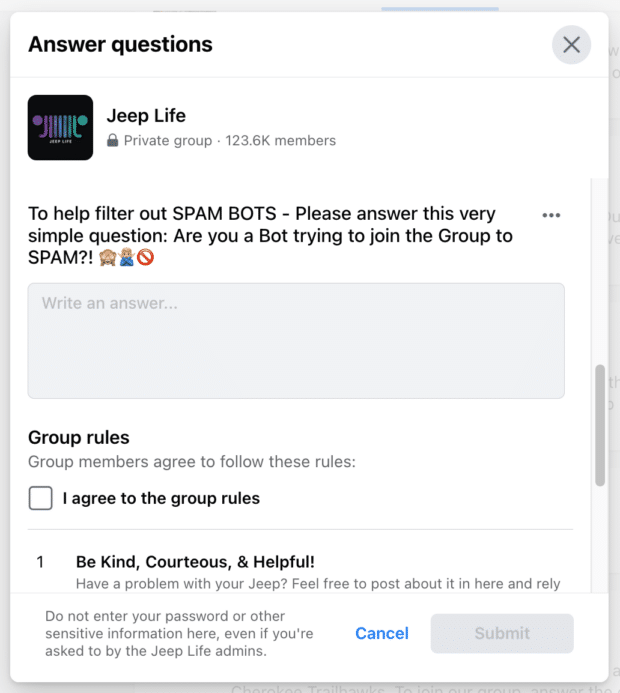
Facebook lets you ask up to three questions that people must answer before joining. This allows you to somewhat vet incoming members.
A few common examples include:
- Asking users to read and agree to follow the group rules.
- Requesting an email address (both for marketing and verification purposes).
- Including an easy but specific question to prove their humanity.
These questions help you control who gets access to the community. For example, if your group is for current customers only, asking for their work email address allows you to check whether they’re a customer or not.

Source: Facebook
6. Offer high-value, exclusive content to members
Give people a real reason to join your Facebook Group.
Joining a community is a bigger commitment than simply following your brand page. That usually only happens when they feel they’re getting something valuable in return.
A few ideas for Facebook-group-only content:
- A monthly AMA (Ask Me Anything) thread
- Livestreams or other live events
- Special discounts for members
- Early access to new launches
- Survey invitations with incentives (e.g., discounts, product swag, or gift cards)
- Voting on new product options (colors, features, etc.)
- Opportunities to join an affiliate or ambassador program
There are countless ways to make your group members feel special, but you only need to do one or two to make it happen. Think about what you can offer that’s valuable and scalable to your group.
How should you measure Facebook Group success?
To measure whether your Facebook Group is actually working, focus on metrics that reflect real business impact. Look at signals like engagement, customer support impact, and overall community health.
While member count looks nice in a report, it tells you surprisingly little on its own. What matters more is what value the community is creating.
Here are a few key metrics worth tracking.
Active members (not just total members)
A Facebook Group with 20,000 members sounds great, but if only 20 are participating, that’s a problem. Which is why you should track active members.
Inside your Facebook Group Insights, see how many members are joining or leaving your community over time.
You can also calculate a simple participation rate by comparing the number of people posting or commenting to your total member count. That gives you a clearer picture of how engaged your community really is.
Support deflection
Support deflection is when your community answers questions that might otherwise become support tickets.
In other words: fewer tickets, less strain on your support team.
Here’s how to get a rough sense of it:
- Monitor how many posts are “support-style” questions (e.g., “How do I…?” or “Why isn’t this working?”).
- Track how often those questions get answered by other members versus your team.
- Look for overlap between ticket topics and Group discussions.
- Check for changes in overall support ticket volume over time.
If you see members answering questions inside the Group — without your support team stepping in — that’s deflection at work.
And while your Group shouldn’t replace your support team, it can absolutely extend it. Even modest deflection can make a big difference at scale.
Quality of engagement
Not all engagement is equal. A quick reaction is nice, but real conversation is better.
Quality of engagement looks at whether members are having meaningful discussions, asking thoughtful questions, and responding to each other (not just hitting “like” and moving on).
Inside your Facebook Group Insights, look at:
- The average number of comments per post.
- Which posts generate the most comments.
- What type of content drives conversations — for example, memes versus educational posts, customer spotlights, or product sneak peeks.
Remember: You’re not just looking for activity. You’re looking for depth.
Response time
Response time measures how long it takes for a member’s question or post to receive its first reply, whether it’s from your team or from another member.
Keep an eye on:
- Whether questions are being answered at all.
- How quickly new posts receive their first comment.
- Whether responses are coming from your team, other members, or both.
If posts regularly sit unanswered for hours (or days), it might be time to rethink how you’re monitoring the Group.
If members are consistently stepping in to answer questions, that’s even better. It means your community is self-sustaining.
Common themes and questions
Your Facebook Group gives you a front-row seat to what customers are confused about, excited about, and asking for.
Instead of treating posts as one-off conversations, zoom out and look for patterns. Are the same questions coming up week after week? Are multiple members requesting the same feature? What’s the overall tone: frustrated, curious, energized?
Those patterns are signals.
If customers consistently struggle with the same feature, it may point to an onboarding gap. If they can’t stop talking about a specific benefit, that’s likely a message worth calling out in your marketing.
Over time, your Group becomes a hub of strategic insights.
FAQ: Facebook Groups
What are the latest Facebook Groups statistics and usage trends in 2026?
How do brands use Facebook Groups to build community and drive engagement?
Brands use Facebook Groups to build community and drive engagement by creating spaces where customers can safely interact with each other and the brand. Groups encourage discussions, user-generated content, and feedback that strengthens brand loyalty and retention.
What Facebook Groups metrics should enterprises track to measure success?
Enterprises should measure Facebook Group success using metrics that show real business impact, such as active members, quality of engagement, response time, and support deflection. Together, these signals reveal whether your community is actually alive, engaged, and making an impact.
How do Facebook Groups compare to other community platforms for brands?
Compared to platforms like Discord or Slack, Facebook Groups are easier for customers to find and join because they live inside the Facebook ecosystem. They also provide moderation tools and community rules, making them ideal for brand communities.
What best practices help enterprises grow and moderate Facebook Groups effectively?
The best way for enterprises to grow and moderate Facebook Groups is to balance community engagement with smart governance. Set clear rules, assign moderator roles, create an escalation path for bigger issues, and keep the conversation going with posts that invite members to share, ask, and help each other.
Save time and get the most out of your Facebook marketing strategy with Hootsuite. From a single dashboard, you can publish and schedule posts, find relevant conversions, engage the audience, measure results, and more. Try it free today.