
Even if your brand doesn’t post regularly, many of your employees are. When they mention where they work or post about projects, your brand is part of that conversation.
A clear social media policy protects both your organization and your people from reputational, compliance, and security risks.
Keep reading to learn how to create a social media policy that actually works. Or, download our free, customizable social media policy template to start building or updating yours right away.
Key takeaways
- Every brand needs a social media policy. It’s your playbook for staying consistent, on-brand, and compliant.
- Think beyond rules. A good policy also outlines roles, ownership, and security so everyone knows who’s doing what (and how to do it safely).
- Protect your brand and your people. Clear guidelines help avoid legal, compliance, and reputational messes before they happen.
- Train and update often. Social media changes fast, so keep your policy fresh and make sure your team actually understands it.
- Plan for the “what ifs”. Include crisis protocols, escalation paths, and even AI guidelines, so you’re ready for anything.
A social media policy is an official company document that provides guidelines on how your organization and its employees should use social media.
It sets clear expectations for your brand’s official channels and for employees who talk about your company online.
For enterprise organizations — especially those in regulated industries — a social media policy is more than a set of rules for posting online. It’s a governance document that defines ownership, reduces legal and compliance risk, and protects brand reputation across multiple markets.
Your team needs a social media policy to protect your brand, curb compliance issues, and help employees show up confidently online.
For marketing leaders, a social media policy isn’t just about avoiding mistakes — it’s a framework for scaling your brand presence responsibly.
Here are some of the most important reasons to implement a social media policy:
Ensure regulatory compliance
A social media policy helps your organization stay compliant, which is crucial if you operate in a regulated industry. But all brands have compliance responsibilities, especially around marketing claims, endorsements, sponsorships, and disclosures.
A well-crafted social policy keeps your team in line with rules and regulations.
For example, The Candida Diet updated its social media policy after an employee “posted a very personal and passionate piece about our probiotics that unintentionally landed us in non-FDA-compliant territory,” says Lisa Richards, CEO of The Candida Diet.
The updated policy now includes guidelines for making health claims, and it applies to all employees’ personal social accounts.
“This taught us to include a non-negotiable disclaimer, like ‘Personal opinion, not medical advice,’ on all employee wellness-related posts,” Richards adds.
Manage brand risk
A good social media policy helps protect your accounts against brand risks. When security protocols are clearly defined (more on that later), it reduces the chance of:
- Security breaches
- Reputational damage
- Compliance violations and legal issues
For example, cybersecurity firm Action1 includes explicit instructions in its social media policy on how to stay alert for phishing attempts, “especially on LinkedIn, where attackers might pretend to be recruiters,” says Peter Barnett, VP of Product Strategy.
Your social media policy should also include an emergency response plan if something goes wrong.
Empower employees to share, safely
When you’ve got big product news or a message to share, it’s great to have your whole team on board. But that can be a delicate dance.
A social media policy empowers employees to share company news and thought leadership safely and confidently.
“With more employees acting as thought leaders and influencers on LinkedIn, policies need to help employees navigate their online presence when representing the company they work for or are promoting,” says Trish Riswick, former Social Team Lead at Hootsuite.
The key elements of a strong social media policy includes clearly defined roles, account ownership rules, security protocols, acceptable use standards, escalation paths, legal and compliance requirements, and AI guidelines.
Together, these pieces form a framework that protects your brand and gives employees clarity on how to participate online.
If you’re building yours from scratch, you can follow along using our free social media policy template — it’s structured to include all of these elements.
Roles and responsibilities
Define your team’s roles and responsibilities for your social accounts. Who covers which responsibilities on a daily, weekly, or as-needed basis?
Common responsibilities include:
Essentially, this section outlines who can (and can’t) speak for your brand on your official social media accounts. It can be helpful to include names and contact information for each responsibility or role. That way, people from other teams know who to contact.
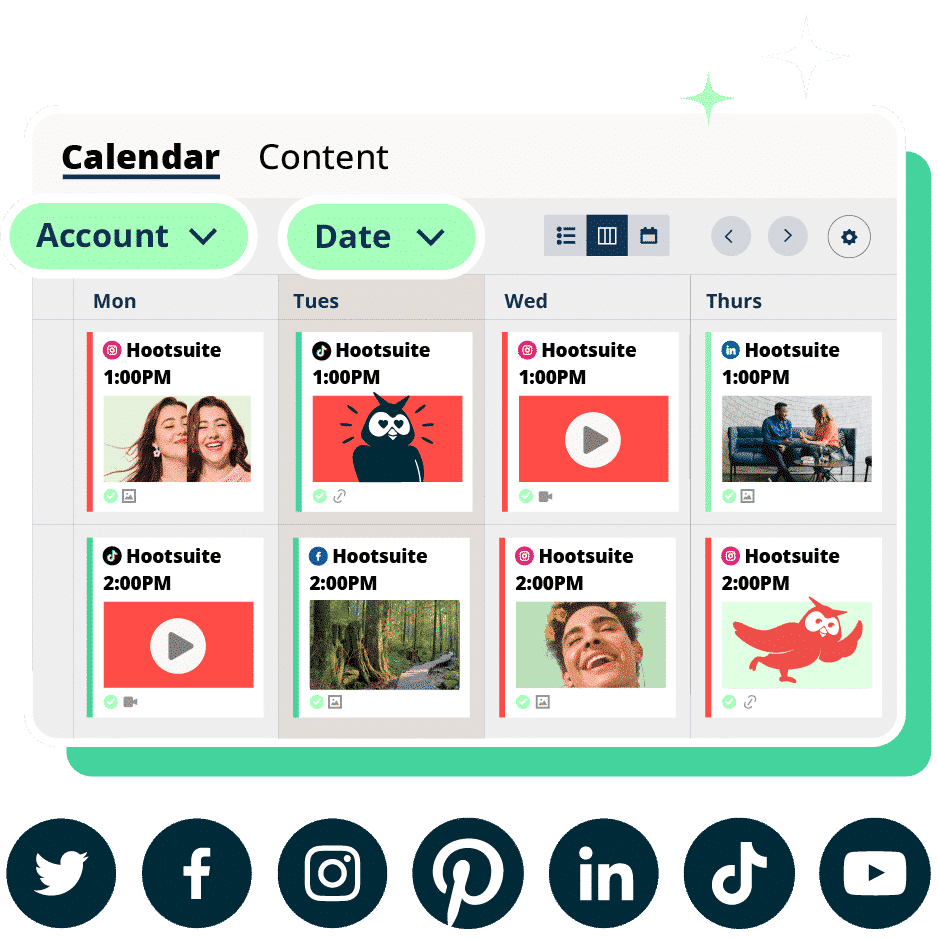
To take it a step further, a platform like Hootsuite can formalize your social media workflows. With Hootsuite, teams can:
- Set up easy approvals so the right people have final sign-off
- Collaborate on drafts
- Set posting permissions for individual team members

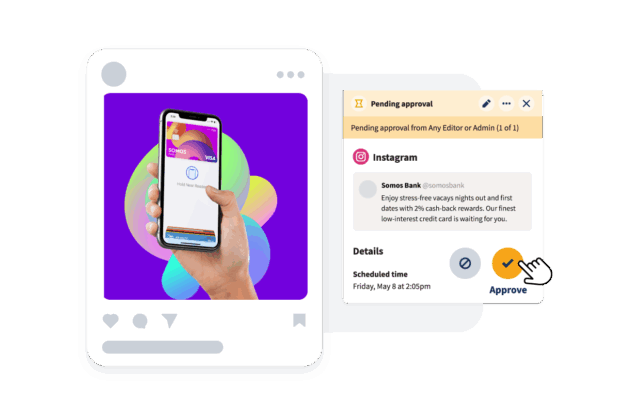
This ensures all published content is brand-approved. It also keeps the quality of your conversations with followers on brand.
Account ownership structure
As employees become more active online, ownership can’t be a gray area.
Your policy should spell out who owns your social accounts, communities, login info, and the content created inside them.
For example, employee contracts often clarify who owns the content they create. But what about the LinkedIn Group they built? Or the Facebook community they’ve managed for years?
“When the top sales manager quit at one of our SaaS clients, he tried to take a LinkedIn group with him,” says Steve Morris, Founder & CEO of NEWMEDIA.COM.
“This is a group that was bringing in dozens of solid leads every week. Because our client had a policy with precise ownership details, logins, and a checklist for handing over account access, they had all the proof they needed,” he shares. “That paperwork stopped what could have been a financial disaster.”
If someone can build it, they can try to leave with it. That’s why it’s important to outline handoff procedures when roles change.
Security protocols
Social media introduces real security risks. Your policy should make it clear how to identify and handle those risks before they snowball.
At a minimum, cover:
- Rules for personal social media use on company devices.
- Social media activities to avoid, like participating in quizzes that ask for personal or sensitive information.
- Guidelines on how to create effective passwords, plus how often to change them.
- Expectations for keeping software and devices updated.
- How to recognize scams, phishing attempts, and other security threats.
- Who to notify if a social media security concern arises.
But don’t stop at digital security. Some brands need to think more broadly.
For example, property management company FLATS prohibits “sharing any content that reveals unit availability, occupancy rates, or resident demographics,” according to Marketing Manager Gunnar Blakeway-Walen.
Why? “Social media posts can inadvertently signal to bad actors which buildings have higher vacancy rates or vulnerable populations.”
Even timing matters. If your entire team is out of office for a volunteer day, broadcasting that in real time may create unnecessary exposure.
Acceptable use and code of conduct
Your employees can be some of your most powerful brand advocates. But enthusiasm without guardrails is risky.
A clear code of conduct protects your brand and your people at the same time. For example, you don’t want a well-meaning employee posting about a feature before launch.
At the same time, you can’t overreach.
In the United States, company policies must respect employee rights under the National Labor Relations Act (NLRA). That is why many organizations include a savings clause stating that the policy doesn’t restrict legally protected activity.
To curb unwanted behavior online, consider adding a code of conduct to your policy that covers:
- Guidelines for sharing content that shows the workplace
- Guidelines for posting photos in uniform
- Whether employees should mention the company in their profile bios
- Whether it’s acceptable to connect with clients, customers, or other business associates on social media platforms
- Any required disclaimers when sharing personal opinions
- When employees must identify themselves as company representatives
Dell Technologies, for example, requires employees to disclose that they work for Dell when posting about the company. The policy states:
“When you talk about Dell Technologies on social media, you should disclose that you work for Dell Technologies. Your friends may know where you work, but their network of friends and colleagues may not, and you don’t want to accidentally mislead someone.”
Make sure to list any specific resources that can help, and consider providing an approved content library that employees can access.

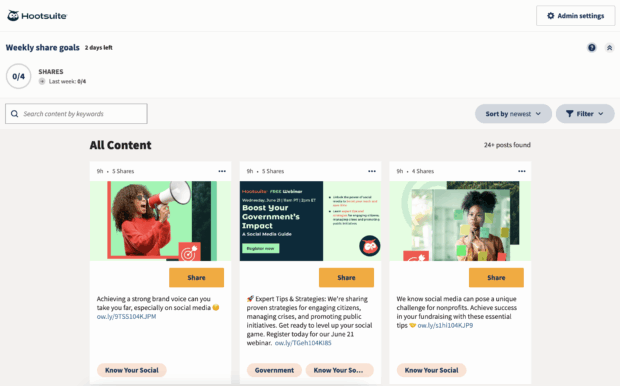
Hootsuite Amplify is an employee advocacy tool that allows you to create a library of pre-approved brand content. Employees can customize the posts and share them with a couple of clicks.
Diversity, equity, and accessibility guidelines
Your social media policy should reflect your organization’s commitment to diversity, equity, and inclusion.
That means providing clear guidance on inclusive language, avoiding stereotypes, and ensuring content meets accessibility standards — including alt text for images and captions for videos.
This helps protect your brand reputation, widen your audience reach, and align your online presence with organizational values.
For example, the UK Government Communication Service (GCS) advises employees to build accessibility into every stage of social media planning — including providing alt text, captions, and color contrast checks — and to consider the needs of audiences with diverse cognitive, visual, hearing, or motor needs.
Escalation paths and a “pause rule”
Employees need direction for what to do — and what not to do — when sensitive situations arise.
That includes guidance around “what not to post during high-stakes situations — like product recalls, layoffs, or PR crises,” Riswick says. “This is a great addition to any social media policy.”
Two simple guardrails can make a big difference:
- Pause rule. “If there’s an ongoing internal sensitive issue, employees should avoid commenting about it, even from personal accounts,” Riswick says. Depending on how serious the issue is, you may want to pause all scheduled brand social content as well. (Psst: Hootsuite allows you to pause all scheduled content with just two clicks.)
- Escalation path. “If an employee sees something concerning about the brand online, they should flag it to the social or comms team — not engage directly,” Riswick shares. Make sure everyone is clear about who they need to notify. It can be helpful to link to your crisis communication plan, so no one has to hunt for documentation at a stressful time
Overview of relevant legal or compliance requirements
Legal requirements vary by country, state, and industry. And if you operate in a regulated space, expectations will be higher.
At a minimum, your policy should cover:
- How to comply with copyright law and respect intellectual property on social media — especially for third-party content.
- How to handle customer information and other private or confidential information.
- Restrictions or disclaimers required for testimonials, influencer content, or marketing claims.
- Confidentiality regarding your organization’s internal information.
“Many policies leave out disclaimers, but all policies should specify that personal opinions be clearly identified,” says Martin Gasparian, Attorney and Owner, Maison Law.
“Employees who post on their personal accounts about company products or services should also disclose their relationship with the company,” Gasparian continues. “Failure on their part to be fully transparent can lead to fines and reputational damage. Often, this will be labeled as deceptive marketing tactics, regardless of the intent.”
Want to put some automated guardrails in place? Proofpoint compliance software integrates with Hootsuite.

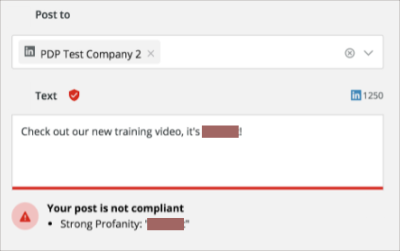
It checks all your social posts for compliance issues before you publish. You can customize the controls based on industry regulations, brand style, or your social media policy.
AI guidelines
From content creation to moderation, AI now touches almost every part of social media operations.
In fact, more than 40% of marketers are using AI to generate, edit, and refine images. And usage is even higher in heavily regulated industries.

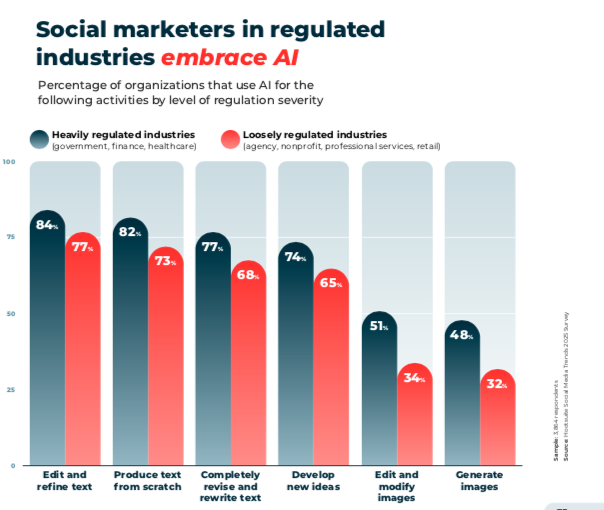
If your teams are using AI (and there’s a good chance they are), your social policy needs to define how, when, and why it’s appropriate. Clarify which tools are approved and how outputs should be reviewed, attributed, and disclosed.
“Policies now need clarity around AI disclosure and quality control,” Riswick says. “For example, is it okay for an employee to make an AI-generated picture or video that features brand elements? Is that aligned to the brand identity? Could that be a brand risk?”
You should also address whether employees can use company materials (including proprietary information) to train AI systems.
Psst: We’ve got a whole guide to AI compliance if you need help building this out. And tools like Hootsuite’s OwlyGPT learn from your existing social channels, so there’s no need to upload brand materials into a third-party training tool.

#1 Social Media Tool
Create. Schedule. Publish. Engage. Measure. Win.
Free 30-Day Trial
How to write a policy your team will actually use
Follow these five steps to build an effective social media policy:
- Work cross-functionally
- Customize for regions and business units
- Train your teams
- Audit and update on a regular basis
- Enforce the policy consistently
Psst: If you’re starting from scratch or updating an outdated document, our free social media policy template can help you organize these steps and ensure nothing gets missed.
1. Work cross-functionally
Your social media policy applies to every employee, not just the social team. You need expertise from other departments and stakeholders to get all the details right.
Be sure to consult:
- Human resources
- General counsel
- Public spokespeople
- Marketing and social teams
- Product leaders or subject-matter experts
It’s also wise to get regular employees involved. After all, this policy affects all of them.
This doesn’t mean you need feedback from every single employee. But do gather input from team leads, union reps, or employees who can represent broader groups.
2. Customize for regions and business units
A strong social media policy should stay consistent at the core, but flexible where it needs to be. Larger companies may want to create subsections that apply to specific regions or business units.
For example, a product development team might require stricter non-disclosure language, while a social team may need more brand voice guidance.
3. Train your teams
A social media policy only works if people understand it. Organizations should communicate updates clearly and include revision dates. We also recommend adding your policy into onboarding and employee handbooks.
Don’t just tell employees to read the policy. Make sure they understand why it’s important.
“I have learned firsthand that just providing the written document can make people prickly,” says Kevin Hwang, Managing Director, Ultimate Kilimanjaro. “It feels like we are encroaching on their personal space.”
Instead, he recommends taking a more personal approach.
“Sharing the reasons in a friendly, nuanced approach one-on-one has helped my people to understand the whys. Keep it clear and concise about how it links to their work, and why it matters.”
4. Audit and update on a regular basis
Social media evolves quickly, with platforms, features, and trends constantly shifting. This means your social media policy needs regular review to keep up.
Commit to an annual, biannual, or even quarterly review. This ensures your policy stays useful and relevant.
Pro tip 💡: Schedule a quarterly review with legal, HR, and marketing leadership to capture platform changes, regulatory updates, and emerging brand risks (like AI misuse or deepfake threats). This keeps the policy aligned with both your compliance requirements and your brand strategy.
5. Enforce the policy consistently
Creating a social media policy is a start. Enforcing it is what makes it matter.
A good social listening program can help you spot posts that go against your policy. It also helps orgs take action quickly and decide whether disciplinary action is necessary.
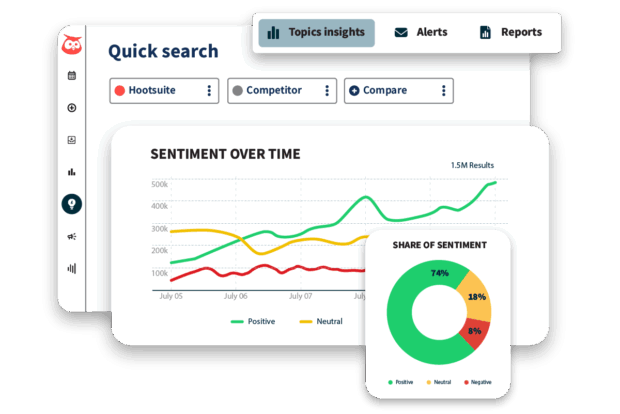
You can use Hootsuite Listening, which is built into all Hootsuite plans. It monitors for brand mentions, along with any keywords that may indicate a policy violation. You can even set up alerts to get a notification when there’s a post you need to look at.
Here’s how this can work in practice, and why it’s important:
“A relatively new team member posted a LinkedIn update to celebrate a big executive placement,” says Jon Hill, Chairman & CEO of The Energists. “No names were mentioned. But the timing and location could have been enough for some people to guess the company.”
Luckily, their monitoring process caught it.
“Our internal social monitoring caught it quickly, and we had it taken down within the hour,” Hill reports. “If that post had stayed up longer, it could have damaged a longstanding relationship or even risked legal consequences, since our work was under an NDA. Instead, the client appreciated how quickly we addressed the issue and the relationship was salvaged.”
Regulated industries often offer the clearest examples of strong, enforceable social media policies. With higher legal and compliance risk, these organizations tend to be more explicit about disclosure, confidentiality, and approval standards.
The examples below show how different organizations present guidance employees can actually follow.
1. Canadian Bar Association

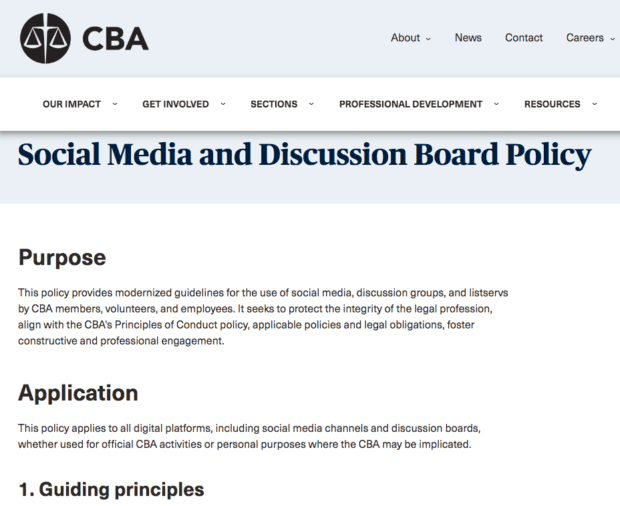
The Canadian Bar Association’s social media policy is a masterclass on how legal organizations can align social media activity with regulatory standards. The policy is detailed, clearly structured, and directly tied to relevant laws, while remaining easy to understand.
Key takeaway: “Distinguish personal opinions from official CBA positions and use disclaimers when appropriate.”
2. Tufts University

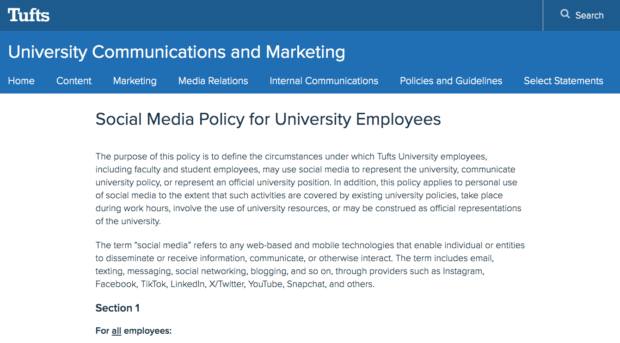
Tufts University has a thorough social media policy with clear guidelines for all employees. There’s also a more specific section for employees posting on official university channels.
Key takeaway: “If, from your social media post, it is clear you are a university employee, or if you mention the university, or it is reasonably clear you are referring to the university or a position taken by the university, and also express a political opinion or an opinion regarding the university’s positions or actions, you must specifically note that the opinion expressed is your personal opinion and not the university’s position.”
3. The International Center for Wellness

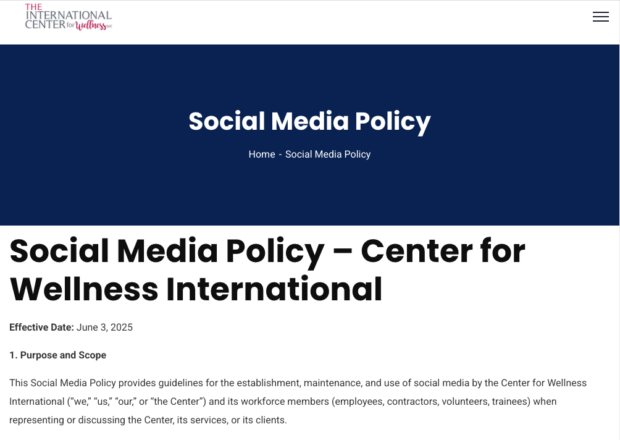
Brands in the healthcare and wellness industries have a complicated set of regulations to navigate on social media.
This policy from the International Center for Wellness narrows in on the compliance requirements around confidentiality. It also specifies the limits on social media relationships with clients and patients.
Key takeaway: “You are bound by HIPAA and Center confidentiality policies even on your personal social media. Never disclose PHI or any confidential client information. This includes avoiding posts that could inadvertently identify a client (e.g., “Just had a tough session with a client dealing with X…”).
You now have the key elements, best practices, and real-world examples to create a social media policy that protects your brand and empowers your team. The fastest way to put this into action is to start with our free social media policy template.
It’s designed for enterprise organizations and regulated industries, with a structure that’s easy to adapt to your specific needs. Use it to capture the roles, responsibilities, and guidelines covered in this guide — and ensure nothing gets missed. Download the template here and make it your own today.
FAQ: Social media policy
What is a social media policy and why do organizations need one?
A social media policy is a formal company document that defines how employees and the organization should use social media. Organizations need a social media policy to protect their brand reputation, ensure regulatory compliance, and help employees post responsibly.
What should be included in a corporate social media policy?
A corporate social media policy should define who it applies to, what counts as company-related activity, and which platforms are covered. It should speak to confidentiality, disclosure requirements, employee identification, acceptable conduct, and how to handle negative interactions. Regulated industries should also outline compliance obligations.
How do enterprises create a compliant and enforceable social media policy?
Enterprises create enforceable social media policies by collaborating across legal, HR, communications, and compliance teams. The policy should reference relevant laws and industry regulations, and outline consequences and reporting pathways so enforcement is consistent. Most importantly, the social media policy should be updated regularly.
What is the difference between a social media policy and social media guidelines?
A social media policy defines the rules for posting online. It focuses on legal protection, compliance, confidentiality, and risk. Social media guidelines, on the other hand, help employees understand how to communicate well online — including tone, voice, and best practices.
What are some social media policy examples for regulated industries?
Social media policy examples in regulated industries include policies from the Canadian Bar Association, Tufts University, and the International Center for Wellness. These policies include disclosure requirements, confidentiality guardrails, and when employees should note personal opinions from official positions.
Manage and execute your social media strategy using Hootsuite. From a single dashboard, you can schedule and publish posts, engage your followers, monitor relevant conversations, measure results, manage your ads, and much more.