




Table of Links
Abstract and 1. Introduction
-
Some recent trends in theoretical ML
2.1 Deep Learning via continuous-time controlled dynamical system
2.2 Probabilistic modeling and inference in DL
2.3 Deep Learning in non-Euclidean spaces
2.4 Physics Informed ML
-
Kuramoto model
3.1 Kuramoto models from the geometric point of view
3.2 Hyperbolic geometry of Kuramoto ensembles
3.3 Kuramoto models with several globally coupled sub-ensembles
-
Kuramoto models on higher-dimensional manifolds
4.1 Non-Abelian Kuramoto models on Lie groups
4.2 Kuramoto models on spheres
4.3 Kuramoto models on spheres with several globally coupled sub-ensembles
4.4 Kuramoto models as gradient flows
4.5 Consensus algorithms on other manifolds
-
Directional statistics and swarms on manifolds for probabilistic modeling and inference on Riemannian manifolds
5.1 Statistical models over circles and tori
5.2 Statistical models over spheres
5.3 Statistical models over hyperbolic spaces
5.4 Statistical models over orthogonal groups, Grassmannians, homogeneous spaces
-
Swarms on manifolds for DL
6.1 Training swarms on manifolds for supervised ML
6.2 Swarms on manifolds and directional statistics in RL
6.3 Swarms on manifolds and directional statistics for unsupervised ML
6.4 Statistical models for the latent space
6.5 Kuramoto models for learning (coupled) actions of Lie groups
6.6 Grassmannian shallow and deep learning
6.7 Ensembles of coupled oscillators in ML: Beyond Kuramoto models
-
Examples
7.1 Wahba’s problem
7.2 Linked robot’s arm (planar rotations)
7.3 Linked robot’s arm (spatial rotations)
7.4 Embedding multilayer complex networks (Learning coupled actions of Lorentz groups)
-
Conclusion and References
3.2 Hyperbolic geometry of Kuramoto ensembles
In 1994. Watanabe and Strogatz [69] demonstrated that the simple Kuramoto ensemble with globally coupled identical oscillators exhibits 3-dimensional dynamics. They have shown that dynamics of a large ensemble can be reduced to the system of ODE’s for three global variables. This implies that an ensemble consisting of N oscillators admits N − 3 constants of motion. This result initiated the new research direction which deals with symmetries and invariant submanifolds in simple Kuramoto networks.
The underlying symmetries have been exposed in 2009. by Marvel, Mirrolo and Strogatz [70].
Proposition 1. [70]
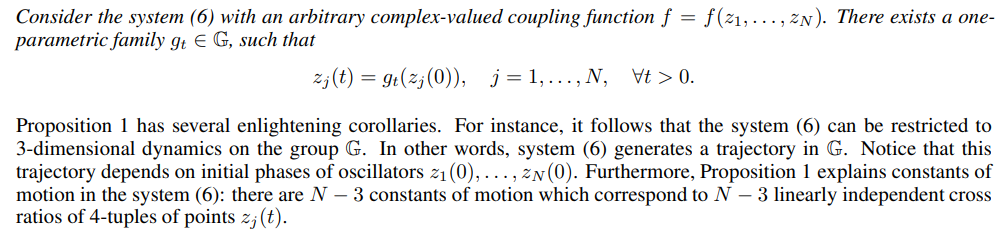

Further insights into the relation between hyperbolic geometry and Kuramoto models have been reported in [71]. It has been demonstrated that (under certain conditions on the coupling function f) Kuramoto dynamics of the form (6) are gradient flows in the unit disc with respect to hyperbolic metric. Potential function for dynamics (7) has particularly transparent geometric interpretation. It turns out that dynamics of Kuramoto ensembles with repulsive interactions uncover a point inside the unit disc that has the minimal sum of hyperbolic distances to the initial points on S1. In complex analysis this point is conformal barycenter [72] of the initial configuration.
:::info
Author:
(1) Vladimir Jacimovic, Faculty of Natural Sciences and Mathematics, University of Montenegro Cetinjski put bb., 81000 Podgorica Montenegro (vladimirj@ucg.ac.me).
:::
:::info
This paper is available on arxiv under CC by 4.0 Deed (Attribution 4.0 International) license.
:::


