Most people in crypto see one part of the cycle. They get in, something happens, they get out.
I stayed for the whole thing. Launch, growth, peak, the slow deterioration you try to explain away, and the end. Three years inside a single project. I still do not know exactly what to make of it, but I will try to write down what I saw.
September 2022
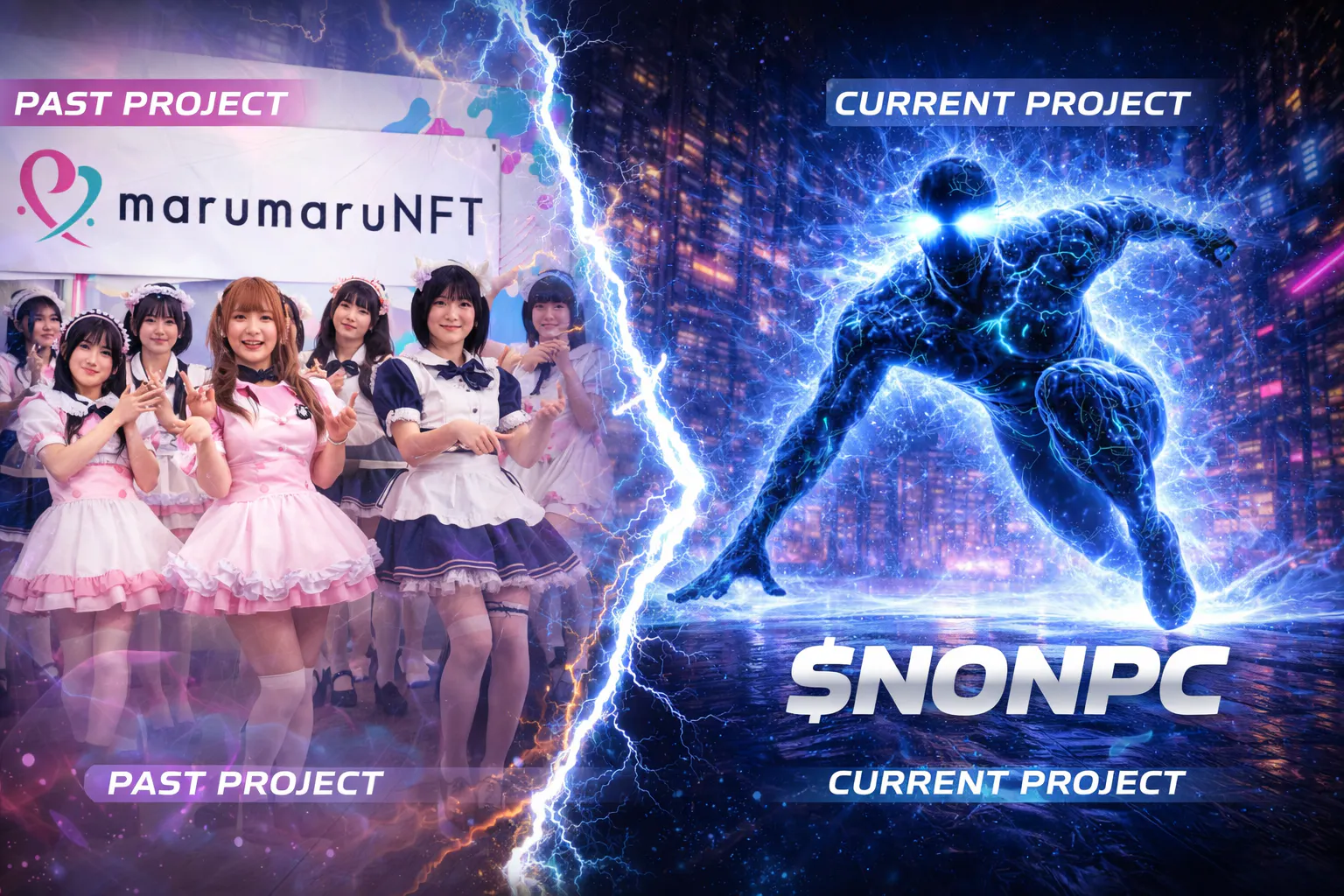
I launched marumaruNFT with genuinely low ambitions.
I had been investing in IDOs since around 2020. The pattern was always the same: buy a token, watch it drop 90% within a few months. I did this ten times in a row. Ten tokens, all down more than 90%.
At some point I noticed something that I am not proud of noticing: tokens have a property that stock equity does not. When a token price collapses, the issuer’s obligation to return capital basically disappears. If someone buys $10,000 worth of your token and it drops to 1/10 of its value, you only need to return $1,000 worth of value to make them whole. That math interested me before the building did.
That was my starting mindset. Small and a little cynical.
The presale raised over $100,000 anyway. The IDO boom was already fading, but money came in. Then more money came in. I was a first-time builder who had never designed a protocol before, and the numbers were going in a direction I did not fully understand. Peak liquidity hit approximately $6,000,000. The token appreciated roughly 500x from presale pricing over about twelve months. We got listed on CoinW. A Tokyo Stock Exchange-listed company filed two formal regulatory disclosures about their partnership with us. U.Today and Bitcoin.com covered the project editorially.
I did not have a framework for what was happening. I just watched it and kept building.
The Thing I Was Trying to Build
I had watched enough DeFi protocols collapse by this point to have a theory about why.
Hyper-APY, Play-to-Earn, liquidity mining — all of these inflate token supply while the underlying asset base stays the same. Prices can only go one direction under that pressure. The protocols were engineering their own decline. I thought I understood the problem.
My answer was: build a company. A real business generating real revenue. If the NFT marketplace worked, there would be an actual reason for the token to hold value that did not depend on how many new buyers showed up today. That was the thesis.
It failed.
The NFT market collapsed broadly during this period. The marketplace business model turned out to be weaker than I had modeled. And NFTs had product problems I probably should have weighed more heavily from the start. People perceived them as just image files. The usability was poor. The reputational deterioration was faster than I expected.
I sometimes think about whether building around AR or VR instead of NFTs would have changed things. Maybe. I cannot prove it. The decision to build around NFTs constrained everything downstream in ways that only became clear much later, when it was too late to pivot cleanly.
When the business failed, the token had nothing holding it up. In December 2025, MARU was delisted.
It was not fraud. Third parties with their own due diligence processes — a regulated exchange, a TSE-listed company, international crypto media — had all verified the project before associating with it. They checked. The project passed. Then it failed for other reasons.
Many investors who entered late lost money. That is true, and I am not going to minimize it. The critical assessments of me that still exist online are fair. That is a significant part of why No NPC Society ($NONPC) has to work. It is the closest thing I have to an honest response to the people who were hurt.
What I Got Wrong
I could list this cleanly. Four bullet points, each one a lesson. But that would make it look more organized than it actually was, and I think the disorganized version is more useful.
The first thing I got wrong was confusing price performance with design validation. Twelve months of upward price movement felt like evidence that the architecture was correct. It was not. Bull markets hide problems. By the time those problems became visible, the decisions that created them were already locked in. I had no way to evaluate the design independently of whether the price was going up, and I did not try to.
The second thing: I had $6 million in liquidity, and I treated that number as though it were a permanent property of the project. It was not. It was a snapshot of participant confidence and market momentum at a particular moment. When confidence weakened, the liquidity left. I had no mechanism that made it stay. I just had a large number, and I mistook its size for permanence.
The third thing I got wrong was harder to see while it was happening. Attention — media coverage, event participation, community energy — was doing more structural work than I realized. I thought the NFT marketplace would eventually replace it as the engine. It did not. And when attention faded, and the business failed, there was nothing else.
I know these things now. I did not know them clearly then. I learned them by living through the consequences.
NONPC: What I Built After
After MARU, I made one firm decision: no product.
I had seen what happens when a token’s survival depends on a product working. I did not want to build that again. But I also came out of that experience with a conviction: a token that can only sustain itself through continuous external inflows is not structurally different from a liquidity mining scheme. The energy source is still attention and momentum, just dressed up differently.
So the question became whether a protocol could generate its own capital without a traditional product. That question produced the two engines inside No NPC Society.
ACE — Awakening Creator Engine — generates capital from the community’s creative activity.
It runs as a recurring NFT contest. Community members submit original works, the community votes to select winners, and winning works are minted as NFTs and sold. The revenue split is fixed in the published specification and enforced on-chain: 50% goes directly to the creator. The remaining 50% enters a treasury, of which 80% is injected into the NONPC/SOL liquidity pool within 7 days of settlement, and 20% goes to DAO and operational funds.
No external capital required. Every transaction is disclosed publicly on-chain.
AFX — Awakening Flywheel Experiment — compounds existing liquidity using trading fees instead of new token issuance.
Every trade generates fees. A program-controlled smart contract account collects those fees automatically, rebalances them to match the current pool ratio, and reinvests them as permanently locked LP positions. No new tokens. No inflation. The only energy source is fees from real trading activity.
The execution is constrained to prevent the protocol’s own operations from destabilizing the market: maximum once per week, size capped at 0.5% of pool SOL reserves per execution, 0.5% slippage cap, retry logic that reduces execution size from 100% to 70% to 50% on failure, with random delays of 2 to 4 hours between attempts to eliminate timing predictability.
When trading continues, locked liquidity grows. When trading stops, growth stops. But locked liquidity does not leave. That is the thing MARU was missing.
I want to be clear about what this does and does not solve. AFX compounds what exists. It does not manufacture value from nothing. If there is no trading activity, there are no fees to compound. What it does is prevent the specific failure mode I watched in MARU: liquidity that evaporates the moment external confidence drops.
Whether that is enough to build something that lasts, I genuinely do not know yet. This design is still being tested in real market conditions.
The Record
The failure does not disappear. The people who lost money do not disappear.
What I can do is document it honestly and make the next design verifiable. Every NONPC specification is publicly versioned on GitHub. Every on-chain state can be checked by anyone. The treasury wallet addresses are documented. The LP lock conditions are public.
If NONPC works, the reasons will be traceable. If it fails, too, that will be on the record as well.
That is what I owe.
References
- marumaruNFT Full Record: https://github.com/NoNPCSociety/nonpcsociety.github.io/blob/main/docs/marumarunft-record.md
- AFX Technical Specification: https://github.com/NoNPCSociety/nonpcsociety.github.io/releases/tag/afx-v1.0.2
- ACE Public Specification: https://github.com/NoNPCSociety/nonpcsociety.github.io/releases/tag/ace-v1.1
- No NPC Society Official Site: https://nonpcsociety.com
- Founder Reflection Essay: https://medium.com/@info_nonpcsociety.com/i-failed-once-nonpc-is-what-i-learned-2fd70084e3e3