An essential requirement for an energy and digital transition to occur in Spain is that there are enough engineers to cover demand.
Although it is true that there are more and more degrees that have the last name of engineering, the reality is that there are fewer and fewer professionals with the legal capacity to carry out the transformation of the state, as stated in the III Report of the Institute of Graduates in Engineering and Technical Engineers of Spain. In addition, the offer is being concentrated in specific communities. And that is a problem.
Why is it important. Enabling engineering is that which grants legal powers for infrastructure and safety, for example what is behind ensuring that a bridge does not fall. With classic branches such as Civil, Mining or Naval Engineering decimated, Spain would lose autonomy and competitiveness by having to resort to imports to sign its essential projects. Jose Antonio Galdón, president of INGITE, delves into the consequences of this fact: “On the students, who access Degrees with the title of Engineering without a clear career path, and on society, which needs engineers with powers and responsibility to guarantee the safety, quality and sustainability of infrastructures and services.”
On the other hand, the lack of complete supply in certain communities forces talent to emigrate, emptying technical capacity to regions that need engineering professionals to develop and establish their industry.
Engineers are going to be needed. Two decades ago, those studying engineering represented 24% of the total university students and today that weight has fallen to 17%, as detailed by the COIGT. Engineering is the one that has lost the most students and this is also concentrated around computer engineering and emerging technological branches. Although the global female quota in engineering is 23%, it is precisely in these branches where it is most concentrated.
On the other hand, Engineering such as Mining and Energy, Topography, Civil or Naval continue to decline and in some Autonomous Communities they already have less than 10 graduates. Although there are thousands of graduates each year, it is estimated that in Spain there will be a deficit of 200,000 engineers in the next decade to meet demand.
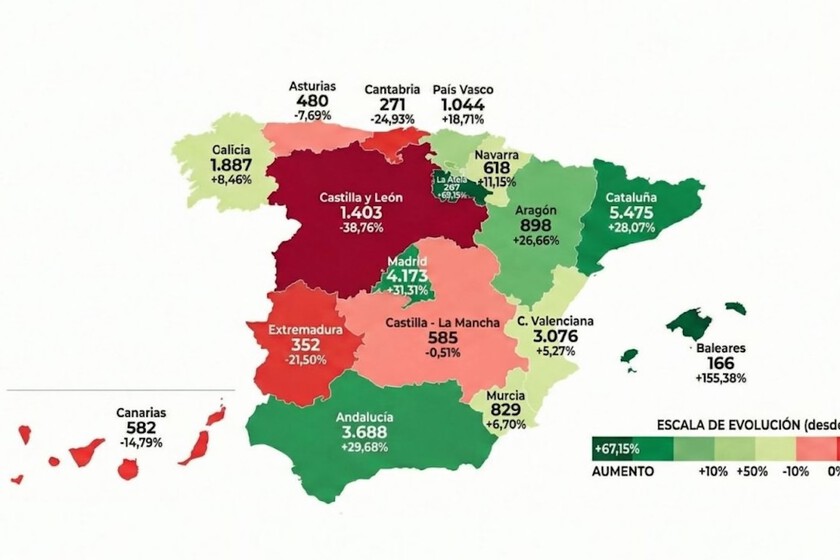
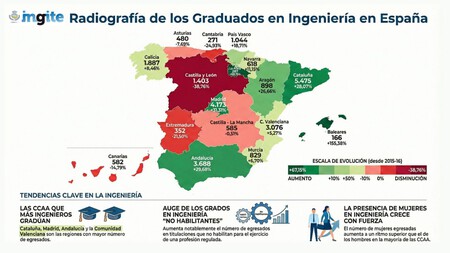
More engineering but less enabling. The IGNITE report confirms a phenomenon that has been recorded in previous analyses: non-qualifying degrees, that is, those that do not allow the exercise of the regulated profession, have increased massively and now reach 53% of the total. On the other side of the scale, those enabling them are stagnating and even decreasing in some autonomous communities. The decline has been especially serious in places such as Asturias (-28.56%), Castilla y León (-28.79%) or Extremadura (-34.02%).
The report makes a special mention: La Rioja. The small upstate community takes the cake with explosive 190% growth in engineering. But in small print: the fault lies with the non-qualifying degrees, which have grown by 431%, going from 433 to 2,289 enrolled. At the opposite extreme is Extremadura, which has the greatest drop in students, with 20.25% less.


Engineering students from CCAA in Spain. INGITE
Spain at two speeds. According to the report, the Autonomous Communities that concentrate the largest number of engineering students and graduates are in Andalusia, Catalonia, the Valencian Community and the Community of Madrid. In addition to obviously because its population is larger, also because only Andalusia, Madrid and Catalonia have all the branches of engineering, revealing a territorial inequality in access to studies.
The gap between public and private. The phenomenon of non-qualifying degrees is especially important in private universities, a type of center that is growing uncontrollably in the state, although unevenly. Thus, while in the Balearic Islands, Castilla-La Mancha and Extremadura there is no this type of center and Galicia opened the first in 2022-2023, in Madrid there are 13 according to data from the Community itself. Since the 2015 – 2016 academic year, the autonomous communities where the number of degrees in private entities has grown the most has been Andalusia (from two to nine), Aragón (from three to nine) and La Rioja (from two to seven).
In WorldOfSoftware | If the question is which countries have the most workers with higher education, the answer is not Spain
In WorldOfSoftware | The university degree with the most job opportunities in 2025 looks into a great abyss: that of a future conditioned by AI
Portada | INGITE