




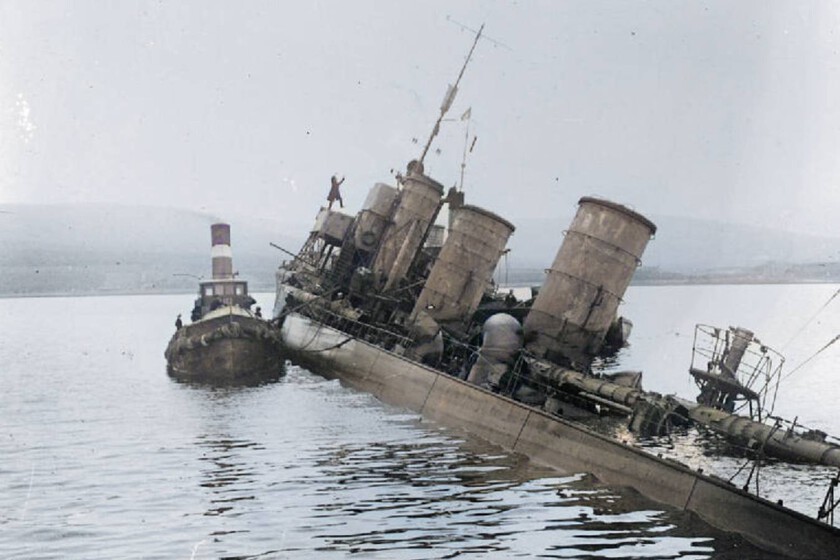
At 11:20 in the morning of June 21, 1919, Admiral von Reuter’s ship began to signal to the rest of the German ships in Scapa Flow Bay, England. The taps and water intakes were opened, the pipes were destroyed, the portholes were dismantled: no one noticed anything. Until around midday, the Friederich Der Grosse began to list to starboard.
It was already late, the German flag was flying from the 74 masts.
Scapa Flow. The image tells the story of Scapa Flow, the sinking of the German fleet immediately after the First World War. While the Allies negotiated the terms of the Armistice with Germany, the fleet was held captive and stationed off the British coast. Von Reuter feared that the Allies would divide up the ships, so he decided to sink it completely, at any cost.
The British naval ships that were on maneuvers arrived at 2:30 p.m. and were only able to save one ship. The last to sink was the battlecruiser Hindenburg. Nine Germans were killed, 16 were wounded, 1,774 were detained. 52 ships were sunk on June 21 at Scapa Flow. But they are no longer there: they are on the Moon, Jupiter and beyond the orbit of Pluto.
steel is steel. A tough guy, with bad temper and few words. But in 1945 (or a little before), everything changed. We didn’t realize it at first, but we quickly discovered that although all steels are equal, there are some steels that are more equal than others. I’m not going around the bush: what happened in ’45 was the atomic bomb, the device of the Devil that made us change the geological era.
The problem. Since the first atomic bombs exploded on the Earth’s surface, the air contains traces of radioactive elements. They are there, dissolved in it, but the amount is so small that they are harmless. Unless for some strange reason you have to blow in enormous amounts of air in the manufacturing process of some material.
It’s almost useless to us. That is, all steel manufactured after the explosion of the first atomic bomb is radioactive. Very little, almost nothing. But enough so that some medical, physical or astronomical instruments do not work correctly. For example, radioactivity monitoring systems used by spacecraft.
It is told by David Bodanis in “E = mc². Biography of the most famous equation in the world”, a book that, although it has become somewhat outdated, is still a delight. You may have heard the story, but it’s a good story.
Steel = expensive. In the book, Bodanis explains that, faced with this problem, uncontaminated steel became very expensive. Above all, because before ’45 we did not make steel in quantities tan industrial as now. I imagine dozens of NASA engineers rummaging through their family’s cutlery so they can send reliable machines into space. Until someone remembered Kaiser Wilhelm’s ships.


The peculiarity of Scapa Flow. There are sunken ships in many places, but there are not many shallow inlets with 52 sunken ships in their waters. Not all of them were there, but a few were enough for us to manufacture the equipment that the Apollo mission left on the lunar surface, that which the Galileo probe took to Jupiter, and that which the Pioneer probe is taking even further. The evil, the sea.
In WorldOfSoftware | Quantum find in Cambridge points to solar ‘Holy Grail’: single-material solar panels
In WorldOfSoftware | The Atacama salt flat is the key on which the electric car industry pivots. And it’s starting to dry


