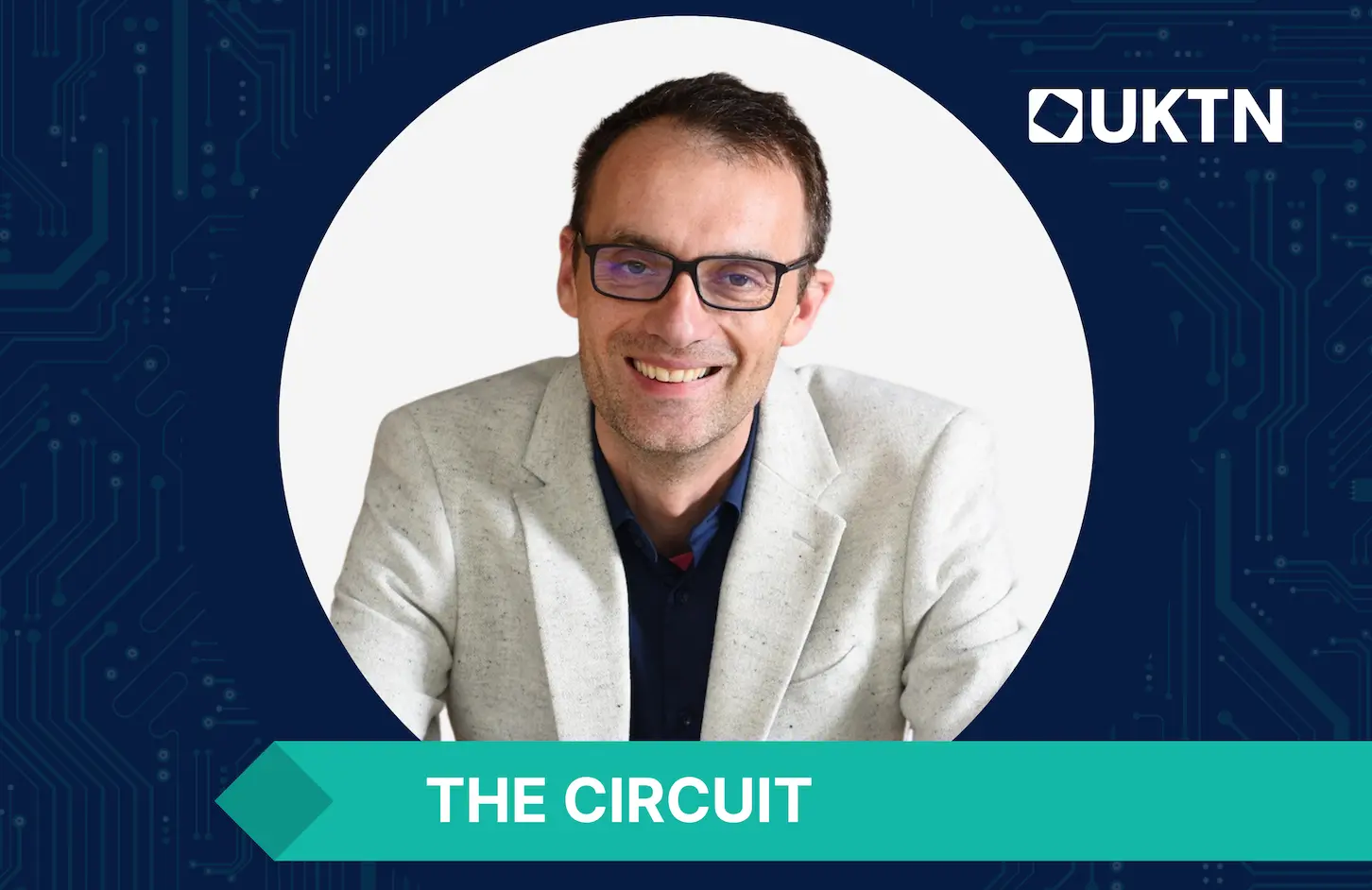
Welcome to The Circuit series. Meet our next interviewee:
Your browser does not support the video tag.

Among the fields perhaps most ready for AI-driven efficiencies is industrial engineering, which has already for years now been using automated software to make improvements.
For companies like Monumo, which in 2024 emerged from stealth with more than £10m in funding, the use of AI in the design process of mechanical engineering represents an enormous opportunity.
Monumo provides engineers with its proprietary AI engine Anser, which is used to explore various design tweaks based on millions of simulations run daily.
In this exclusive interview with UKTN, Jarek Rzepecki, the recently appointed chief executive officer of Monumo, discusses how his illustrious background at firms ranging from Codemasters to Arm to Microsoft has prepared him for his current role, how he sees AI impacting engineering and where else the technology could go.
What learnings from your experience did you take to your role at Monumo?
At Codemasters, I learned what it takes to ship production-quality software under real constraints.
Arm taught me the importance of getting architectural decisions right early, especially when building a complex new library from the ground up.
At Microsoft, working on a reinforcement learning project showed me how to bridge the gap between researchers pushing the frontier and engineering teams that need things to work at scale.
That ability to translate between research ambition and engineering pragmatism is essentially what we do at Monumo every day. Above all, each role reinforced that great technology only matters if you build a team capable of delivering it.
What drew you to Monumo?
It was the combination of a genuinely hard scientific problem, a mission that matters, and the challenge’s interdisciplinary nature. After years at large organisations, I wanted to build one myself – see it grow, shape its culture and technology.
I also really like the diversity of work – at a startup, you need to wear many hats working across technology, management, investment relations, and talking to customers – no day is ever the same!
Do you see AI incorporation as a future standard in motor engineering?
Absolutely. Traditional design relies on finite-element analysis and iterative manual tuning, which limits the number of design variants an engineer can realistically evaluate.
AI changes that equation – it can explore millions of candidates and find non-obvious trade-offs that a human would never think to try. The key is to tightly couple AI with physics-based simulation so that the results respect the underlying electromagnetic, mechanical, and thermal constraints.
I believe this physics-informed AI approach will become the standard way of working within the next decade.
As the new CEO, where do you see the future of Monumo under your leadership?
Our technology is already proving its value with customers, so the priority is scaling that commercial traction and the technology that enables it. This means more partnerships and a deeper impact on real production workflows.
I want Monumo to become the default design intelligence platform for electric motors across EVs, home appliances, industrial, and robotics.
Beyond the work of Monumo, what areas do you see as the most improvable using AI?
Scientific discovery more broadly is the obvious one.
AI can dramatically accelerate the search for better solutions in any situation where you have expensive simulations and high-dimensional trade-offs – whether that’s drug discovery, materials science, or energy system design.
Education is another area where AI’s ability to provide personalised feedback at scale could be genuinely transformative, particularly for people without access to world-class institutions.
Healthcare diagnostics is already showing remarkable results, with AI matching or exceeding specialists in areas like medical imaging.
Finally, climate and energy – optimising power grids, improving battery chemistry, making buildings more efficient – where speed genuinely matters given the timeline we’re working against.