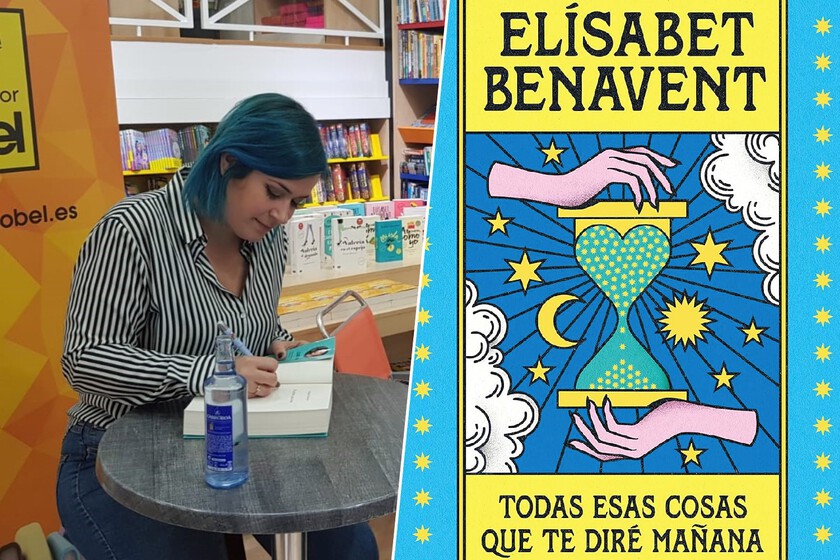
Elisabet Benavent has just surpassed five million copies sold in Spain, which places her among the most read fiction writers in the country in the last decade, a success comparable to that of much more established names on the Spanish publishing scene. However, while his books occupy bookstore windows and Amazon‘s best-seller lists, his name barely appears in cultural supplements or debates about the state of Spanish fiction.
The perfect moment. Benavent’s story begins on January 3, 2013, when he uploaded ‘In Valeria’s Shoes’ to Amazon for 2.68 euros. There was no plan or strategy: it was the resource of those who did not have a large publishing house behind them. But it was the ideal time for self-publishing: Kindle Direct Publishing had arrived in Spain just two years earlier, in 2011, and digital self-publishing still carried the stigma of being “the alternative for those who can’t make it.” But at that time the publishing ecosystem was changing.
Travel companions. Benavent was not the only one. Javier Castillo, today one of the most read and adapted thriller authors, began by self-publishing. Eva García Sáenz de Urturi, winner of the Planeta Prize in 2020, also went through Amazon before the big publishers signed her. The pattern of “success in digital, subsequent legitimation via traditional publishing” is also repeated with Benavent: Suma de Letras (Penguin Random House label) later opted for the ‘Valeria’ saga, but by then Benavent was no longer a hidden talent, but a product validated by tens of thousands of readers.
We said above that Benavent has achieved success without appearing in cultural supplements, but success is already measured in another way: through Amazon reviews and recommendation algorithms, not with what established critics say. However, despite the dizzying sales figures, the target audience of the romance genre (mostly women aged 25 to 45) has historically been ignored by traditional literary criticism, and what millions of female readers read does not count as a cultural phenomenon.
Constant writer. But… what is its success due to? Twenty-three novels in eleven years: we are not talking about an isolated stroke of luck or a single work that triggers the phenomenon, but about a narrative machinery that works with the regularity typical of a franchise. The ‘Valeria’ saga sold 1.2 million copies, but it was the subsequent trilogies (‘My Choice’), the bilogies (‘Silvia’, ‘Songs and Memories’) and the independent titles (‘A Perfect Tale’, ‘Esnob’) that consolidated the empire.
The formula. Very recognizable: urban female protagonists, in their thirties, professionals with work or sentimental crises and who suffer from contemporary emotional conflicts. There is no formal innovation or narrative experimentation, because Benavent does not intend to reinvent anything, but rather to use the tools of the romantic genre in accessible and direct novels: agile dialogues, humor, happy endings. It’s formula literature executed effectively, and its audience knows exactly what to expect.
And the highlight is Benavent’s own constant and close activity on social networks under the nickname BetaCoqueta. There she shares her creative process and generates a community of faithful who tirelessly recommend her on networks like TikTok.
Netflix adaptations. They have exponentially accelerated their success: ‘Valeria’, which already has four seasons and was followed by ‘Fueimos songs’; ‘A Perfect Tale’ was number 1 in 2023 for weeks. And book sales accompany: these can skyrocket by 40% after the release of their audiovisual versions. But it is a relationship that goes in two directions: the platforms also benefit, having identified in the romantic novel a mine of content, with audiences already convinced and without having to invest too much (Prime Video did it with Mercedes Ron and her ‘Guilty’ trilogy).


The abyss As the lists of best-selling books in Spain show, the gap between commercial success and critical recognition has widened to the point of becoming an abyss. Thrillers, romantic fantasy, youth sagas: everything that really moves the Spanish publishing market takes place in a parallel dimension, different from the one supposedly analyzed by cultural criticism. How many authors sell hundreds of thousands of copies without any cultural supplement mentioning them? How many entire genres function as million-dollar industries, regardless of major promotions? Elisabet Benavent is not an anomaly, and that is the real crux of this matter.
Header | Ariaglz on Wikipedia