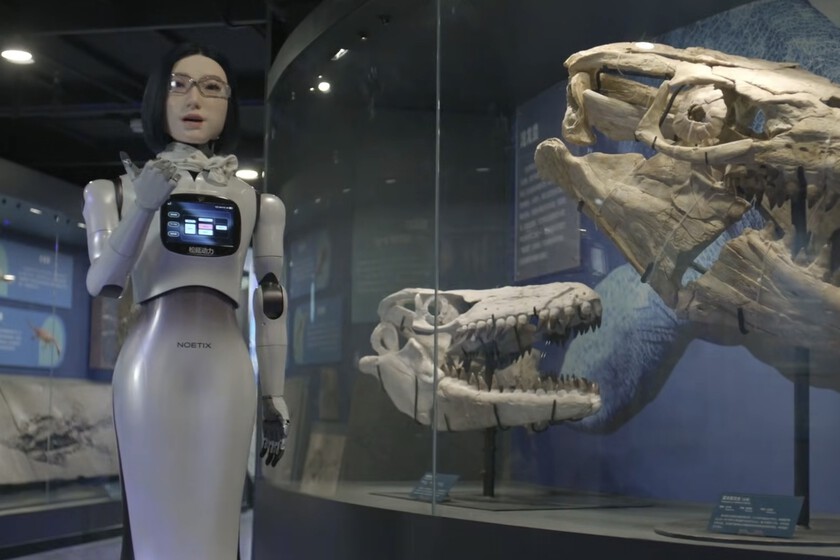
There are those who are clear that, not long from now, robots will be like today’s smartphones: we will all have one. There is still time for prices to become so democratized as to reach that point, but if there is a country that has taken the lead in pushing humanoid robotics, it is China. And the Hobbs W1 is the latest example: a humanoid robot with a human face, and hands capable of performing fine motor work.
And they have already put it to work.
Hobbs W1. A far cry from Star Wars robots and closer to the uncanny valley. Hobbs W1 still looks like a robot, but the fact that they have given it a face and a body with an absurdly stylized female silhouette is a declaration of intent: they want us to feel “comfortable” with their presence.

Very low on the evolutionary scale of robots are those tray holders (or Sardinator) with faces that look like emojis and cat ears: the Hobbs W1 does not have legs, but it does have a face, upper joints and a screen. They are tools that are used to give instructions to people.
Because Hobbs W1 is already working and its managers, the Beijing-based Noetix Robotics, are targeting a very clear segment: commercial spaces where it can guide clients, answer questions and perform reception tasks.
great players. Noetix is one of the many – many – Chinese startups that the country itself is promoting. China’s strategy is to become a robotics power (technological, in general, especially driven by the ‘Delete A’ plan), and although there are many companies, we can already talk about very prominent names.

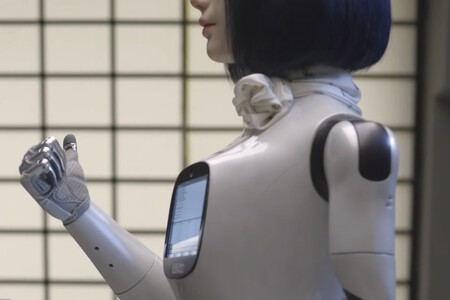

Hobbs W1
Unitree, UBTECH and AgiBot are estimated to practically control the humanoid robot market in China. It is still a small market, but these three companies are looking to position themselves as soon as possible. Its key is the ability to manufacture at scale, but also specialization:
- Unitree may be the best known name. The most direct comparison would be with Boston Dynamics, since it has its ‘robodog’ – the Unitree Go2 – and its humanoid, the G1. Unitree is already selling units to end customers. In fact, you can Buy that Go2 on Amazon.
- UBTECH It has the Walker S1, a robot focused more on professional use. It is the one that directly seeks to replace humans on assembly lines and, in fact, is already working in one of the Geely plants – manufacturer of electric cars -.
- AgiBot It is the third in contention. Instead of being specific, it has specialized in being multiplatform and going to volume so that they can do tasks in different sectors. It has humanoid robots from its X series, but also much more specialized ones from the A and G series (although they also give them faces to humanize them.


Imagen: Unitree.
Muscle and brain. These companies are closely linked to the development of another of China’s priorities, artificial intelligence, but there is a fourth that stands out for its focus. It’s Galbot, and he’s taken a less conventional route. Instead of focusing on promoting its robots as mountebanks or capable of lifting heavy weights in factories, Galbot has developed multimodal AI models with one thing very clear in mind: that they can already serve humans in the real world.
When we talk about topics of this type, it is always difficult to know to what extent it is smoke, promises or there is someone in control behind the scenes. In the case of Galbot and his G1, I can say that, although slow, it works. It already operates a store of just 10 m² in Beijing and you can order drinks perfectly. There is no human nearby and the company plans to expand with more than a hundred automated stores throughout the rest of Beijing, Shanghai and Shenzhen.


From the laboratory to the store. Therefore, the Hobbs W1 is just one more of those humanoid robots that China has already put to work. And the truth is that it contrasts with what we see in the West. We have been talking about robotics for many years, but the proper names were different. China has arrived later in this race, but has managed to position itself as the country to beat.
And the reason is your approach. While Tesla promises to have “many” Optimus and Boston Dynamics continues to show its Atlas performing jumps, Chinese robots are already in stores, but also walking around the subway supplying 7 Elevens or extinguishing fires alongside real firefighters. The vast majority of the startups that are starring in the conversation have been created in the last two years and make it clear that the country is very interested in leading the sector.
It’s not only for fardar. And it may not just be a strategy to demonstrate technological muscle. We have been saying it for months: China faces a future with many more elderly people and, as a consequence, much less labor. They have a tremendous youth unemployment rate, but even so in the medium term the country faces a spectacular demographic contraction.
Putting the elderly to work is an option – also in Japan – but at a certain point, and with a low birth rate, only the elderly working is not an option. That is where the country’s strategy comes into play: leading the conversation in robotics, attracting talent and, in addition, developing robots that can fill the job gap that is anticipated in a few years.
Stepping on the accelerator. In whatever way and for whatever reason, it is clear that both the country and the startups are in a hurry. It is estimated that 800 humanoid robots will be sold in 2024 compared to more than 4,000 in 2025. By 2045, the projection is that they will have more than 100 million operational units with a market of 1.4 billion dollars.
And the main advantage is that economy of scale, the national push and being able to access key elements in the domestic market, such as the batteries that China leads or rare earth components. What is evident is that Chinese botos are no longer an idea, but an industry.
Images | Noetix Robotics at BliBliBli
In WorldOfSoftware | Huawei and SMIC find the key to creating 7nm chips: do an ‘Ikea hack’ to the oldest ASML machines