If that icy land called Greenland was historically already a strategic enclave, with the second term of Donald Trump it has returned to the fore with more force than ever: the United States wants to annex that territory belonging to Denmark and there are a few reasons: from the enormous amount of rare earths that it hides to the magnificent surveillance point that it constitutes there, in the North Atlantic, between the United States, northern Europe or Russia. In fact, it already has plans to mount a new radar.
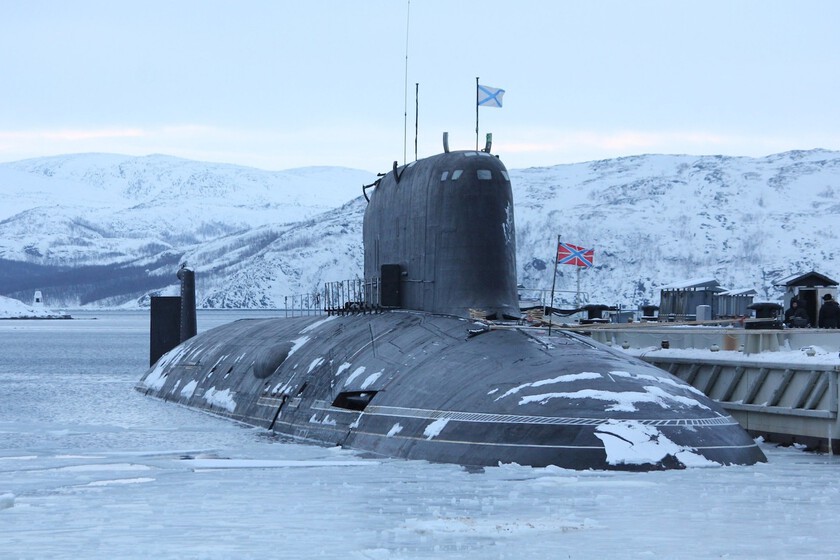
The moment has arrived not only because Trump has returned to the presidency, but because global warming and the consequent thaw has generated a kind of new polar “Silk Road” through which China wants to pass, the US wants to control and Russia does not want it to control, from what it would mean from a strategic and competitive point of view. But that thaw has also left something else visible: nuclear submarines.
The Arctic is melting. January 2026 was the warmest January ever recorded in western Greenland. In Nuuk, the capital of the island of Denmark, the average temperature was 7.8 °C above usual. In other locations bathed by the Arctic such as Baffin Bay, the Barents Sea or Svalbard, thermometers frequently exceeded +15°C above the average in those areas.
The melting is breaking records but unfortunately, it is not an isolated phenomenon, but rather follows the accelerated trend that the scientific community has been documenting for years. And geopolitically, the mercury is also red-hot.
Why is it important. In short, because of the geopolitics of the thaw. Directly, it has consequences in the form of:
- Maritime routes. The opening of the Arctic on both the Canadian and Russian sides brings a notable reduction in distances between Asia, Europe and North America, which affects trade on a planetary scale.
- Natural resources. With the thaw, it is easier to access oil, gas, rare earths and other critical minerals for the technology industry and industry in general.
- Military security. This thick layer of ice has functioned for decades as a shield to make nuclear submarines invisible. When the ice is thinner, detecting them becomes an easier mission.
Down the periscope. John Methven, professor of atmospheric dynamics at the University of Reading, explains to the Financial Times that as Arctic sea ice “shrinks and retreats, it becomes more difficult to hide warships. This is changing the strategic landscape in the Arctic.”
Without going any further, the New York Times echoes at least 33 Russian military maneuvers in the Arctic, according to the Center for Strategic and International Studies. The Russian nuclear submarine base on the Kola Peninsula and its growing exposure is becoming more and more blatant, so much so that it already equals and even exceeds Cold War levels, reports the United States Naval Institute. However, the United States fleet is also being seen at a docking in Reykjavik in July of last year. But Russia is also doing its homework: according to the Washington Post, it has secretly built a network of underwater sensors to monitor what is happening.
Temperatures rise, tensions rise. Climate change is not “only” an environmental problem, but its consequences multiply geopolitical tensions: where the ice melts, competition between powers appears.
In WorldOfSoftware | The US is preparing a new radar for Greenland with one objective: to monitor every movement of Russia and China in the Arctic
In WorldOfSoftware | Now that Europe has sent its troops to Greenland, a question emerges that no one wants to ask: what happens if the US invades it?
Cover | Mil.ru, CC BY 4.0, Wikimedia Commons