




In World War II, the Soviet Union produced more than 100,000 tanks, many of them technically inferior to the German ones, but enough to tip the balance of the conflict. Because sometimes in war, the deciding factor is not sophistication, but how many times you can repeat the same move.
Win by forcing take off. The conflict with Iran has exposed an American paradox, yet another, most uncomfortable one: the largest military power in the world can destroy targets with unprecedented precision and speed, but has enormous difficulties in sustaining the defense against much simpler and cheaper threats.
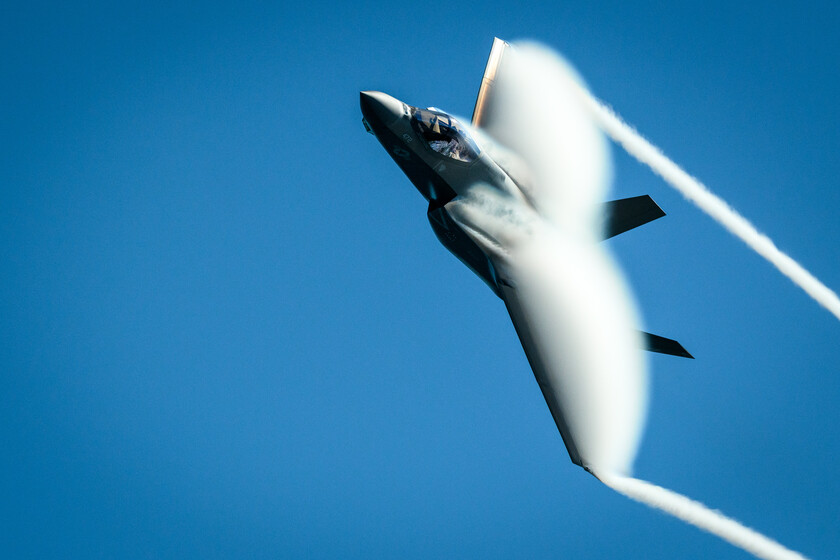
Because instead of trying to shoot down fighters or directly confront American air superiority, Iran has adopted a different logic, one much closer to (or exactly the same as) what Ukraine has perfected in its war: saturate the enemy system. Each drone launched does not seek to impact so much as to force a response, to activate radars, to take off fighters, to, in short, consume resources. The key, therefore, is not the individual damage, but the accumulated wear and tear to which it is subjected.
The mathematics of combat. It’s as simple as a matter of numbers. The core of this strategy is purely economic. Drones that cost tens of thousands of dollars force us to use million-dollar interceptors or keep planes in the air whose operational cost per hour already far exceeds the value of the objective they pursue.
The result is a deeply unequal exchange in financial terms, where each defense is a small major economic defeat. The image is crystal clear, because using elite technology to counter low-cost threats is equivalent to spending high-end resources on problems that, first, do not justify it, and second, create an unsustainable dynamic in the long term, even for an army with the most monstrous budget like that of the Pentagon.

The Ukrainian mirror. As we said before, the model does not emerge from nowhere, but from the experience accumulated in Ukraine, where the mass production of cheap drones has completely changed the battlefield. There, quantity has proven to have its own value over technological quality, with thousands of drones operating daily and forcing the adversary to disperse its defense.
Furthermore, constant evolution (with software improvements every few weeks) has turned these systems into increasingly autonomous tools that are difficult to counter, especially in environments where GPS or traditional communications stop working.
A preparation error. We have told it on other occasions. For years, Western defenses were designed with high-end threats such as ballistic missiles in mind, leaving simpler systems in the background. The result is that smaller, slower, and harder-to-detect drones have found an unexpected loophole.
Radars need specific adjustments, fighters have difficulty intercepting them due to their speed and flight profile, and the available solutions are totally inefficient in terms of cost. In this context, resorting to advanced fighters or missiles does not seem like a structural solution, but rather a patch that aggravates the problem.

War of attrition underway. In summary, and although it is impossible to ignore the US budget for stretch a war, Iran has so far not needed to win in the traditional sense to alter the balance of the conflict. A simple calculation exercise has been enough for him, one based on maintaining the pace while forcing the United States and its allies to continue responding, to consume inventories, to strain their logistics and blow a hole in their budget.
It is a war that, for the moment, is not decided on the classic battlefield, but on the ability to sustain the effort. And in this area, mathematics plays a decisive role: if each response costs more than the attack, the final result does not depend on who has better weapons, but on who can afford to continue using them for longer.
“Ukrainian mathematics” applied in Iran.
Image | RawPixel
In WorldOfSoftware | We wonder if it is safe to fly now that there are more drones than Ryanair planes: the answer is an Ockham’s razor
In WorldOfSoftware | The weapon to liberate Hormuz has fled 6,000 km from the war. And that just means the US is preparing for what comes next.


