




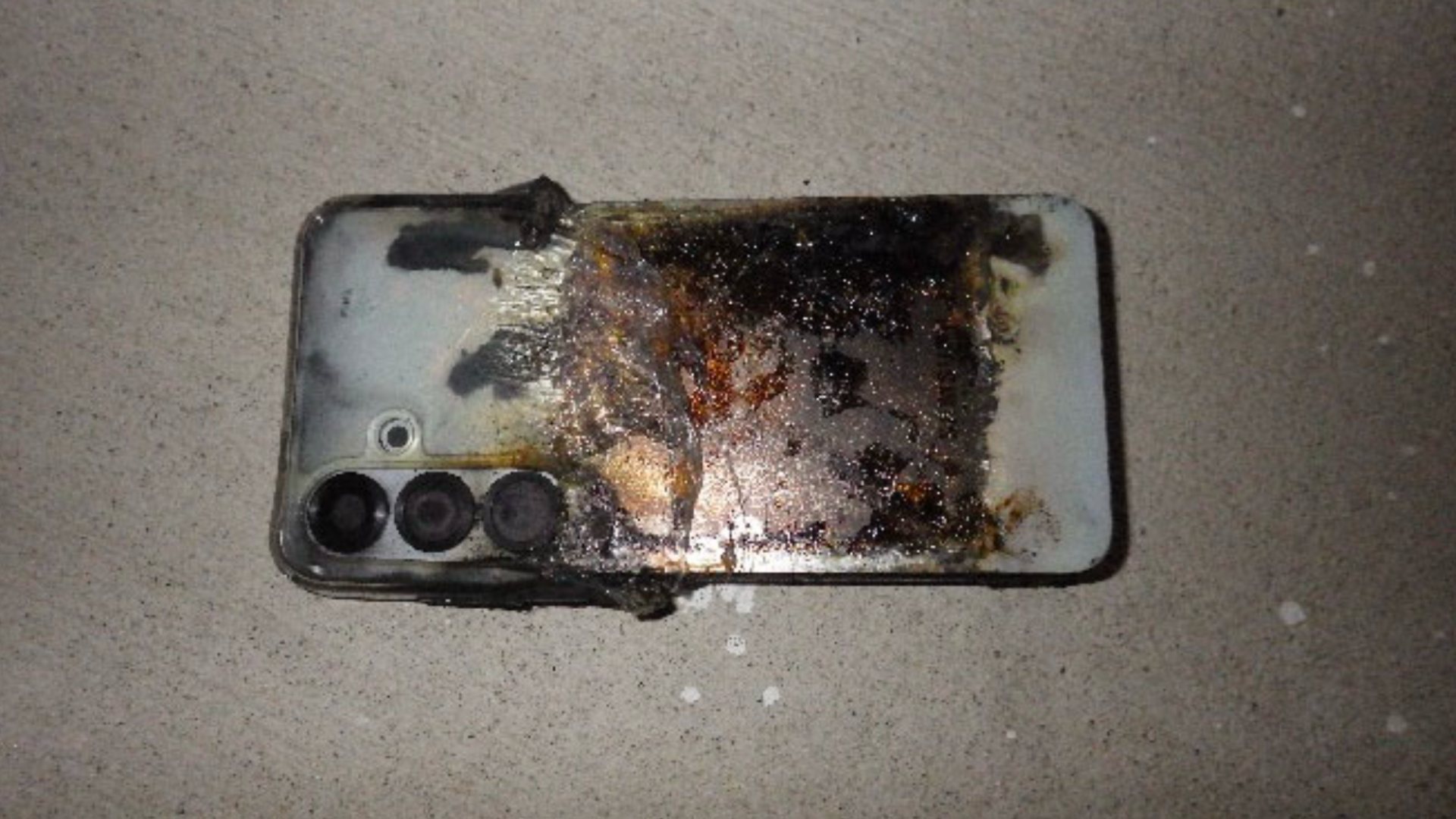
It was the sound that came first. Pop…pop…pop…pop.
In the middle of the night, the man’s partner woke up to what “sounded like popcorn popping in the microwave,” he told us. At first, the woman didn’t register what was going on, then she realized the popping sound was coming from her phone, a Samsung Galaxy S25 Plus that she had put on charge before going to bed, and one that was now sizzling on her carpet.
Don’t want to miss the best from Android Authority?


Less than two minutes passed from the moment the couple noticed the Galaxy S25 Plus in flames to the moment the fire was tamed. But from what the user has told us, the damage — physical, emotional, and psychological — has stretched far beyond that night.
The user, who asked to remain anonymous for privacy reasons, agreed to speak with Android Authority to help others understand what it’s really like when a modern smartphone suffers a catastrophic battery fire, and what people should, and shouldn’t, do if it ever happens to them.
While smartphone battery fires are not very common, and there’s no evidence to suggest that this is a widespread issue with Samsung phones on the market, the user’s experience is an important reminder of what can go wrong when a phone does catch fire, and how to react in a situation like this.
This report is based on an interview conducted by Android Authority, official fire department documents reviewed by us, written communication between the user and Samsung, and Samsung’s acknowledgment of the incident.
The fire


When a fire breaks out, instinct takes over. Most people reach for water without even thinking about whether that’s the best way to put out the flames. That’s exactly what the user did, and, in hindsight, it’s the one decision he wishes he had made differently.
“When I saw the smoke coming from the phone, my first reaction was to pour water on it,” the user told us. “Then I wet some T-shirts I had nearby and threw them on the device.”
If your phone caught fire while charging, what would you do first?
0 votes
While this luckily worked and the user managed to control the fire quickly, it was far from ideal. The visible flames died down, but the reaction inside the battery continued.
“The device continued smoking for another 15 to 20 minutes,” he said. It was a bit of a blur after that, he said, as he managed to take the phone outside and emergency services started arriving.
Even though the fire itself had already been extinguished, the police dispatcher the user first contacted told him that a fire truck still needed to be sent for inspection. A crew of firefighters arrived and began investigating, but because the fire involved a lithium-ion battery, they escalated the situation further.
A bomb squad was dispatched to a family home in the middle of the night.
“The firemen then called for an arson investigator,” he said. “And for the fire department to take possession of the device, the arson investigator had to call in the bomb squad.”
Let that sink in for a minute. A bomb squad was dispatched to a family home in the middle of the night, all because a phone was left charging with its official accessories. Still, the user says that wasn’t the scariest part of the night.
“The scariest moment is realizing that my family inhaled a lot of lithium smoke and not knowing how it will affect our health years from now,” he said.
According to the official fire department investigation report, which Android Authority has reviewed, the phone’s lithium-ion battery entered a thermal runaway event while charging on the bedroom carpet, igniting the surrounding flooring. The incident was classified as accidental, and the fire department said the fire originated inside the Samsung Galaxy S25 Plus itself. But there’s a lot that happened before that official report came in.
“I’d never heard the term thermal runaway before this,” the user said. “But after doing research and watching videos, it lined up exactly with what we experienced.”
Meanwhile, Samsung’s official statement to Android Authority paints a different picture. The company told us that according to its analysis, the cause of the incident was “external force.” However, Samsung also admits it lacked sufficient evidence to reach this conclusion and determine what was ultimately responsible for the incident.
“While our analysis concluded external force was the cause, there was insufficient evidence to determine what was responsible for this isolated incident. We remain in contact with our customer to reach a resolution,” Samsung stated.
The investigation

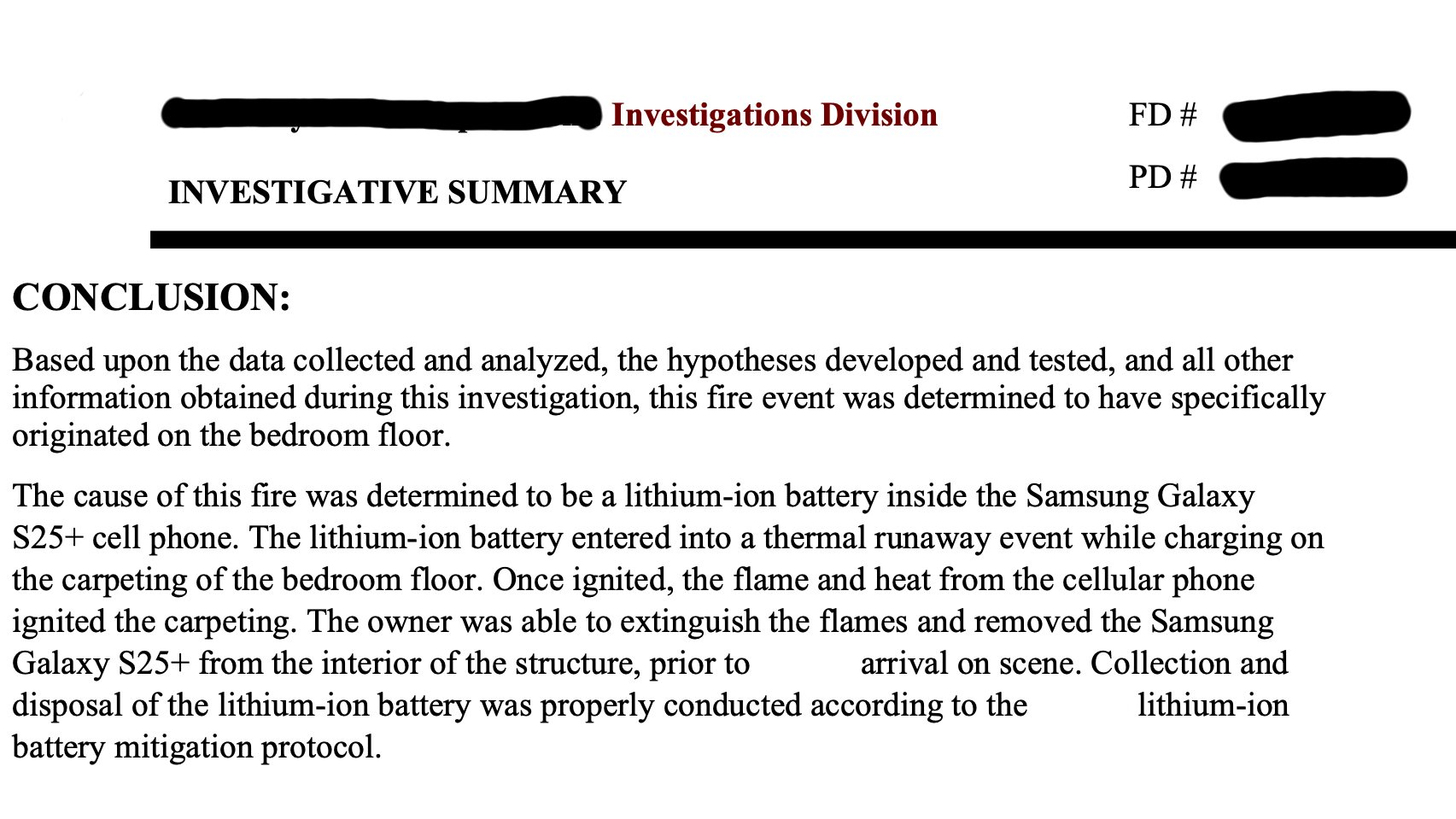
Official Fire Department report
“It was a lot of waiting,” the user told us. According to both the fire and police departments, this was the first time they had ever worked together to file an incident report. What followed was a long and unfamiliar process that required patience at every step.
Once the bomb squad took charge of the burnt device, it was sealed and stored in a hazardous waste facility, probably following local lithium-ion battery safety protocols.
Retrieving the phone from the hazardous waste facility once the investigation was concluded was anything but smooth. The user spent nearly three hours waiting at police headquarters while officers figured out which form was required. One admitted he had never handled a form request like this in more than a decade on the force.
“Basically, nobody knew who I needed to talk to in order to get the release document,” he said, showing just how unprepared official systems are for incidents like phone fires, and how much persistence it takes for an ordinary person to follow every step by the book. Most people would have just given up and junked their phones, but not this user.
Dealing with Samsung

Joe Maring / Android Authority
Once the fire investigation concluded that the incident was caused by the Galaxy S25’s battery overheating, it was time to reach out to Samsung. The user told us that their experience dealing with the company’s customer support has been “pretty poor overall.”
“Trying to get a hold of someone who can assist with our situation proved to be unnecessarily difficult. We initially contacted Samsung via WhatsApp, but after spending nearly an hour going back and forth with the WhatsApp representative, we were advised that the WhatsApp team only served Singapore. We then found Samsung’s CEO Office Email link and were able to get our concern escalated relatively quickly.”
“The initial claims manager was great. Courteous. Prompt updates,” the user said. But things apparently changed when the case moved to Samsung’s insurance representatives.
“That’s when the tone shifted,” the user said. “My inquiries kept being met with ‘I don’t know’ or ‘I’m not sure.’ I felt like I was being stonewalled.”
The user claims Samsung eventually admitted liability and agreed to cover costs for the phone itself, medical bills, lost wages, and cleanup expenses. He says those updates were provided to them in a timely fashion for the most part.
“I wasn’t surprised they admitted liability,” he said. “But I am deeply disappointed in their offer. Offering $500 per person for toxic chemical inhalation feels like an insult when their faulty hardware directly jeopardized my family’s future health,” he said.
The user says the incident has left a lasting psychological impact on him and his family.
In his view, Samsung has handled the visible damage but failed to acknowledge the invisible cost — fear, mental trauma, and long-term health uncertainty.
“I’m very active in fitness and meditation,” he said. “But since the fire, my lung capacity has noticeably decreased.” “We still experience sudden flashes of internal heat throughout the day,” he added.
The psychological impact has been just as lasting.
“I’ve become much more wary of charging devices at night,” he said. “But my partner has been truly traumatized. She refuses to charge her phone unless she is awake and nearby to monitor it.”
At night, she now stores her phone inside a silicone container, not because anyone told her to, but because it helps her feel safe enough to sleep.
Because of these reasons, and the impact the incident has had on the user and his family, he feels the reparations Samsung has offered to date aren’t fair.
“A fair resolution would actually acknowledge the long-term health risks and the trauma they caused,” he said. “Not a nuisance payment.”
The learning

The user did many things right. Things most people wouldn’t think to do in the middle of a crisis. He immediately contacted the police department to make sure the incident was officially documented. That decision triggered a chain of investigations involving the fire department, arson investigators, bomb squad, and Samsung itself.
Given this can happen to phones from any brand, not just Samsung, knowing these steps can make a critical difference, helping authorities document what happened and ensuring the manufacturer, whoever it is, responds to your claims.
That said, the user wishes he had done some things better.
“DO NOT USE WATER TO PUT OUT A LITHIUM FIRE! I wish I knew that prior to this incident, but I learned about this from the firemen after I put out the fire. I also wish there were clearer resources on what to do immediately after inhaling lithium smoke,” he said
Lithium-ion battery fires are difficult to extinguish and can reignite even after flames appear to be out.
Fire safety authorities generally advise that lithium-ion battery fires are difficult to extinguish and can reignite even after flames appear to be out. The priority, when possible, is to create distance, avoid inhaling fumes, and let trained responders handle the situation, especially indoors. According to fire safety protocols, a direct attack with water is preferred, but only with full PPE (Personal Protective Equipment) and a facepiece. In this case, the user just poured water on the burning phone, without any safety equipment, which could have resulted in much graver physical injuries.
The user doesn’t believe most people should panic about their phones. But he does believe people should be informed.
“These incidents are rare, but when they happen, the lack of clear safety information is terrifying,” he noted.
His trust in Samsung is certainly shaken, even though he initially thought that this was an isolated event.
“I realized this is a pattern for us: our previous Galaxy S22 devices both experienced battery swelling within a year of each other. It’s shocking that in 2025, after the Note 7 disaster, Samsung still hasn’t mastered basic battery safety,” he said.
What to do if your phone catches fire

Andy Walker / Android Authority
If your phone ever catches fire, here are some steps you can take to handle the situation effectively or prevent it from happening in the first place.
Before: Lower the risk
- Use original or reputable brand-name chargers and cables.
- Stop using damaged accessories or phones with swollen batteries.
- Don’t charge devices on beds, sofas, carpets, or under pillows.
- Avoid charging unattended or overnight when possible.
During: Put safety first
- Move people away immediately and avoid inhaling smoke or fumes.
- Don’t touch a burning or smoking phone with your bare hands.
- If possible, create distance and call emergency services rather than handling it yourself.
- Avoid using water to extinguish the fire indoors. Lithium-ion batteries can behave unpredictably.
After: Document and escalate
- Seek medical attention if anyone inhaled smoke.
- Contact authorities so the incident is officially recorded.
- Do not discard the device carelessly. Follow hazardous material guidance.
- Most importantly, document everything and request a formal investigation from the manufacturer.
Thank you for being part of our community. Read our Comment Policy before posting.


