





KeepAm, a Nigeria-based tax record and filing app launched in January, is built for remote workers, creators, and small operators who have historically earned first and thought about tax later.
Instead of a once‑a‑year tax chore, the app reframes as something users quietly keep up with through everyday record‑keeping.
Its founder, Emmanuel Oshola, frames the product around two linked ideas: many new earners now fall under tax rules they do not understand, and many also miss deductions that could reduce what they owe if they kept proper records. The app, available on the web and usable offline, is built to address this.
Large parts of economic activity in Nigeria sit outside payroll systems, where tax is deducted automatically. Policy, however, is moving toward greater data visibility. For instance, Nigerian banks already report transaction data under financial surveillance rules. The Federal Inland Revenue Service has pushed e-filing systems alongside closer monitoring of digital and cross-border income. Platforms like KeepAm sit between raw bank transactions and formal tax filings, translating one into the other.
Turning bank inflows into tax records
KeepAm’s design is based on a practical problem that defines modern tax enforcement in digital economies. When money lands in a bank account, authorities can see the amount and the account holder, but cannot determine whether the transfer represents profit, reimbursed expenses, a pass-through payment to suppliers, or a personal gift.
In an open banking system that relies on customer data, the default risk for organised freelancers is that gross inflows begin to resemble taxable income, Oshola explains, unless the individual can prove otherwise.
Oshola describes this burden of proof as central to the product’s design, arguing that without structured records, people who work project to project may be assessed on turnover rather than actual earnings after costs.
KeepAm responds by building a continuous documentation layer over everyday transactions.
Signing up
The product follows a simple and intuitive flow. Users start by signing up and logging income each time they are paid. Next, they attach related expenses and store corresponding proof or receipts in one place.
From there, users can generate a detailed report whenever they need it. This process continues throughout the year, making it easier to stay organised rather than rushing to compile records during filing season.
“We use multi-layer validation with Nigerian-specific patterns,” Oshola. “Common issues include mixed currencies (we auto-convert to NGN), cash transactions (we allow with confidence scoring), and informal descriptions.”
Users log income as it comes in and are prompted to attach related expenses, ranging from data purchases and transport to software subscriptions and equipment.
The system asks whether costs were incurred to deliver a specific job, then classifies those items as potential deductions.
Receipts, whether paper or digital, can be captured and stored within the app, turning what might otherwise be lost or informal evidence into a retrievable archive.
According to Oshola, this structure feeds into the filing report that users can download and submit to their state tax authority.
The product also incorporates digital invoicing, which aligns with broader government interest in traceable billing.
Instead of sending clients only an account number, users can issue invoices through the app, linking payment requests to documented work.
Once paid, the invoice, payment and related expenses sit within a single chain of records. For creators and freelancers accustomed to informal workflows via messaging apps, this represents a shift toward formal bookkeeping without the need to adopt full accounting software, which many find too complex or expensive.
Oshola said the goal is not to turn individuals into accountants, but to embed tax-relevant structure into actions they already take.
That design choice matters because the platform deliberately avoids accounting jargon.
Using KeepAm

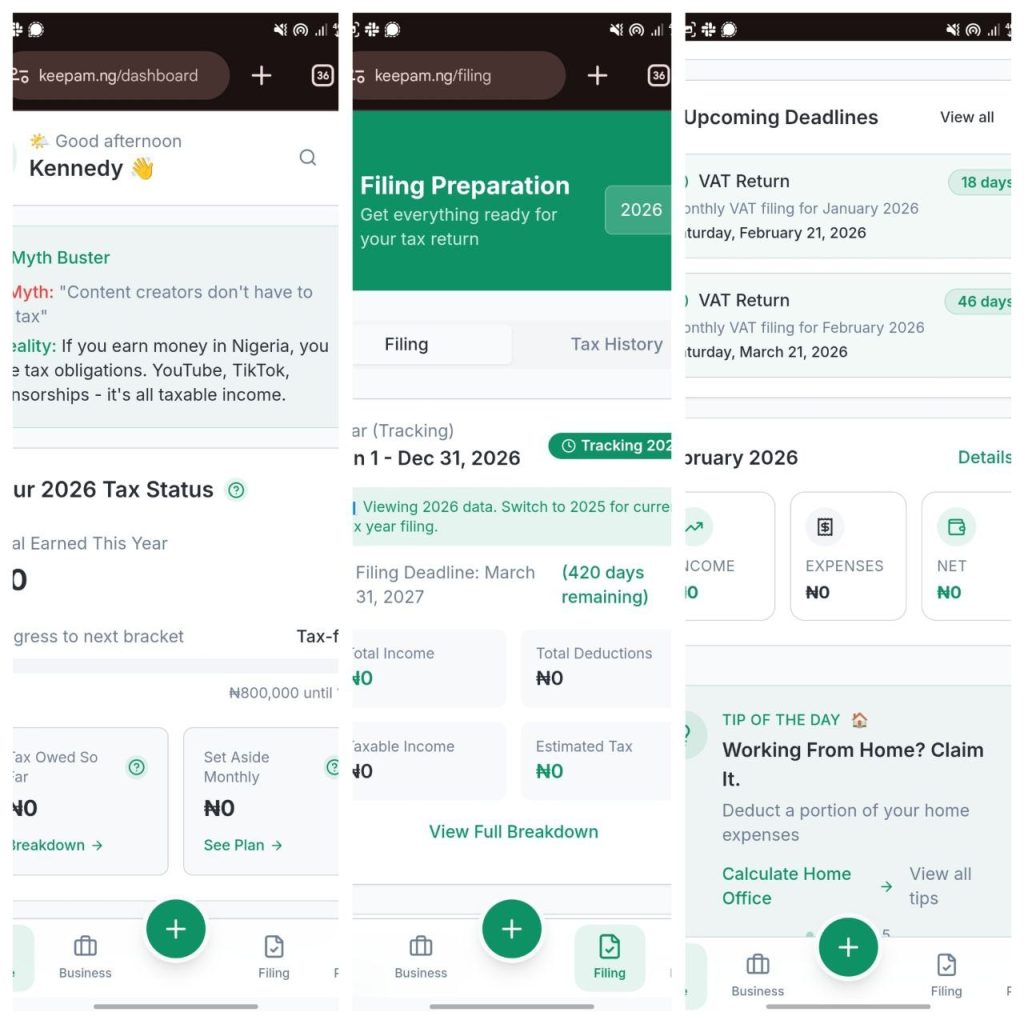
Signing up for KeepAm took less than three minutes, with instant email verification and a dashboard that loaded in about two seconds on my device. The main screen gives a clear overview of a user’s finances, showing income, expenses, net position for the month, and tax status for the year in one place.
The dashboard highlights practical tools across the top, including Calculate, Tax Plan, Clients, Projections, Invoices, and Savings, allowing users jump straight into core tax and business tasks without digging through menus. Each section opens into a focused workspace, such as tracking income and expenses, managing receipts, or handling clients and business profiles.
Upcoming tax and value-added tax (VAT) deadlines are displayed in a dedicated panel, with due dates and countdowns in days, making it easier to stay compliant rather than relying on memory or separate reminders. A “Tip of the Day” card surfaces context-aware guidance, such as how to claim home office deductions, with quick links to launch a relevant calculator or view more tips.
The tax status module shows total earned this year, progress toward the next tax bracket, tax owed so far and how much to set aside monthly, with links to view a detailed breakdown or plan. Myth‑buster banners at the top address common fears about taxes and compliance in plain language, helping users feel more confident about starting to file, even if they have not been paying regularly.
Automation
KeepAm positions itself as an automated system rather than a human advisory service. Oshola clarified that calculations and classifications are run through the software, with limited back-end visibility into user data and no logging of administrative access, reflecting compliance with Nigeria’s data protection framework.
This architecture matters because target users are being asked to centralise sensitive financial information in one place, including income records and tax identifiers.
There is a free basic account that includes up to 20 invoice checks, 20 income and expense entries, and 20 receipt scans. The pro version costs ₦2,500 ($1.79) and provides access to invoicing, expense tracking, and tax filing tools. The business version costs ₦7,500 ($5.37) and includes all pro features, plus full business tools designed for SMEs.
For a population that often mistrusts government and digital platforms, perceived data risk can be as significant as tax risk.
Automation here does not remove user responsibility. The platform records behaviour: if a user misclassifies a personal transfer as business income, the software does not block it; instead, it preserves the record trail to improve documentation.
App works offline
I tested KeepAm while in Kenya, which mirrors how many of its target users work across borders for foreign clients. The service runs as a web app, and once users sign up through the site, they can add it to their home screen like a regular app without going through an app store.
The offline mode stands out because you can enter income, log expenses, and scan receipts without an active connection, with data syncs later.
In a market where mobile data is expensive and connectivity is uneven, this supports consistent record-keeping rather than delayed bulk entry. From a tax perspective, that timing matters because deductions are easier to defend when logged close to when the cost occurred, not reconstructed months later from memory.
Issues with automation
Automation helps, but it does not eliminate structural complexity: personal income tax in Nigeria is administered at the state level, with each state operating its own filing process layered on federal rules.
Compliance
The pricing model reflects the breadth of the intended audience. The free tier limits apply to invoices, but it makes the product easy to try without committing upfront.
The paid plan removes those caps and enables bank account linking via open banking, allowing transactions to be pulled in and sorted with less manual work. The higher-tier targets small businesses that need payroll tools and payslip generation, moving the product beyond solo freelancers into a broader business context.
Overall, this structure aligns with policy efforts to broaden the tax base. If more freelancers, creators, and remote workers keep organised records, tax shifts from a vague threat to a set of numbers tied to documented profit.
This mirrors what payroll software did for salaried workers decades ago. Compliance shifted from an annual calculation to an automatic process embedded in daily work. Apps like KeepAm attempt the same shift for the self-employed.
Tools like this only matter if users treat tax tracking as part of everyday work, rather than a last-minute scramble near deadlines, which remains common in markets like Kenya.
Despite testing the app outside Nigeria with two colleagues, I noted that it was built around expense prompts that appear at the right moment. The platform also compiles daily entries into reports that function as tax records.
“We generate PDF reports with unique IDs, bracket breakdowns, and timestamps,” Oshola concluded.


