




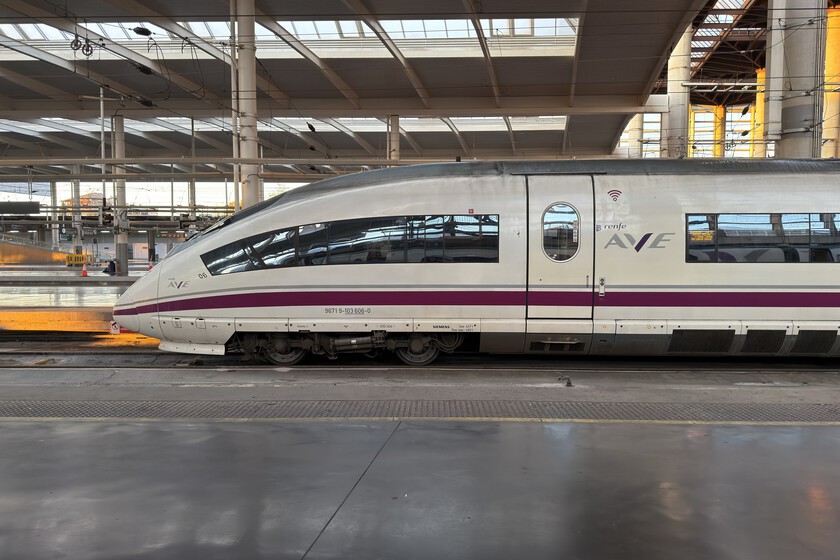
A high-speed runner that is becoming more expensive and others that seem to have hit the ground. The arrival of competition to Renfe promised to reduce the Price of train tickets. In fact, it reduced them. But the big question is knowing when they will rise again. Or, if necessary, how far they will end up going up.
spring. These are the data collected in the latest report published by the CNMC. It analyzes the price and occupancy of high-speed trains in our country. Specifically, the data refers to the months of April, May and June, which are the last recorded by Competition.
It is an interesting study as it covers dates in which rail traffic increases, with passengers opting for this type of transport for their Easter holidays and first summer trips. The impact of both events is clear because despite offering 0.6% fewer seats, the number of travelers has increased by 4.4% compared to 2024.
What do the data tell us? That we travel faster and faster. Because the previous data breaks down the high-speed markets open to competition and reflects that in the second quarter of 2025, a total of 11.8 million passengers boarded the high-speed long-distance train, 16.1% more than in the previous quarter and 15.2% more than in the same quarter last year.
The data also tells us that Spain clearly moves at two speeds. One is represented by Madrid-Barcelona, which increases its prices and remains the main corridor in the country. The other is the Andalusian or Valencian high speed, whose prices are already beginning to remain stable.

The cheapest. The brokers who reduce their prices are, as we said, the Andalusians and Valencians. Traveling from Madrid to Seville was, on average, 8.6% cheaper than the previous year, boosted by the arrival of Ouigo as Iryo reduced its prices by 2%, AVE by 3.8% and AVLO raised prices by 3.4%. The average price of the trip was 49.47 euros.
Below is the Madrid-Málaga corridor, which maintains a price about two euros cheaper but which barely changes its prices compared to the previous year (-1.2%). Again it is Ouigo who presses down.
For their part, Madrid-Valencia and Madrid-Alicante have also significantly reduced their price compared to the previous year. In the first the decrease is estimated at 8.3% and in the second 8.7%.
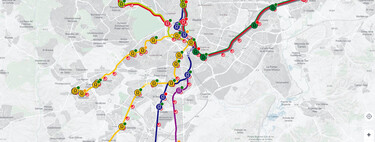
The (almost) cheapest. Although prices are lower in these corridors than in the same period in 2024, the truth is that the average ticket price has been lower. In all the previous cases, the average ticket price was lower in various months last year. In the graphs, in addition, a certain stagnation and slowdown in the fall is observed.
It must be taken into account that, except for Madrid-Málaga, Renfe has considerably lowered the ticket price on its AVE. In the Sevillian corridor it has fallen by 3.8%, in the Valencian corridor by 10.6% and in the Alicante corridor by 11.6%. These falls, despite being partially offset by the increases in AVLO where the AVE falls, have a great impact on the average price of the ticket since a percentage drop in the AVE is more money than the same reduction in Ouigo, Iryo or AVLO, which are lower cost for the customer.
That is, we have cheaper general prices, yes. But above all because Renfe seems to be pressuring customers to “jump” to the AVE, with an increase in the prices of AVLO and an evident drop in the price of its most expensive option.
The most expensive. The corridor that has experienced the most increase in cost has been Madrid-Barcelona. Since competition entered, traveling between both cities has never been so expensive. At the beginning of 2024, the average price hit the bottom, standing at around 40 euros. On the same dates in 2025, that same bill was already looking at 50 euros. Between April and June, the average price reached 63.14 euros.
All companies have made their tickets more expensive and no small feat. The cheapest average price was that of Ouigo, with 50.11 euros and despite this it became 18.7% more expensive. The second, that of AVLO (offer that no longer exists, which will continue to increase prices) with 51.95 euros and an increase of 14.5%. Between the two Renfe options is Iryo, with 56.01% and an increase of 22.5%. The AVE closes at the top with an average price of 73.91 euros and an increase of 13.1%.
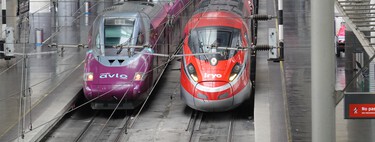
Have we hit the ground? It is the big question that arises now for the client. Although year-on-year prices have fallen, the truth is that we continue to see a slight increase in the overall price for the year or, at the very least, stagnation where the three companies operate at full capacity. Only the entry of Ouigo in Andalusia seems to have moved the market a little.
But Iryo and Ouigo have been sending more or less clear messages that they are beginning to move away from the price war. Everything indicates that this was not sustainable to maintain these companies and both the Italian and the French companies seem to be embarking on new paths (with changes in management) now that their landing seems consolidated.

“We will follow them”. Renfe, for its part, has been clearer. The company defends that the situation is not profitable for the companies and that sooner or later their competitors are going to raise prices. And the company does not seem to want to compete with them on price. Its president has already announced that if its rivals raise prices “we will follow them”, anticipating a growth in the cost for the user that has already been seen in Madrid-Barcelona.
Photo | WorldOfSoftware
In WorldOfSoftware | Ouigo and Renfe have found a new way to make life impossible: torpedo repairs


