





Social networks and messaging applications have become one of the favorite places for scammers to look for victims. It’s not a coincidence. They are platforms that we trust, where we interact with known people and where many decisions are made quickly, almost without thinking. In that scenario, a seemingly normal message, link, or request may be the first step in a scam. Meta has decided to reinforce its alert systems with new tools that seek to detect suspicious signals and warn the user before it is too late.
When someone tries to link your WhatsApp without you knowing. One of the novelties announced by Meta affects a fraud technique with which scammers try to link the victim’s WhatsApp account to another device. According to the company, they can try to convince the user to share their phone number and then the pairing code that appears on WhatsApp, or even ask them to scan a QR code under a false pretext. With the new alerts, the application will display warnings when it detects signs of suspicious behavior in these types of requests and will indicate where the request comes from so that the user can stop and reconsider the action before accepting it.


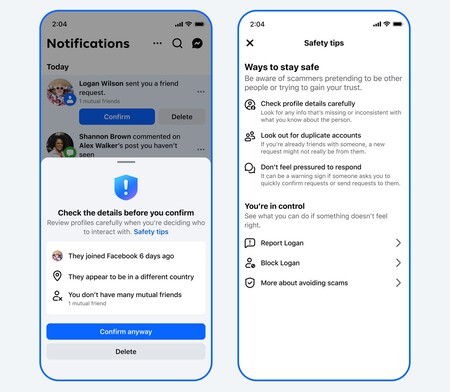
Suspicious friend requests. Another of the functions that Meta is testing focuses on Facebook and such an everyday gesture as accepting a friend request. The platform tests warnings when it detects signs that may point to suspicious activity on an account. These signs include, for example, profiles with very few friends in common with the user or accounts that indicate a location in another country in their profile. The goal of these alerts is not to decide for the user, but rather to provide them with additional context before accepting the request, blocking it, or simply ignoring it.


Messenger also receives news. Meta will expand its advanced scam detection system within this application to more countries this month. In this case, the focus is on the content of the conversation itself: when a chat with a new contact presents patterns associated with common fraud, the platform can show a warning to the user. The company mentions as an example messages that include suspicious job offers. At that point, the system can ask the user if they want to share recent messages for an AI-based tool to analyze and, if it detects signs of deception, offer additional information and suggest actions such as blocking or reporting the account.
Beyond the visible notices. The firm led by Mark Zuckerberg explains that these in-app alerts are only part of its strategy against scams. In parallel, the company is strengthening its automatic detection systems with tools based on artificial intelligence capable of analyzing multiple signals at the same time, such as the text of a publication, the images used or the context in which the content appears. These systems seek to identify more complex patterns, such as accounts that impersonate celebrities, public figures or well-known brands, as well as links that redirect to pages designed to imitate legitimate sites.


The figures. According to the company, during 2025 it removed more than 159 million scam-related ads worldwide for violating its policies. Of that total, around 92% were removed before any users reported them, suggesting that automatic detection systems were already acting before the fraud spread. Meta also points out that it took down 10.9 million accounts on Facebook and Instagram linked to scam centers and participated in an international operation that allowed the deactivation of more than 150,000 accounts associated with criminal networks in Southeast Asia.
Images | Aman Pal | Goal
In WorldOfSoftware | China has turned OpenClaw into a viral phenomenon. And then it has prohibited its officials from using it


