





Satya Nadella has passed through Madrid and, of course, has talked about agents. He did it with a message that sounded more like a call to attention than a sales speech: 2026 is the year in which AI has to demonstrate that it serves more than just to impress in presentations. At the Microsoft AI Tour held today at Kinépolis Ciudad de la Imagen, the CEO of Microsoft has marked distances with the story of recent years and has focused on the real usefulness of technology for companies and employees, the governance of agents and a concept of digital sovereignty that does not exactly coincide with the one handled by Brussels. It has been one of those interventions where the subtext matters as much as what is said from the stage, with subliminal messages both for the competition and for its own partners.
From promises to real systems
Nadella has made it clear that the “discovery” phase it’s over. The narrative of technological wonder (the “wow” effect of recent years) we have to leave it behind. Now it’s time for what he calls useful engineering: Turn AI into systems with measurable economic impact, not technology demonstrations. It is a significant turn of speech coming from the CEO of the company that has invested the most in positioning AI as the definitive revolution. The implicit message is that if organizations do not begin to see real returns, the entire sector has a credibility problem.
To illustrate this, he cited specific cases of Spanish companies such as Factorial, Ferrovial, Repsol or Sanitas, and brought up the work of GigaTime, an AI tool that is accelerating oncological research with measurable results. These types of examples (applied science, industrial processes, health management) are what Nadella wants to establish as bases for the discourse of AI useful for companies and institutions, far from the more or less spectacular consumer applications that have dominated the public conversation about AI during the last two years. He wants to demonstrate that AI and agents are ripe for real, transformative business applications.
In this context he has introduced the term «context engineering» as the key discipline of the moment: getting AI models understand the specific data of each organization instead of operating on generic knowledge. His vision is that there should be an own AI model for each companya kind of living repository of corporate tacit knowledge that until now lived dispersed in documents, emails, meetings and, of course, in tools like Power BI. The idea is that this collective knowledge, once structured and accessible to the models, becomes a real competitive advantage. The tokens, according to Nadella, They are already the new raw material of the economyand companies that do not learn to produce and manage them will be at a structural disadvantage.
Agents: several per employee, but with governance
Charles Lamanna, President of Business Apps & Agents of Microsoft, has completed the argument from the operational angle. The direction of travel is towards mixed teams of humans and agents, and the scale that Microsoft manages is no less: several agents working in parallel for each employeeeach one specialized in a specific task or process. Nadella has called them, with some poetry, «infinite minds»: intelligences that do not get tired, do not forget the context and can operate autonomously at the margins of workflows without the need for constant supervision.
The metaphor that has been used to define the relationship between humans and agents is that of cognitive scaffold: AI does not replace the worker but allows him to redesign his work from end to end, taking on repetitive or synthesis tasks and freeing capacity for what requires judgment or creativity. It’s a more nuanced account than mass automation, and probably more honest about how real adoption is working in enterprises. It is the Copilot philosophy that Microsoft has defended from the beginning when it comes to AI.
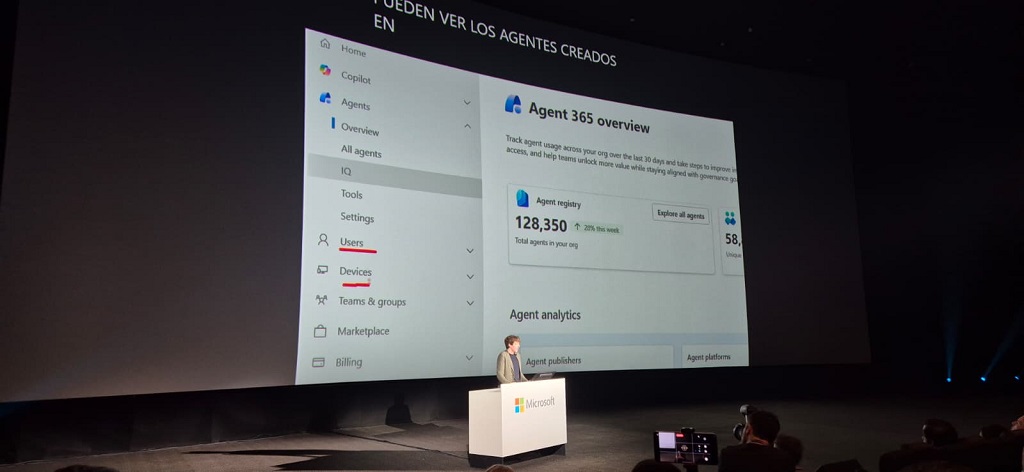

But the most interesting part was not the rhetoric about productivity, but the emphasis on governance and sovereignty in the management of these agents. As the number of agents per organization grows, the challenge stops being technical and becomes organizational: who controls which agent does what, what data it operates with, what decisions it can make autonomously and which ones require human validation in addition to how many resources it is consuming. Microsoft has presented specific new developments in this field that go beyond marketing: Azure Local in offline modewhich allows you to manage critical infrastructures without connection to the cloud while maintaining Azure policies, Microsoft 365 Local for sovereign environmentswhich allows Exchange, SharePoint or Skype for Business to run within the customer’s perimeter, and Foundry Localwhich makes it possible to integrate large AI models in completely isolated environments using proprietary hardware with NVIDIA support. For sectors such as defense, public health or regulated banking, these capabilities are not an extra, they are a requirement.
Digital sovereignty: compliance and competitiveness
One of the central axes of the event has been digital sovereignty, understood not only as data protection but as enabling condition for organizations to adopt AI with guarantees. Nadella’s thesis is that sovereignty and competitiveness are not opposite concepts: a company that fails to incorporate AI into its processes loses the ability to generate value, regardless of where its data is hosted. During the event, Microsoft reinforced its commitment to the EU Data Boundary, the initiative that ensures that European customer data remains and is processed within the EU territory. For organizations that operate in highly regulated environments (banking, healthcare, public administration) this framework is not a minor detail: it is what makes it possible to advance the adoption of AI without compromising regulatory compliance or operational resilience.
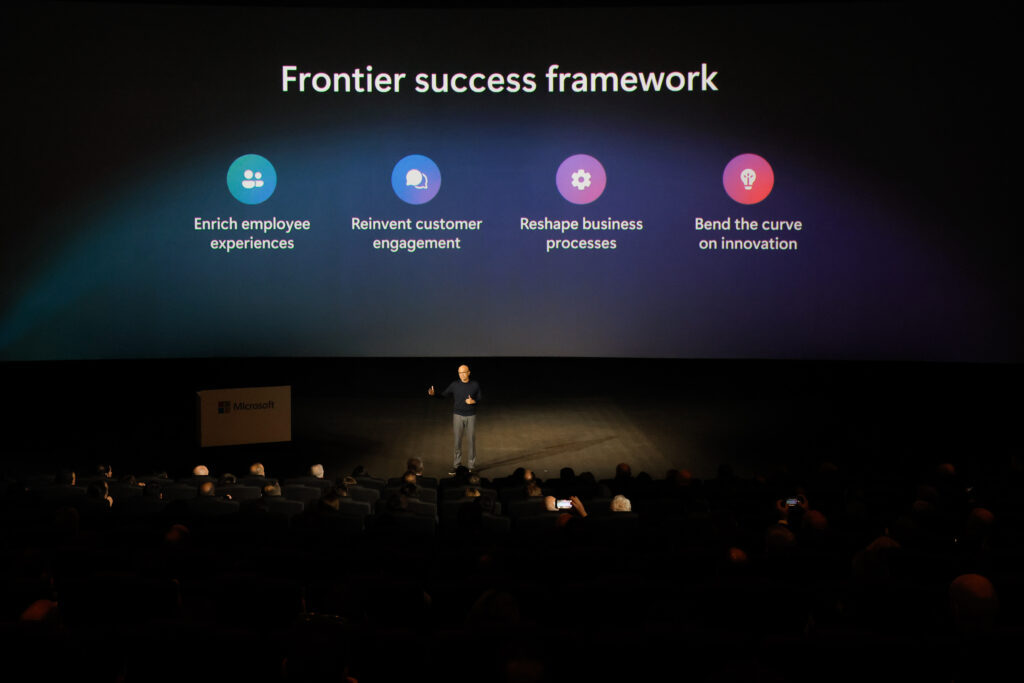

The infrastructure developments presented in Madrid are in line with this: Azure Local in offline mode, Microsoft 365 Local for sovereign environments, and Foundry Local with support for large models on their own hardware. The company’s message is that governance and deployability do not have to be at odds, and that the sovereign perimeter can also be an environment where AI operates at full power.
A relevant part of the keynote was dedicated to the agent creation layer, with a message explicitly aimed at the technical profiles of the organizations– Empower internal teams to build and deploy agents, without depending on an external provider for each use case. Microsoft’s commitment is to use Copilot Studio as a central tool so that any organization can create agents connected to its own data and processes, adjusted to its specific context and not to a generic manual case.
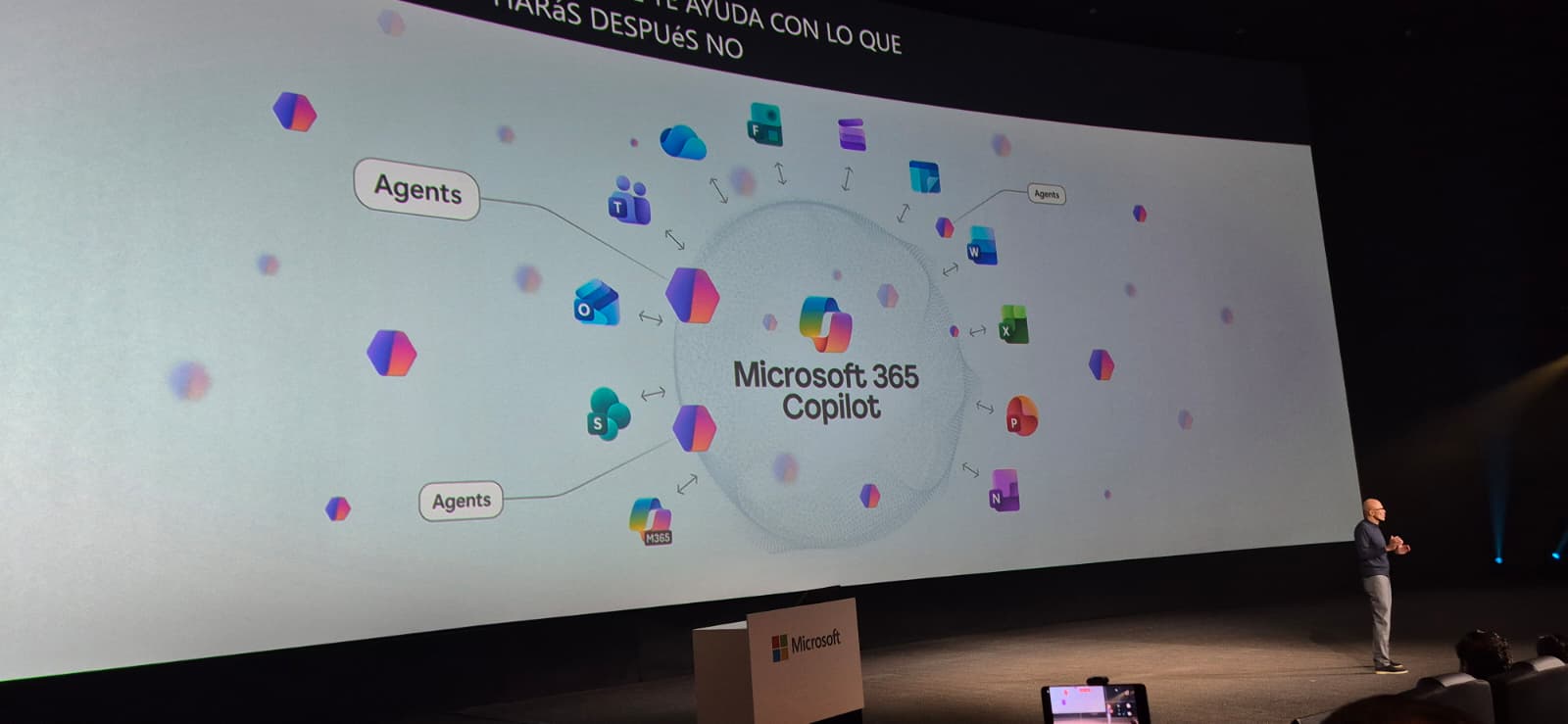

We were also able to see the agent dashboard in action, a direct response to the problem that inevitably appears when adoption scales: if there are multiple agents operating for each employee, someone has to see what each one is doing. The dashboard allows IT managers and business managers themselves to have visibility over agentic workflows: which agent intervenes in which process, with what permissions it operates and where human validation is required before an action is executed.
The brake that no one wants to mention
Nadella has been more transparent than usual about the real limits of AI expansion. Energy, chips and talent are scarce resourcesand the industry has to decide judiciously where it applies them if it wants to maintain the social support necessary to continue growing. AI consumes energy infrastructure on a scale that is beginning to be visible to public opinion, and if this demand is not accompanied by demonstrable and widely distributed utility, the risk of social reaction is real. Nadella has put it on the table without euphemisms: without adoption at scale, AI runs the risk of remaining in a bubble due to a lack of demonstrated usefulness. It is not the type of warning that usually opens a keynote, but in Madrid it has been there, and it deserves attention.
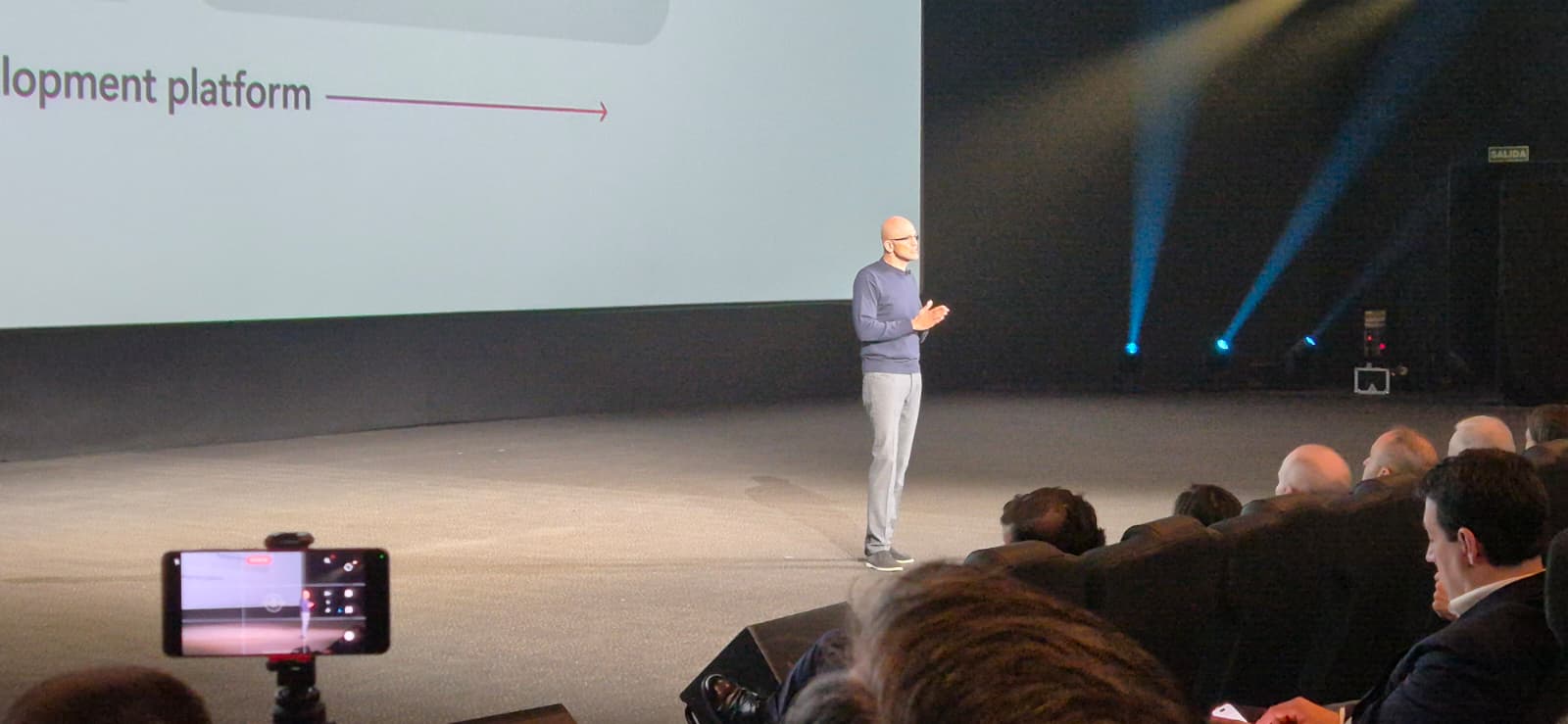

The Spanish context is not bad for this argument. The data provided by Microsoft places Spain in sixth position in the world in AI adoptionwith 42% of the working-age population using artificial intelligence tools in the second half of 2025, above the United Kingdom or the United States. 89% of Spanish managers plan to hire agents in the next twelve months, according to Microsoft’s own Work Trend Index. And the companies called Frontier Firms —those that have already integrated AI at the center of their operations— show growth rates that almost double those of the rest of the market.
The stage is set and the numbers are there, at least on paper. What Nadella has left in the air is the underlying question: If engineering will be as useful as it promises when it stops being the center of attention and begins to be the basic infrastructure of companies. The pending issue, despite the use cases that have been shown in the keynote, is the implementation of all these promises and their conversion into a real competitive advantage. That is the real test that comes.


