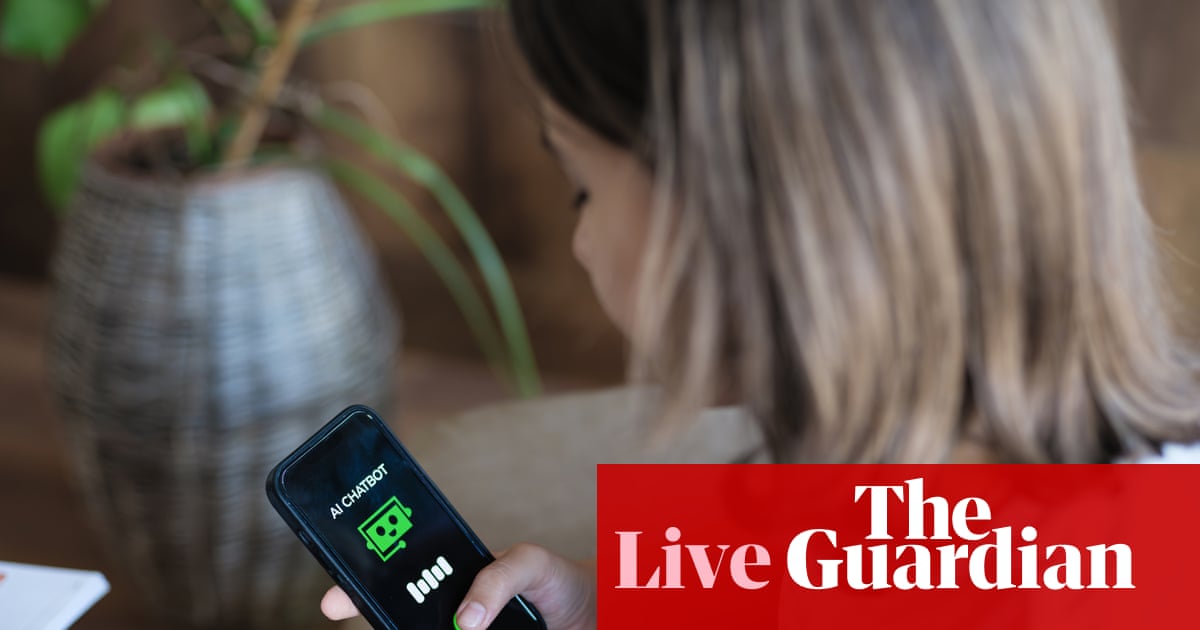
Starmer suggests tighter rules for teens on social media could include restrictions on ‘doomscrolling’
At his event this morning Keir Starmer made it clear that the laws on how teens access social media will definitely be tightened. But he said he was “open-minded” about whether this would include a full, Austalian-style ban.
Starmer suggested that one option will be to limit the technology that allows “doomscrolling”. He said:
We’ve taken the powers to make sure we can act within months, not years.
We also need to act very quickly, not just of the age concern, but on the devices and applications that make the sort of auto-scrolling, the constant glueing to the machine that you can never stop scrolling.
In a post on his Substack account, Starmer said out in more details the options that could be implemented as a result of the consultation being carried out. He said:
We will be going to parliament for new government powers, enabling us to act on the findings of the social media consultation where the evidence suggests we need to. This could include:
-Setting a minimum age limit for social media: unlike the Tories, who took years to pass the Online Safety Act, we will take powers that would allow us to implement a minimum age for social media in a matter of months to prevent kids from accessing harmful social media.
-Restricting specific functionalities: that are detrimental to kids’ wellbeing and keep them hooked to their screens like endless scroll or autoplay
-Limiting VPN access for kids:
to make it harder for kids to get around age limits of services or certain functionalities.This is all designed to put the wellbeing of children first.
Key events
The Internet Watch Foundation has welcomed the government’s commitment to tighten rules relating to social media and teenagers. (See 9.32am and 11.55am.)
Hannah Swirsky, its head of policy, said:
New tech can be a dangerous frontier. It is crucial legislation can keep pace with the evolving threats …
We are very pleased to see the government taking further steps. Now, we urge them to provide clear guidelines on how companies must build platforms which are safe by design, and where children are a central consideration rather than an afterthought.
No 10 says PM has confidence in Josh Simons, minister who commissioned probe into journalists when running thinktank
At the Downing Street lobby briefing the PM’s spokesperson also said journalists must be able to do their job “without fear or favour” in response to questions about the Labour Together investigation into reporters writing about it.
The spokesperson would not give details about the Cabinet Office investiation (see 9.53am and 10.45am) into what happened. But he confirmed that “of course journalism and the free press is a cornerstone of any democracy”.
The spokesperson also said Keir Starmer had full confidence in Josh Simons, the Cabinet Office minister who commissioned the report when he was running Labour Together before the general election.
Asked if Simons would be sacked if he were found to be at fault, the spokesperson said he would not comment on a “hypothetical” scenario”.
No 10 says Antonia Romeo, likely next cabinet secretary, is ‘outstanding leader’, in response to report about 2017 complaint
Dame Antonia Romeo, the permanent secretary at the Home Office, is tipped to replace Chris Wormald as cabinet secretary. But Sir Simon McDonald, a former permanent secretary at the Foreign Office, has suggested she should not get the job until there has been a further inquiry into a complaint about the way she treated colleagues when she worked for the Foreign Office in 2017.
Today Harry Farley from the BBC has a report quoting from a letter sent to Romeo by the government’s chief people officer, Rupert McNeil, after this complaint was investigated. Romeo was told there was “no case to answer”, but it was also put to her that she might benefit from advice about her leadership style.
In the 2017 letter McNeil said:
I appreciate processes of this type are always distressing, but as discussed, they are rich sources of feedback about management and leadership style.
I know from our conversation that you are very alert to this, and this process has given you rich insight.
At the No 10 lobby briefing, asked about this report, the PM’s spokesperson said the letter quoted by the BBC confirmed there was no case to answer. He said Romeo was “an outstanding leader with a 25-year record of excellent public service”.
The BBC report also quotes McNeil as saying the “smears” being thrown against Romeo now are “reprehensible and hypocritical”.
Q: If things are going so well, why did you almost lose your job?
Starmer says he is angry that he was lied to by Peter Mandelson about his relationship with Jeffrey Epstein. He says he has apologised for that.
Q: But, before you appointed him ambassador, you knew that he had stayed in Epstein’s house after Epstein had been convicted. It was in the FT.
Starmer says Mandelson was asked about that. He gave an answer that was “not truthful”. He says he cannot disclose the details because there is a police investigation going on.
Q: What do you regret most about your time in office?
Starmer says he wants to focus on things that have gone well.
Some things that have gone very right for the government. Waiting lists are down. Interest rates are down for anybody on mortgage. That’s a massive step in the right direction. Inflation is coming back down to 2%. We’re now leading on the international stage.
Vine repeats the claim about considering a social media ban for under-16s amounting to a U-turn.
Starmer says what matters is to get this right.
He says there are no easy answers on this. He is a “pragmatist”, he says.
Vine starts by asking about social media and children.
Starmer starts by repeating the points that he made at this event earlier; that he knows parents have concerns; that the government intends to act, and act, quickly once its three-month consultation is over; and that this could lead to a ban on under-16s accessing social media, but that this is not the only option, because other, more specific restrictions, might be preferable.
Q: Lisa Nandy used to say you were not considering a ban. So is this another U-turn?
Starmer says he does not accept that.
He says a ban is “a possibility”.
But it is not the only option, he says.
He quotes the concerns of the NSPCC about a total ban. (See 12.05pm.)
UPDATE: Starmer said:
I think this is such an important issue that we need to go into it with a ban as a possibility.
I definitely want to look at the evidence over the three months of the consultation.
There are powerful arguments on both sides.
Some people simply say just get all under 16 years of social media, and that’s the end of it.
NSPCC, obviously an organisation very concerned with children’s protection, says no, it’ll push children to even darker places.
Others – I was with young people this morning, 16 and 15-year-olds who are actually going to be affected by this – they said to me, look we get our news from social media, we don’t read the papers, and therefore you’ll stop us accessing the news.
We need to look at all of this in the round.
Starmer interviewed by Jeremy Vine on Radio 2
Keir Starmer is now being interview on Radio 2 by Jeremy Vine.
You can listen here.
Starmer says social media has become something ‘harming our children’
Keir Starmer’s new post on his Substack account also contains an explicit statement staying saying social media is harming our children. This is not surprising; the government would not be tightening the rules on teenagers and young children accessing social media it did not accept it is causing problems. But this is not something that ministers normally express this bluntly.
Starmer said:
When Facebook first launched in 2004, it was a pretty simple concept. Make a profile, post updates that people could look at in the order they were posted, like and comment on what your friends had to say.
That is a world away from the algorithms, endless scrolling, For You pages and private chats that make up the modern world of social media. In the past 20+ years, social media has evolved to become something completely different from the simple, stripped-back pages it was in its conception.
And in that evolution, it has become something that is quietly harming our children. A harm that, due to the inaction of previous Tory governments, we are allowing to happen.
(While Starmer is right to say that this is a problem that developed while the Conservatives were in power – the iPhone had only just been invented when the last Labour government left office, teenagers did not have smartphones and Instagram and TikTok did not even exist – it is probaby unfair of him to blame “Tory inaction”. The Labour party was not warning about the risks of social media at the time either.)
In her interviews this morning Liz Kendall, the technology secretary, said that organisations like the NSPCC were among those saying that specific restrictions on teens using social media might be more helpful than a blanket ban on under-16s using it, as has been implemented in Australia. (See 9.32am.) Keir Starmer subsequently adopted this line at his event this morning, saying the government’s consultation would not necessarily lead to a full ban. (See 10.40am and 11.55am.)
In its news release today, the government quotes Chris Sherwood, the CEO of the NSPCC, making this point. Sherwood said;
We welcome the prime minister’s promise to act quickly and decisively to hold tech companies to account and make the online world safer for children. The status quo can’t continue, and without real change the pressure for an under‑16 social media ban will only increase.
Much of what is being proposed mirrors what we have been pressing for: proper age‑limit enforcement, an end to addictive design, and stronger action from platforms, devices, and AI tools to stop harmful content at the source. Delivered swiftly, these measures would offer far better protection than a blanket ban.
Starmer suggests tighter rules for teens on social media could include restrictions on ‘doomscrolling’
At his event this morning Keir Starmer made it clear that the laws on how teens access social media will definitely be tightened. But he said he was “open-minded” about whether this would include a full, Austalian-style ban.
Starmer suggested that one option will be to limit the technology that allows “doomscrolling”. He said:
We’ve taken the powers to make sure we can act within months, not years.
We also need to act very quickly, not just of the age concern, but on the devices and applications that make the sort of auto-scrolling, the constant glueing to the machine that you can never stop scrolling.
In a post on his Substack account, Starmer said out in more details the options that could be implemented as a result of the consultation being carried out. He said:
We will be going to parliament for new government powers, enabling us to act on the findings of the social media consultation where the evidence suggests we need to. This could include:
-Setting a minimum age limit for social media: unlike the Tories, who took years to pass the Online Safety Act, we will take powers that would allow us to implement a minimum age for social media in a matter of months to prevent kids from accessing harmful social media.
-Restricting specific functionalities: that are detrimental to kids’ wellbeing and keep them hooked to their screens like endless scroll or autoplay
-Limiting VPN access for kids:
to make it harder for kids to get around age limits of services or certain functionalities.This is all designed to put the wellbeing of children first.