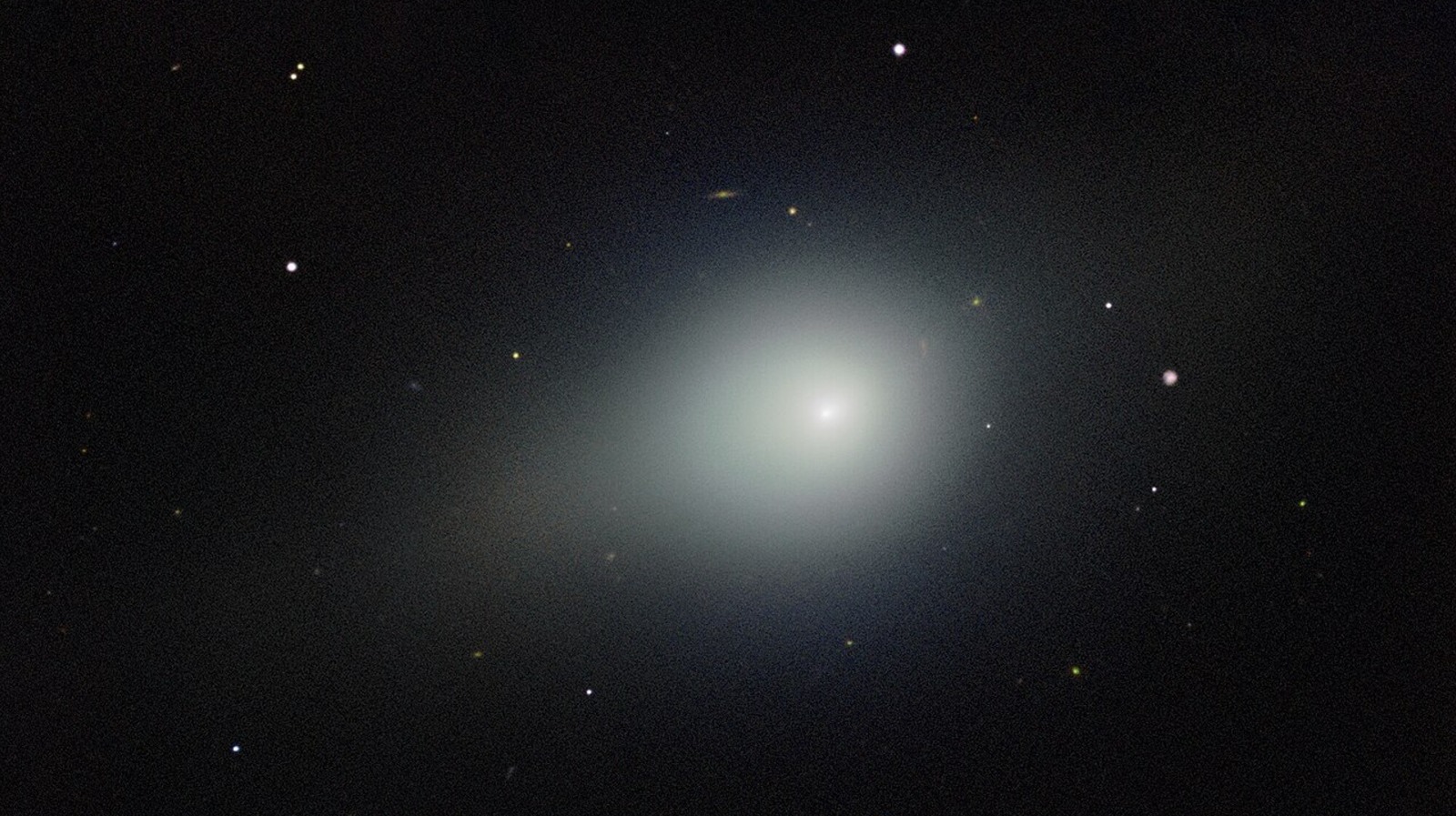
When some scientists and conspiracy theorists saw the strange trajectory of the space object 3I/ATLAS, some of them thought one thing: aliens. With a bizarre shape, an unusually precise trajectory, and unpredictable acceleration patterns, several observers believed 3I/ATLAS was of extraterrestrial design. But a new paper might provide some much needed clues about the origins of this strange object. Spoiler alert: It likely isn’t an alien.
Submitted to Research Notes of the AAS, the paper likens the behavior of 3I/ATLAS to that of other comets zooming through our solar system, linking its abnormal flight patterns to a phenomenon called outgassing, which can change speed, spin, and orbit trajectory. According to the paper’s author Marshall Eubanks, the team measured the objects non-gravitational acceleration through two interplanetary spacecraft. The results, according to Eubanks, showed that the object followed typical patterns of other comets flying through our solar system.
The paper largely debunks months of speculation, during which a group of Harvard astrophysicists speculated that 3I/ATLAS might be a piece of alien technology. Avi Loeb, a Harvard astrophysicist, even discussed the possibility on the Joe Rogan podcast after releasing a draft paper on the subject in July 2025. Such worries were heightened in late December, when astronomers discovered that the comet was emitting a strange radio signal. This isn’t the first time that Loeb and others have made raised the possibility of aliens in recent years, however. In 2017, for example, the comet Oumuamua passed through the solar system exhibiting similar characteristics. This time, however, interplanetary spacecraft allowed astronomers to conduct novel experiments, gauging the comet’s non-gravitational acceleration without observing multiple orbits. As such, the comet’s legacy may be its window into the composition of distant solar systems, rather than a sign of visitors from outer space.
An interstellar visitor?
3I/ATLAS has fascinated the scientific community since it was discovered by the Asteroid Terrestrial-impact Last Alert System (ATLAS) survey telescope in Rio Hurtado, Chile, in July 2025. Due to its trajectory and speed, ATLAS determined that the comet originated from outside our solar system, making it only the third interstellar object of its kind ever recorded. Consisting of a large icy core that scientists estimate is between 1,400 feet and 3.5 miles in diameter, the comet is surrounded by a bright cloud of dust and gas, known as a coma. Traveling on a hyperbolic trajectory, meaning it is too fast to be pulled into closed orbit around the sun, the comet hit a top speed of 153,000 mph as it passed outside Mars’ orbit in October 2025.
Speculation that 3I/ATLAS could be an interplanetary, alien visitor were rooted in these highly unique characteristics, especially its unique flight pattern. According to Avi Loeb’s paper – titled “Is the Interstellar Object 3I/ATLAS Alien Technology?” — the comet’s trajectory is highly improbable, taking a route that passes strangely close to Venus, Jupiter, and Mars, which Loeb’s team determined would only occur 0.005% of the time. Further unlikely irregularities, such as its unique retrograde orbital plane and a perihelion, or point in which the comet is closest to the sun, that conveniently occurs when Earth is on the other side, obstructing it from view, testified to Loeb’s theory of interstellar travel. Written largely as a theoretical exercise, the paper explored the popular “Dark Forest” theory, in which human’s lack of extraterrestrial evidence is an intentional strategy by hostile, silent intergalactic neighbors. With this assumption, Loeb’s team hypothesized that the object’s unique properties, including its obstructed perihelion, pointed towards the possibility of an alien species conducting a clandestine mission within our solar system.
An anomaly explained
Unfortunately for sci-fi fans everywhere, the recent study puts much of these theories to bed. Led by T. Marshall Eubanks at Space Initiatives Inc., the study was a international effort, with astronomers in England, Luxembourg, France, and Chile collaborating with three American scientists from the Institute for Interstellar Studies in Oak Ridge, Tennessee, the Jet Propulsion Laboratory in Pasadena, and the aforementioned Space Initiatives Inc in Princeton, West Virginia.
Triaging six observations from two interplanetary spacecraft, European Space Agency’s Mars Trace Gas Orbiter and NASA’s Psyche, the team was able to measure the object’s non-gravitational acceleration, or the acceleration rate not caused by changes in gravitational pull. These measurements were highly precise — roughly a few hundred millionths of the Earth’s gravitational pull, a finding previously deemed impossible without studying multiple orbits. According to the paper, the small accelerations and unusual trajectory were likely caused by phenomenon called outgassing, in which the dust and gas of a comet’s coma shoot off in small, propulsive bursts. Following the revelation, Eubanks dispelled any controversial theories, telling Spaceweather.com, “The results are pretty typical of ordinary comets, and certainly not record-breaking.”
As it stands, it appears highly unlikely that 3I/ATLAS will testify to the possibility of extraterrestrial life. But despite the mystery likely being solved, 3I/ATLAS still offers scientists the rare opportunity to study an interstellar object, potentially revealing the composition of distant solar systems. Amateur astronomers can even track the comet’s trajectory through NASA’s Eyes On The Solar System module. As it stands, the comet’s next major event will be its approach of Jupiter, which it is expected to pass on March 15, 2026.