




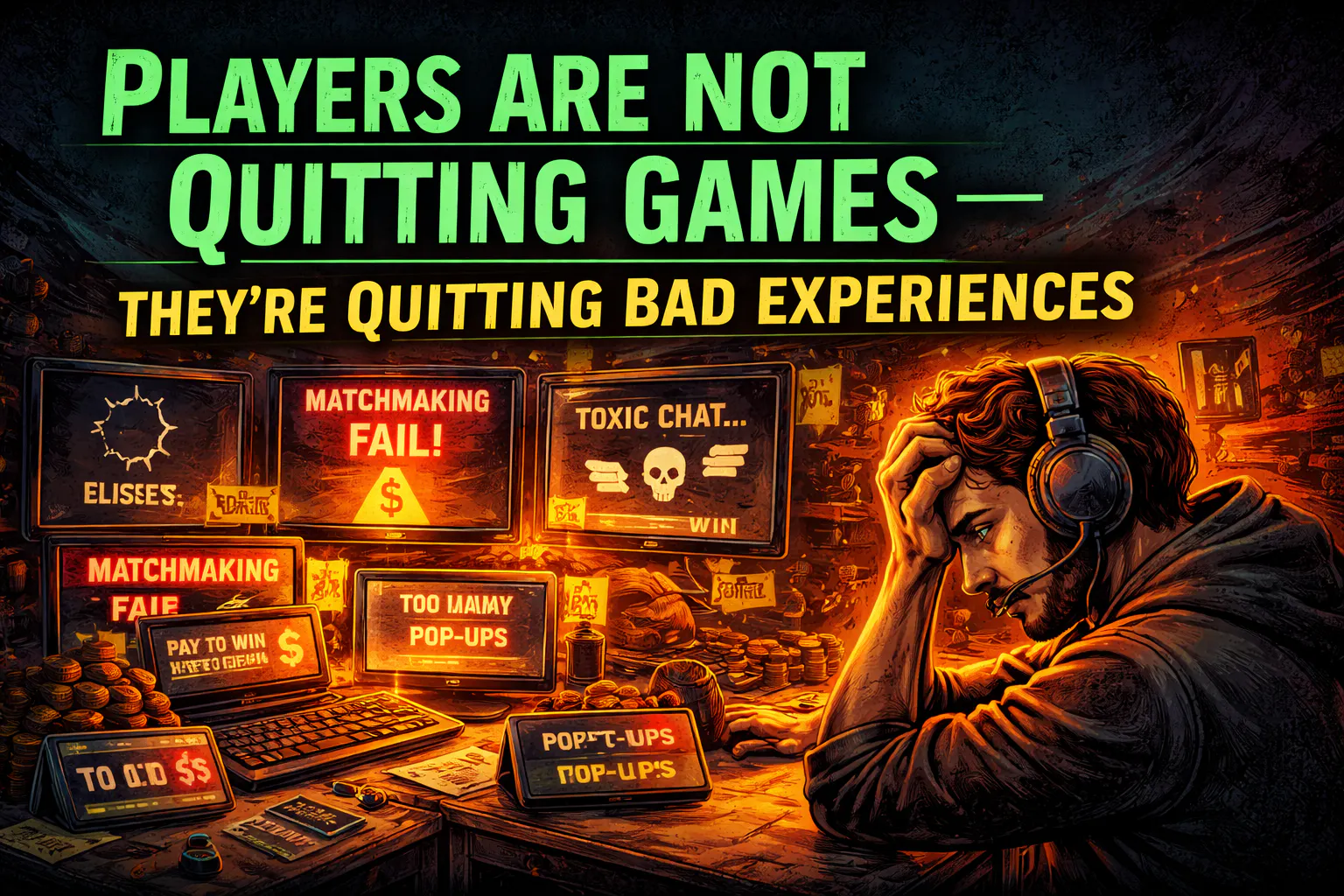
The gaming industry has a favorite excuse.
When players leave, studios blame short attention spans. They blame crowded markets. They blame modern habits, social media, burnout, or the idea that players simply do not stay loyal anymore.
That explanation sounds clever, but it protects the industry from asking a harder question.
What if players are not quitting because they care less?
What if they are quitting because too many games have become frustrating, bloated, manipulative, and exhausting to play?
That is the part gaming still struggles to admit.
Because it is easier to blame the audience than to admit that the experience got worse.
The truth is, people still care deeply about games. They still wait for launches, follow updates, watch creators, and spend hundreds of hours on titles that feel rewarding. They still form communities, build routines, and attach real emotion to games that respect them.
Passion is not gone.
Tolerance is.
Players are not quitting games because gaming matters less. They are quitting because too many games now demand more patience than they deserve.
Friction Is Not the Same as Depth
Somewhere along the way, many studios started confusing inconvenience with good design.
A cluttered progression system became “engagement.” n A heavy grind became “retention.” n Too many currencies became “economic depth.” n Constant pressure became “live-service energy.”
Then the industry acted surprised when players left.
A lot of modern games do not fail because they lack content. They fail because they put too much friction between the player and the fun.
Open the game. n Install the update. n Close the pop-up. n Check the event tab. n Claim the reward. n See the bundle offer. n Read the battle pass screen. n Sort through daily tasks.
Only then do you actually get to play.
That is not exciting. It is exhausting.
Many games now feel less like entertainment and more like systems that constantly ask for attention. They do not pull players in with joy. They hold them in place with pressure.
Players feel that immediately.
Bigger Games Are Not Automatically Better
The industry has spent years chasing scale.
Bigger worlds. Bigger maps. Bigger content plans. Bigger seasonal roadmaps. Bigger promises.
But bigger is not always better. Sometimes bigger just means heavier.
A lot of games today are not fun in proportion to their size. They are tiring in proportion to their size. They overwhelm players with menus, systems, currencies, events, and progression loops, then wonder why excitement fades so quickly.
This is one of the biggest problems in gaming right now: too many games are designed to look massive before they are designed to feel good.
The trailer looks polished. n The feature list looks impressive. n The roadmap looks ambitious.
But the experience feels crowded, unstable, and strangely joyless.
Players notice that fast. They do not need months to decide whether a game respects their time. They can feel it in a single weekend, sometimes in a single session.
And when they feel it, they leave.
Not because they are weak. Not because they are impatient. Not because they got distracted.
They leave because the product is not delivering enough fun for the amount of friction it demands.
Live Service Turned Play Into Obligation
Live-service design changed gaming in powerful ways. It made games more dynamic, more social, and more profitable. It also pushed many games into dangerous territory, where they stopped feeling like entertainment and started feeling like maintenance.
That shift matters.
A game used to ask, “Do you want to spend time here?”
Now, many games ask, “Can you keep up?”
Log in today or miss the reward. n Finish the pass before the season ends. n Play the event before it rotates out. n Buy now before the bundle disappears. n Stay active or fall behind.
This pressure is not always obvious, but players still feel it. It changes the emotional texture of the experience. Even when the gameplay is solid, the surrounding structure can make the game feel heavy.
That is why so many players do not rage-quit anymore. They fatigue-quit.
They do not uninstall in anger. They just stop opening the game. They tell themselves they will return later. They never do.
That quiet exit is more damaging than outrage. Anger means people still care. Silence usually means the game has become a chore.
And people already have enough chores.
Grinding Is Fine. Meaningless Grinding Is Not
Players have never had a problem with effort.
They will grind for gear, practice mechanics, study systems, replay matches, and spend hours improving if the effort feels meaningful. Difficulty is not the issue. Time investment is not the issue.
The problem is emptiness.
If grinding leads to mastery, progress, status, or identity, players embrace it. If it feels like an artificial delay designed to stretch playtime, the illusion breaks quickly.
That is where many games fail. They treat player time like something to extract rather than something to respect. They inflate progress instead of deepening it. They add chores instead of meaningful loops.
Players can tell the difference.
They know when a game is challenging them. n They know when it is stalling them. n They know when a reward feels earned. n They know when it feels manipulative.
Once that trust breaks, retention gets much harder.
Bad Experience Is Never Just One Problem
Most players do not leave because of one dramatic failure. They leave because of accumulation.
One buggy patch. n One unfair balance change. n One broken matchmaking streak. n One weak update. n One overpriced store push. n One too many pop-ups. n One more reminder that monetization seems more polished than the game itself.
Any single issue might be survivable.
But when these problems pile up, the experience changes. The game begins to feel heavier every time the player returns. What used to feel exciting starts feeling mentally expensive.
That is when the connection breaks.
Studios often focus on major moments like launch, reviews, and patch notes. But retention is often shaped by smaller repeated frustrations. Not the dramatic failure, but the constant irritation.
Players remember that feeling.
A game can look beautiful and still feel draining.
Toxicity, Bugs, and Bad Systems Are the Product
Gaming companies sometimes talk about community issues, UI issues, server issues, and progression issues as if they are side problems.
They are not.
Bad matchmaking is part of the experience. n Cheating is part of the experience. n Toxic voice chat is part of the experience. n Lag is part of the experience. n A terrible UI is part of the experience.
Players do not separate these problems from the game itself. To them, the total experience is the product.
So when a game feels unstable, hostile, or unfair, it does not matter how strong the art direction is or how expensive the cinematic trailer was. The player remembers the frustration.
That is why the “players have no patience” excuse feels so weak. Why should players keep defending games that launch unfinished, communicate poorly, and then ask for more money on top of that?
At some point, leaving is not impatience.
It is common sense.
Players Are Harder to Fool
This is the real shift in gaming.
Players still want great worlds, strong stories, rewarding competition, and long-term communities. None of that changed.
What changed is their willingness to tolerate bad design wrapped in hype.
A famous IP is not enough. n A giant map is not enough. n A polished trailer is not enough. n A roadmap is not enough.
If the experience feels bloated, repetitive, manipulative, or emotionally draining, players will leave.
And when they leave, it is not always because another game stole them. Sometimes the game destroys its own retention by making itself feel heavier every month.
Better Experience Is the Real Retention Strategy
The smartest studios will stop asking how to trap players longer and start asking a better question:
What makes coming back feel natural?
Not addictive. n Not mandatory. n Natural.
The answer is not more systems. It is a better experience.
Cleaner design. n Fairer progression. n Less wasted motion. n Better stability. n More trust. n More fun.
Players are not quitting games.
They are quitting games that feel like chores, stores, casinos, or broken workplaces, pretending to be entertainment.
And the studios that understand that first will not need to beg for loyalty.
They will build games that players actually want to return to.


