Legacy code is the dark matter of the software universe. It holds everything together, but nobody wants to touch it.
If you work in enterprise software, you know the struggle: monolithic Java applications, 500-page design documents (PDFs!), and “spaghetti code” that breaks if you breathe on it wrong.
Most AI tutorials show you how to build new apps. But can GenAI actually handle the grit of a 10-year-old legacy system?
In this experiment, we took a massive, real-world Library Management System (built on older Java standards) and stress-tested GPT-4 across the entire Software Development Lifecycle (SDLC). We didn’t just ask it to “write code”, we tried to use it for UI specs, dependency management, and complex test case generation.
Here is what worked, what failed, and the exact workflow you can use to modernize your legacy projects.
The Challenge: The “Bloated Test” Problem
Our subject was a specific module of a Library System (WebiLis/iLiswing). The team faced a classic enterprise problem:
- Complex Configurations: The software runs in varied environments, leading to an explosion of test patterns.
- Skill Gap: transferring knowledge to offshore Global Delivery Centers (GDC) resulted in misinterpretations of design specs.
- Review Fatigue: Senior devs were spending hours catching typos instead of fixing logic.
We integrated an internal ChatAI wrapper (powered by GPT-4) to see if we could automate the pain away.
Phase 1: The Low-Hanging Fruit (UI & Documentation)
Before touching code, we looked at the Design Phase. We fed the AI raw requirement lists and asked it to generate UI Design Specifications.
The Experiment
We deliberately introduced errors into the UI specs:
- Typos: “School Building” instead of “School Library.”
- Logic Errors: “Old System” instead of “Old System.”
The Result
GPT-4 crushed this. It identified contextual typos that spellcheckers missed.
-
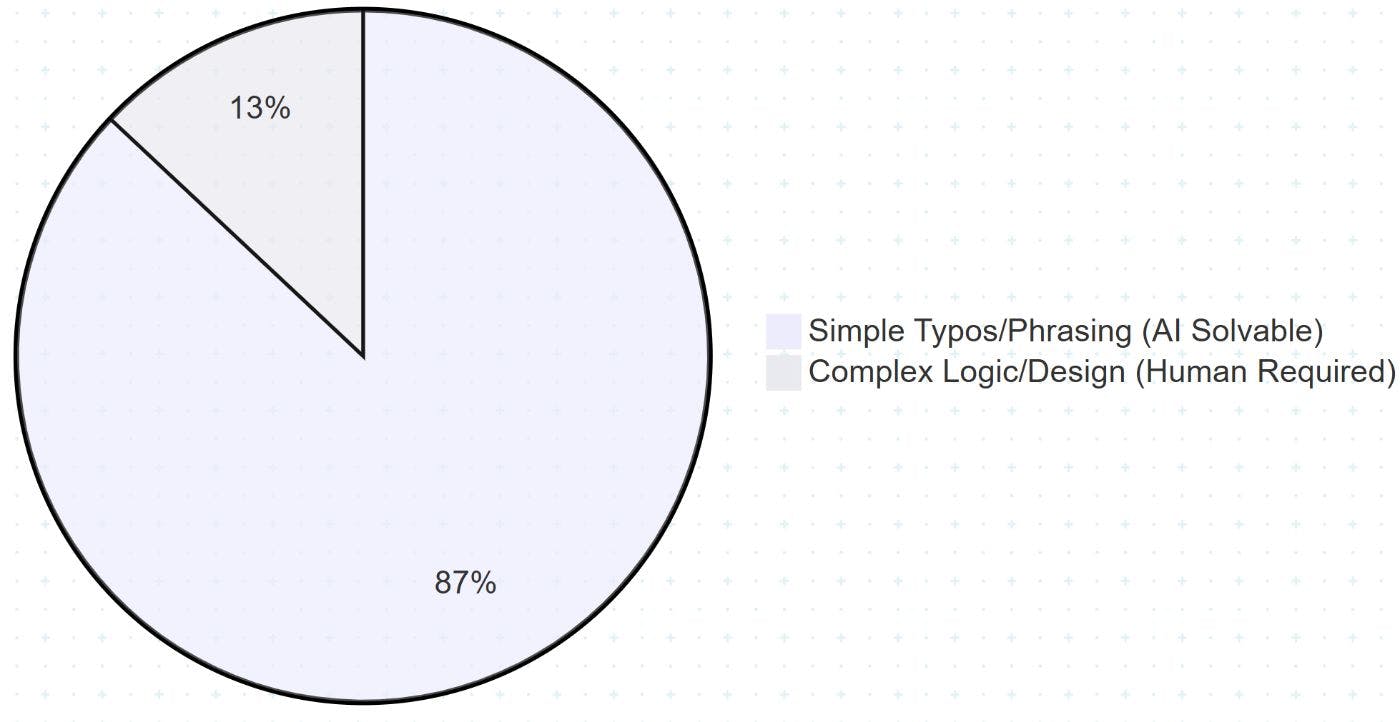
The Data: When we analyzed our manual code reviews, we found that 87% of review comments were related to simple phrasing, typos, or lack of clarity. Only 13% were deep structural issues.
-
The “AI Reviewer” Workflow: By running specs through GPT-4 before the human review, we could eliminate 87% of the noise.
:::tip
Takeaway: Don’t waste senior engineer time on grammar. Use LLMs as a “Tier 0” reviewer for documentation to clean up the noise before a human sees it.
:::
Phase 2: Generative Coding (Java & Maven)
Next, we moved to the PG (Programming) Phase. We asked the AI to generate Java code for specific utility functions.
Success: Boilerplate & Dependencies
We asked for a program to calculate dates using standard Java libraries. n Prompt: “Create a Java program that inputs a number and calculates the date X days from the system date.”
AI Output:
import java.time.LocalDate;
import java.util.Scanner;

public class Main {
    public static void main(String[] args) {
        Scanner scanner = new Scanner(System.in);
        System.out.println("How many days to calculate?");
        int days = scanner.nextInt();

        LocalDate today = LocalDate.now();
        LocalDate futureDate = today.plusDays(days);

        System.out.println(days + " days later is " + futureDate);
    }
}
It correctly used java.time.LocalDate (modern Java) rather than the deprecated java.util.Date.
It also successfully generated valid Maven Dependencies when we asked it to check library versions:
#Xml
<dependency>
    <groupId>org.apache.httpcomponents</groupId>
    <artifactId>httpclient</artifactId>
    <version>4.5.13</version> <!-- AI identified the stable version -->
</dependency>
Failure: The “Context Gap”
We tried to feed it two proprietary Java source files and asked it to refactor a specific method.
- Result: Failure.
- Why: The AI hallucinated methods that didn’t exist in our custom classes because it didn’t have the full project context (the “Class Path”).
Crucial Finding: GPT-4 is great at standard libraries (JDK, Apache Commons) but terrible at proprietary “Spaghetti Code” unless you provide the entire dependency tree in the prompt.
Phase 3: The “Turing Test” for Compilers
We tried something sneaky. We fed the AI code with subtle syntax errors to see if it could debug them better than a compiler.
The Test: We used iff (a typo) instead of if.
- Compiler: Throws a syntax error.
- AI: Correctly identified that iff isn’t valid Java, but suggested it might be a variable name if not a typo.
The Test: We fed it a logic bug where a condition could never be true.
- AI: Failed to catch it.
:::tip
==Reality Check:== GenAI is not a compiler. It guesses the probability of tokens. It is excellent at explaining why an error might be happening, but it cannot guarantee code correctness like a static analysis tool (SonarQube) can.
:::
Phase 4: Test Case Generation (The Danger Zone)
This was the most critical part of the experiment. We asked the AI to generate Test Cases for the Date Calculation program above.
Prompt: “Generate test cases for the date program.”
AI Result (Initial): It generated generic cases:
- Input: 5
- Input: 10
- Input: -1
The Problem: It didn’t provide the expected output. Why? because the output depends on LocalDate.now(), which changes every day. The AI couldn’t “run” the code to know what today is.
The Prompt Engineering Fix: To get useful test cases, we had to be explicit about variables.
:::tip
==Refined Prompt:== “Assume the variable today is ‘2024-06-15’. Generate 4 test patterns for the variable days.”
:::
AI Result (Fixed):
| Test Case | Input (Days) | Expected Output (Date) |
|—-|—-|—-|
| Case 1 | 1 | 2025-06-16 |
| Case 2 | 10 | 2025-06-25 |
| Case 3 | 0 | 2025-06-15 |
| Case 4 | -5 | 2025-06-10 |
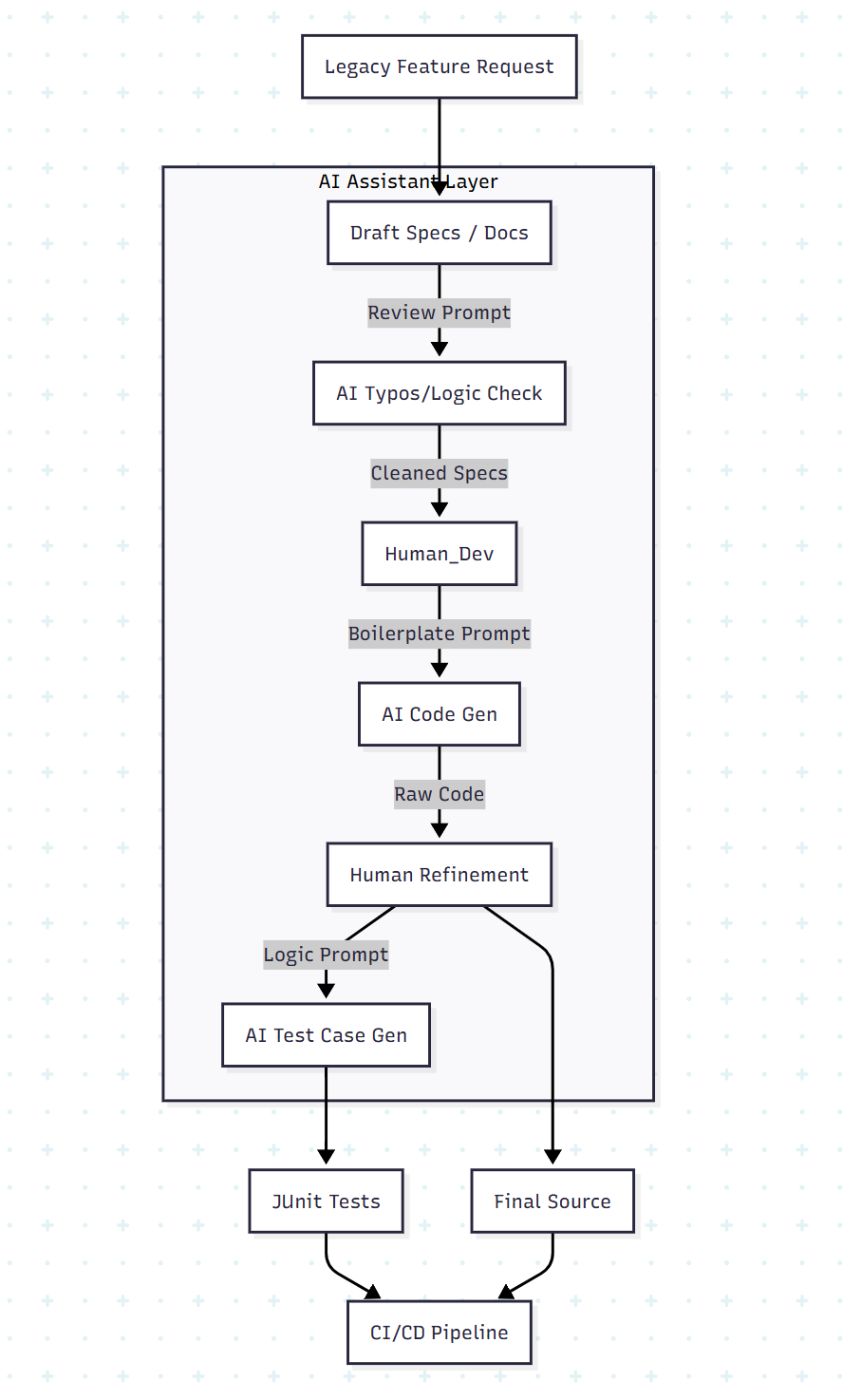
The Workflow for Modernizing Legacy Systems
Based on our verification, here is the architecture you should adopt when applying AI to legacy product development.
Conclusion: The “37% Boost” Reality
MIT researchers claim a 37% productivity increase using Generative AI. Our internal verification supports this, but with a caveat.
The productivity didn’t come from the AI writing perfect complex code. It came from shifting the burden of the mundane.
- Reviews: AI handled the grammar/typo checking (87% of issues), letting humans focus on architecture.
- Boilerplate: AI handled the standard Java imports and setup.
- Tests: AI generated the structure of test cases, even if humans had to verify the logic.
The Verdict: If you are managing a legacy system, don’t expect GPT-4 to rewrite your core engine overnight. Do use it to clean your documentation, generate your test skeletons, and explain those cryptic 10-year-old error messages.
What’s Next?
The next frontier is RAG (Retrieval-Augmented Generation). By indexing our 500 pages of PDF manuals into a Vector Database, we aim to give the AI the “Context” it missed in Phase 2, allowing it to understand proprietary methods as well as it understands standard Java.