




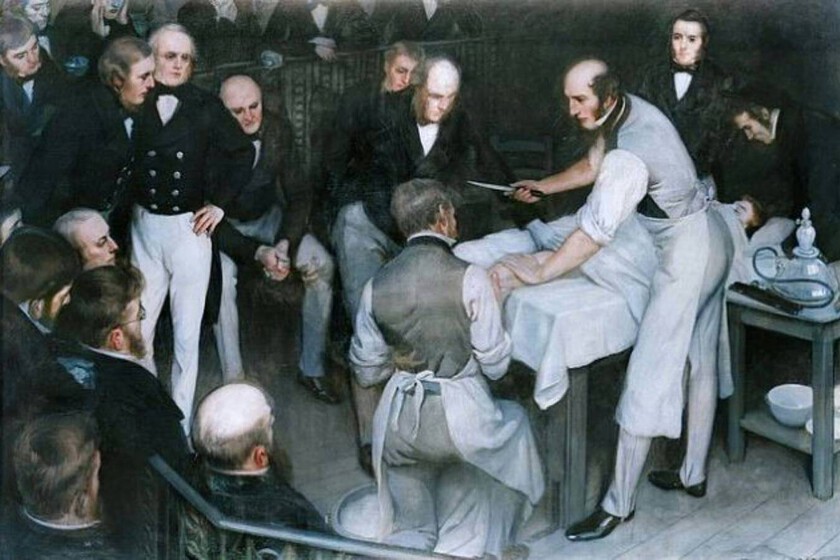
Two and a half minutes. That’s how long it took Dr. Robert Liston to amputate a leg, from making the first incision to cutting the loose threads of the sutures. Today he would be considered reckless, sloppy and careless; but, quite the contrary, in Liston’s time he was considered the most reputable surgeon in the United Kingdom.
And also a clear example of the beginnings of modern medicine.
Your story. We are talking about the first half of the 19th century, a world without anesthesia in which every second was essential. Not only did it minimize the patient’s pain, but it greatly improved the chances of survival. According to medical historian Richard Gordon, it is estimated that one in ten patients died on the tables at the University College Hospital where Liston operated.
In those at St. Bart’s hospital, also in London, one in four died. Surgery was a race against death.
at the doors. That virtuosity caused dozens of patients to camp at the door of the hospital asking to be treated. Especially, cases that had already been resolved by other surgeons. Among the most striking are a 20 and a half kilo scrotal tumor or an aortic aneurysm that is still preserved in the UCH pathology museum.
Problems. But, of course, speed is not always good and the stories attest to this. Historians do not agree on which are true and which are, but there is a group of them that, due to their gruesome spectacularity, would well deserve to be so. It is said that, once, along with the leg he was trying to amputate, he took the patient’s testicles. But the most famous is another.
In that legendary operation, Liston’s speed was such that, without realizing it, he amputated two of his assistant’s fingers next to the patient’s leg. Immediately afterwards, frightened by the accident, he stuck the scalpel into a student who was observing the operation. All three (patient, assistant and student) died from wound infection. And that operation went down in the annals for being the only one we know of with a mortality of 300%.
Pioneer. It is curious that Liston was also the first European surgeon to use the technology that has allowed twelve-hour operations without blinking. On December 21, 1846, he performed the first operation under anesthesia in Europe. A handful of weeks after William TG Morton’s famous surgery at Mass General in Boston.

A century for them. Just in 1846 the “century of surgeons” (as Jürgen Thorwald called it) began. One hundred years during which surgery took great strides to free humanity from pain, infections and disease and during which surgeons were able to access the most hidden parts of the human body (the liver, the brain, the spinal cord or the lungs). Liston was one of those heroes who helped create the world as we know it.
Images | Wellcome


