




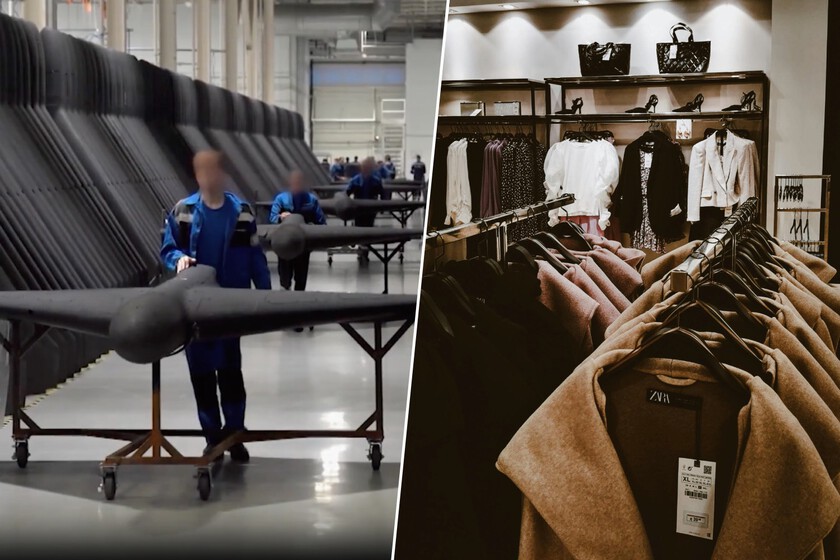
In recent months, a strange wave of Western products has begun to reappear in places where, on paper, they should no longer exist. Between geopolitical changes, forced business exits and an increasingly opaque market, certain brands have unexpectedly become visible again, fueling rumors, theories about how they are getting there and who is really pulling the strings of their distribution towards Moscow.
Now a giant from Spain has (re)appeared: Inditex.
A market that does not close completely. After announcing the end of its operations in Russia a few days after the invasion of Ukraine, Inditex left its second largest market behind and sold its business in the country. However, more than two years later, garments with official labels from brands such as Zara, Bershka, Oysho, Stradivarius or Massimo Dutti have reappeared on the shelves of the Russian chain Tvoe, now renamed Tvoe n Ko, which boasts on social networks a “constantly updated” selection and presents the collections as almost clandestine finds.
The pieces, which match models from previous seasons and carry prices in euros, are already sold in at least 19 Russian stores without (according to the official version offered) any contractual relationship between the Spanish company and the local distributor. In fact, they come two months after the executive director of Inditex, Óscar García Maceiras, declared to the Financial Times that the conditions for his return to Russia “were not met.”
The engineering of the Russian gray market. A few hours ago the FT reported that the mechanism that allows the reappearance of these garments is based on the system of “parallel imports” established by Moscow to circumvent the massive departures of Western brands. This scheme operates Disco Club LLC, a Russian company that has registered 18 declarations of conformity citing Inditex as a supplier and presenting itself as its “authorized representative”, despite the fact that Inditex flatly denies having granted such permission.
The garments come partly from inventories originally destined for several EU countries and partly from Chinese factories, according to labels and customs documents, in a circuit that takes advantage of legal loopholes and the Kremlin’s lack of inhibition to give formal cover to a trade that would previously have been considered contraband.
The denial. For its part, Tvoe assures that it does not have direct agreements with Inditex and hides behind confidentiality agreements so as not to detail its suppliers, while Disco Club insists that it only provided a “punctual technical service.”
Burkhard Binder, the businessman linked to the founding of the company and based in Dubai, is disassociating himself from current operations. Inditex, known for its tight control of inventory, distribution and franchises, completely rejects any link: it claims not to have authorized Disco Club or any Russian entity to act on its behalf and avoids commenting on how its products arrive in the country since it withdrew.
Matter of time. We have been saying it: the ability of the Russian economy to adapt in the midst of war has shown that international restrictions, no matter how strict, always find cracks. A country that has rebuilt complex supply chains to produce drones, precision munitions or long-range missiles despite technological embargoes and industrial vetoes was not going to have difficulties reopening the door to much “simpler” products, such as Western fashion clothing.
In this context, the reappearance of Zara clothing in Russian stores is not so much surprising as confirming a trend: Moscow has perfected an ecosystem of parallel imports capable of circumventing almost any blockade, from military components to T-shirts and dresses from past seasons, turning the impossible into routine and the prohibited into a merely logistical problem.

Russia, a laboratory of consumption in times of sanctions. The appearance of Zara products in Russia despite the company’s departure illustrates the magnitude of the gray market that Moscow has made official since 2022: an ecosystem that allows consumers to access Western brands through private intermediaries and indirect routes, without participation of the original companies.
In this context, the reappearance of the Spanish firm in the Russian commercial landscape is not due to a business return, but rather to a state-run mechanism of commercial evasion that turns its garments into parallel import merchandise.
If you like, the phenomenon also reveals the extent to which Russia has rebuilt its global consumption through third countries and front companies, and how even the strictest groups in the control of its supply chain cannot prevent its products from reappearing in a market from which they tried to leave permanently.
Image | Pexels
In WorldOfSoftware | Ukraine has opened the Russian ballistic missile that has devastated its cities. Your surprise is a condemnation: your main supplier is untouchable
In WorldOfSoftware | Zara has been selling clothes for years. Now he aspires to sell something more difficult: prestige


