





Key takeaways
- Use social listening to drive strategy, not just reporting. Leverage real-time insights to shape messaging, elevate customer experiences, and drive product improvements.
- Tie listening efforts to clear business goals. Whether it’s boosting brand awareness, improving response times, or identifying market gaps, define and track the metrics that matter, including share of voice, sentiment, and engagement.
- React fast — then optimize. Spot trending topics, negative sentiment, or potential crises early. Use those insights to adapt your content strategy and stay one step ahead of competitors.
Social listening is not just about tracking likes or retweets. Smart marketing teams use it to understand customer needs, spot industry trends, and boost brand awareness.
Think of it as eavesdropping (the ethical kind!) to uncover invaluable audience insights that can become the basis of an effective, customer-focused marketing strategy.
Ready to make it work for you? This guide breaks down the benefits of social listening, walks you through building a social listening strategy, and shares tips for optimizing your efforts.
Social listening is the practice of tracking social media platforms, websites, forums, and even podcasts to understand what people say about your brand name, competitors, or industry.
It’s like having a front-row seat to real, relevant conversations across social media channels.
At a high level, social listening moves through four stages: monitoring, analysis, insights, and action.
- Monitoring: Tracking relevant conversations, including brand mentions, keywords, and competitors.
- Analysis: Looking at that data to understand sentiment (positive, negative, or neutral) and recurring themes.
- Insights: Pulling out trends, customer pain points, and unmet needs.
- Action: Acting on those insights to shape messaging, customer experience, and product decisions.
In short, social listening turns large volumes of conversation data into real business insight.
Social media monitoring tracks what people are saying, whereas social listening looks at why they’re saying it, and what to do next.
Let’s take a closer look at how they differ.
| Social monitoring | Social listening | |
| Focus | What people are saying | Why people are saying it |
| Goal | To track conversations online and reply quickly | To learn from those conversations and improve messaging, products, and customer support. |
| Data | Mentions, comments, DMs | Conversations, sentiment, patterns |
| Level of detail | Surface-level | Deeper understanding |
Social listening turns ongoing conversations into insight, helping you drive smarter decisions across marketing, product, and support.
Here’s why social listening is a must for any social media strategy:
- Stay on-trend. Social media listening tools can spot trending topics, keeping your branded content culturally relevant.
- Improve customer experience. Catch pain points early and improve your processes accordingly. It can also enhance customer advocacy by giving you a behind-the-scenes look at what customers want.
- Guide product development. Build an entire product roadmap (or validate an existing one) through customer feedback.
- Protect brand reputation. Spot negative sentiment or potential crises fast and react immediately (sometimes even turning these situations into publicity wins).
- Prove ROI. With global ad spend expected to exceed 1 trillion dollars for the first time in 2026, social listening can help advertisers get more bang for their buck. It ties insights to metrics like engagement, share of voice, and sentiment, showing how your marketing campaigns deliver on business goals.
Here’s how Brian Wright, Head of Social Listening at Wells Fargo, summed it up in a conversation with eMarketer: “Social listening provides real-time insights for strategic decision-making, especially during change.”
TL;DR: Social listening is your ticket to smarter marketing campaigns and decision-making across teams.
To build a social listening strategy, define clear goals, choose the right tools, set up targeted queries, analyze conversation data, and continuously measure and optimize results.
Let’s break it down, step by step:
- Step 1: Set clear goals
- Step 2: Pick the right social listening tools
- Step 3: Set up your queries
- Step 4: Analyze the data
- Step 5: Measure and optimize
Step 1: Set clear goals
Your social listening strategy should tie to specific business goals.
Want to boost brand awareness? Monitor share of voice. Need to optimize customer experience? Track negative sentiment.
Here are the common use cases for social listening:
- Brand monitoring: Track mentions of your brand to gauge sentiment.
- Competitive analysis: Monitor conversations happening around your competitors to spot common pain points and market gaps.
- Product development: Gather feedback for new and improved products and features.
- Crisis management: Spot potential crises in their early moments, and address them before they cause damage.
- Social media marketing: Strengthen content creation efforts by understanding what resonates.
Use SMART (specific, measurable, achievable, relevant, time-bound) goals to stay focused. For example, “Increase positive sentiment by 10% in Q1 by responding to 90% of customer mentions,” is a well-formulated goal.
Step 2: Pick the right social listening tools
You don’t need to scroll through tweets manually — social listening platforms should automate and scale the process for you.
Wondering how to choose a social listening tool? Here’s what to look for:
- Coverage: It should track key social platforms (including video-based networks like TikTok and YouTube), websites, forums, and emerging spaces like podcasts.
- Advanced analytics: Look for features like sentiment detection and analysis, hashtag tracking, influencer monitoring, and AI-powered insights.
- Enterprise readiness: Make sure the tool can support distributed teams with the right permissions, security standards, and reporting.
Psst: Hootsuite Listening is included in every plan (and free trial), so teams can track sentiment, trending hashtags, brands, and events in real time without adding another tool to their stack.
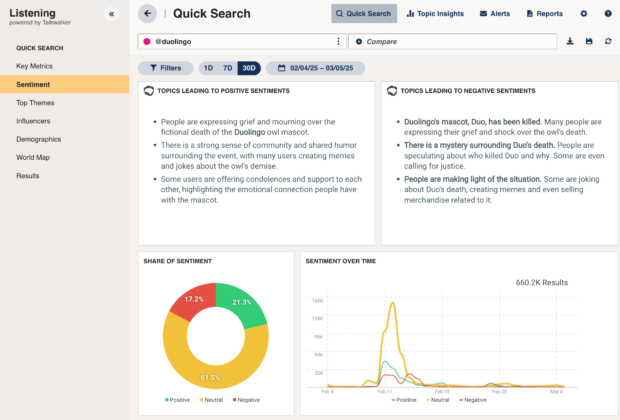
Using Quick Search, you can quickly see how conversations are trending, which themes are popping up, and how audience sentiment is shifting right now.

Step 3: Set up your queries
All social listening tools will allow you to track relevant keywords like your brand name, product names, or industry terms. Check out some of the best social listening tools for brands.
If you want to get more granular in your snooping, use Boolean logic in your queries:
- Broad queries: “brand name” OR “brandname” (cover misspellings).
- Sentiment filters: “brand name” AND “love” OR “hate”.
- Competitor queries: “competitor name” AND “fail” OR “issue”.

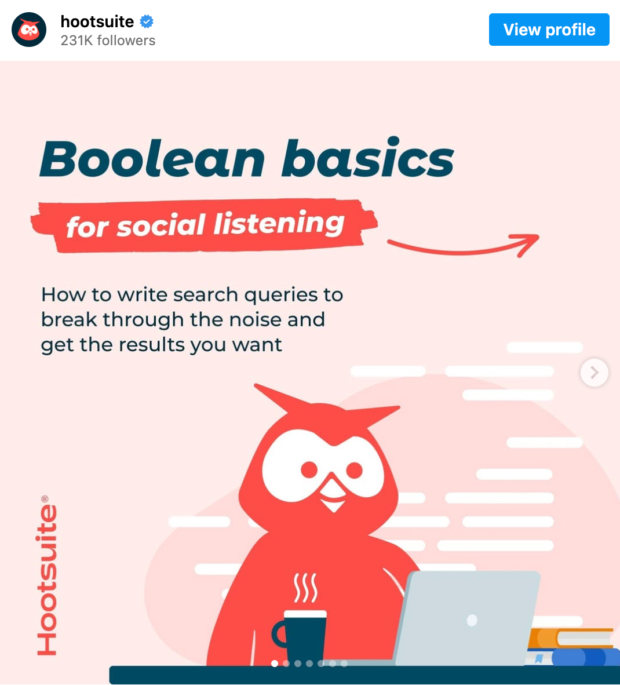
You can also include hashtags, emojis, or slang in your tracking, especially for TikTok or Snapchat. Influencer mentions and online conversations from niche communities can offer valuable insights too.
Pro tip: 💡 Try our free (no sign in required!) Boolean query generator to get started! Just tell it what you want to search for and it will build a full search that you can add to your social listening tool.
Step 4: Analyze the data
To make this task more manageable, start by grouping social listening insights into a few clear buckets:
- Sentiment: Are mentions of your brand positive, negative, or neutral?
- Trends: What hashtags or topics are trending?
- Pain points: Are there recurring complaints in your brand and product mentions?
- Opportunities: Can you spot customer needs none of your competitors are addressing?
But how do you action this data on a regular basis?
The key is creating communication lines so insights reach the right team.
For example, a marketing team might notice a spike in negative sentiment around delivery delays during a campaign launch. They flag it to customer support, giving them time to prepare responses before messages start piling up.
This makes social listening a shared intelligence resource, not just another marketing report.
Step 5: Measure and optimize
Remember the goals you set in step one? Now it’s time to see how much progress you’ve made.
Common metrics for social listening include share of voice, sentiment, response rate, engagement, and influencer impact.
You’ll also need to package this info and share it. This is where a tool like Hootsuite comes in handy, helping teams compare performance over time with clear, easy-to-read dashboards.
For more up-to-the-minute data, you can also look at hour-by-hour reactions and even set up alerts for spikes in mentions and shifts in sentiment.

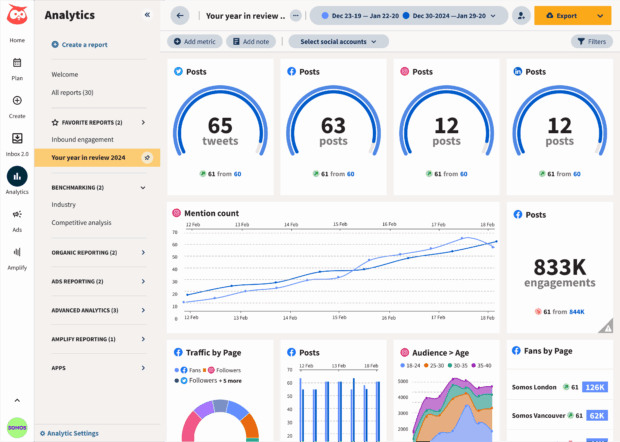
Check out this guide on how to build 10+ social media dashboards to make reporting simple.
Social listening examples: Real wins from real brands
Need proof that social listening works? These case studies show how brands turned insights into results
- NBA team: Used Talkwalker to analyze fan emotions, boosting video views by 352% and impressions by 46%. A 27% engagement lift across all social channels justified hiring a full-time social media lead.
- Hong Kong Airlines: Caught a pricing error via social media monitoring, fixed it fast, and saw a 4,900% engagement spike, turning a crisis into a PR win.
- HelloFresh: Tracked influencer mentions with Talkwalker, informing recipe and packaging tweaks that optimized marketing campaigns and proved ROI.
- Pharmaceutical company: Listened to MS patient conversations, leading to better support programs and messaging.
- Yves Rocher: Used social listening data to align product messaging with customer values like sustainability, strengthening brand reputation.
- Deutsche Telekom: Built a crisis response hub with Talkwalker for real-time brand monitoring, catching potential crises early.
These brands show that social listening isn’t just about collecting data. It’s also a helpful tool for more advanced content creation, customer support for current and potential customers, and market research.


#1 Easy Social Listening
Brand mentions, trending topics, and sentiment at your fingertips. Enhance your social strategy with the insights that matter.
Start free 30-day trial
Want to stand out? These tips, inspired by real-world wins, will supercharge your social listening strategy.
Hack #1: Build a sentiment template
Create a playbook for responding to positive, negative, or neutral mentions. This will help your team scale response rates — and lower response times.
Hack #2: Consistently monitor competitors
Track competitors’ brand mentions, hashtags, or pain points. Spot their weaknesses (e.g., slow customer support) and position your brand as the fix.
Bonus: You’ll catch industry emerging trends early using social media monitoring tools that surface relevant social media conversations and demographics data.
Hack #3: Set influencer alerts
Track mentions from influential accounts, like HelloFresh did, to tap into high-stakes conversations and validate your digital marketing efforts.
The meal kit delivery service set up real-time alerts for callouts from authors with more than 10,000 followers to never miss an opportunity to connect with an engaged target audience.
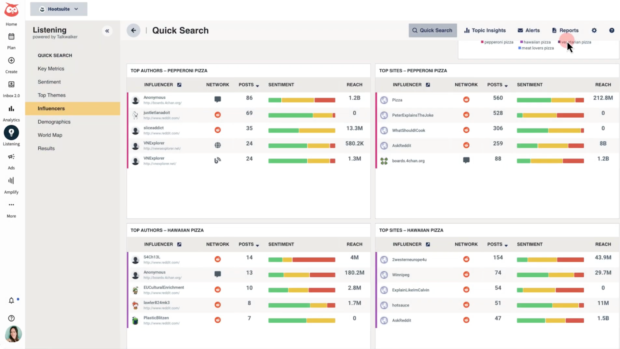
You can do this in Hootsuite Listening by popping over to the Influencers tab. See the top influencers in your space and what they’re saying.

Pro tip 💡: For authentic reach, engage microinfluencers — Gen Z trusts them most.
Social listening is moving fast, and it’s projected to hit $16.19 billion by 2029. Add to this the new spaces (like podcasts and AI-generated content) gaining traction with online audiences, and the math is clear — the brands that listen will win.
Irina Novoselsky, Hootsuite’s CEO, says:
Organizations that systematically capture and analyze social conversations feel more confident in their social ROI. The split is clear. Some still have to defend social in every board meeting, while others shape product roadmaps and forecast market shifts with customer intelligence.
So, if you’re ready to boost your social engagement and turn deep insights into new social media posts and measurable business results — give social listening a try today.
Ready to dive into social media listening? Here’s a quick checklist to kick things off:
- Pick a goal: Start with one, like tracking brand mentions or competitor analysis.
- Choose a tool: We recommend Hootsuite Listening. (Grab your free trial here!)
- Set up queries: Use relevant keywords, hashtags, and sentiment filters.
- Act on insights: Respond to customer feedback, join in on trending topics, or fix pain points.
- Track metrics: Measure engagement, impressions, or share of voice to illustrate the impact of your strategy.
FAQ: Social listening
What is social listening and how does it work for brands?
Social listening is how brands understand what people really think and feel by analyzing conversations across social media and the web. It works by tracking mentions, keywords, and trends, then looking at sentiment and themes over time. Using these insights, brands can better understand what matters to their customers and respond with more relevant content, products, and messaging.
Why should enterprises use social listening in 2026?
Enterprises should use social listening in 2026 because customer sentiment can shift faster than teams can react. Social listening surfaces early signals about risks, opportunities, and changing expectations so leaders aren’t making decisions in the dark. It also supports brand protection, campaign optimization, and smarter planning at scale.
How do companies use social listening to inform strategy and decisions?
Companies use social listening to guide strategy by turning audience conversations into clear insights. Marketing teams use it to pressure test campaigns and ideas, product teams use it to shape direction, and customer teams use it to spot common pain points.
Leadership can also use social listening to validate decisions and reduce risk before launching new initiatives.
What is the difference between social listening and social monitoring?
The difference between social listening and social monitoring is that monitoring tracks what is happening, while listening explains why it is happening. Social monitoring focuses on mentions, comments, and messages that need a response. Social listening goes deeper by analyzing trends, sentiment, and themes over time to support long-term planning.
How do enterprises operationalize social listening across teams?
Enterprises operationalize social listening by making insights easy to share and act on across teams. This usually means clear goals, simple reporting, and ownership for who responds or follows up.
When marketing, customer care, and leadership all use the same insights, social listening becomes part of how the business runs.
Hootsuite makes it easy to monitor keywords and conversations on social media, so you can focus on taking action on the insights available. Try it free today.


