Want to stay ahead of your competitors on social? Start with a social media competitive analysis.
We’ll break down the process, share our favorite tools, and hand you a free template so you can start analyzing like a pro.
Key Takeaways
- A competitor analysis shows how your brand stacks up on social, including your strengths, weaknesses, and opportunities.
- You’ll follow four steps: identify competitors, review their social activity, run a SWOT, and keep monitoring.
- Track engagement, follower growth, posting habits, and hashtags to spot quick wins and places to improve.
A social media competitor analysis is the process of looking at your competitors’ social content and activity to understand how they compare to your own performance.
When you run a competitor analysis, you can:
- Spot who your real competitors are on social
- See which platforms they’re active on
- Learn how they use each channel (organic posts, paid ads, influencer partnerships, or a mix)
- Spot new threats or emerging players
- Identify gaps, quick wins, and opportunities in your own social presence
A solid competitor analysis gives you a clearer picture of the landscape you’re actually competing in.
It shows you where you stand, what your target market expects, and how you can differentiate yourself in a way that actually feels meaningful (and strategic).
Here’s a full rundown of the benefits of a competitor analysis:
- Discover new ideas: Surface new formats, topics, and storytelling ideas you can test right away.
- Catch your audience at their peak: Learn the moments your target audience is most active online.
- Benchmark performance with confidence: Compare follower counts, engagement rates, market share, and share of voice to see where you stand.
- Get a read on customer pain points: Learn what frustrates your customers and how competitors offer customer support
- Match the right tone to the right channel: See how other brands communicate on each platform and what tone actually lands.
- Find ways to differentiate: Get inspiration for what to double down on so your brand feels distinct.
You can run a one-off competitive analysis report or review them monthly or quarterly. Most businesses take a hybrid approach.
You could create your own spreadsheet to keep track of all the information you gather during your social media competitive analysis.
But if you’d rather skip the time consuming steps, download our free social media competitive analysis template and just start plugging in the information you collect.
This template will also help you track key metrics, industry benchmarks, and KPIs, as well as monitor pricing trends across competitors. PS. There’s a tab for your SWOT analysis, too.
You can run a social media competitor analysis by finding your competitors, gathering performance data, and running a SWOT analysis.
Here’s a step-by-step guide:
Step 1. Find your competitors
Identify your competitive keywords
There’s a good chance you already know a few keywords your brand is trying to rank for. But take a beat to go even deeper.
For example, if you run a boutique Manhattan hotel with local art and wine tastings, your real competitors aren’t just “NYC hotels.” They’re other boutique experiences that attract the same kind of guest.
Tools like Google Keyword Planner and Google Search Console can identify the most relevant keywords for your brand.
Not sure where to start? Plug in your own website into these tools. You’ll get a list of relevant keywords, along with the average monthly searches and estimated level of competition.


Or, you can plug in your known target keywords. Again, you’ll get a list of related keywords with data on search volume and competition.
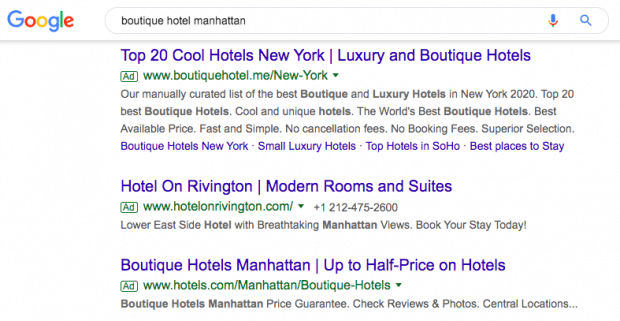
Check who’s ranking for those keywords in Google
Next, search your top 5–10 most relevant keywords on search engines like Google. Look for:
- Brands ranking on page one
- Brands paying for ads (a signal they’re investing heavily)
- Emerging or indirect competitors who may not dominate SEO just yet
Click through your competitors’ websites and grab their social handles for your spreadsheet.

Look at who ranks in social search
Ranking on Google doesn’t always = ranking on social platforms.
Since this is a social media competitive analysis, you need to see who shows up first in social search results, too. So, search your keywords directly in:
- TikTok
- YouTube
Take note of the brands that appear in Reels, For You, Shorts, or hashtag results. These are often your strongest content competitors.


You may have heard that TikTok has become Gen Z’s favorite search engine. So, if you’re trying to reach a younger audience, make sure to run a search there too.
See which brands your audience already follows
One of the easiest ways to spot competitors is to look at who your audience already follows.
Use platform analytics tools like Meta Business Suite Insights, TikTok Analytics, and Instagram Creator Insights to see what brands keep popping up.
As you scroll through the data, pay attention to:
- Brands your audience follows most often
- Patterns in interests or categories
- Competitors your audience interacts with regularly
Then, add any relevant brands to your competitor list.
Narrow it to your top 3–5 direct competitors
By this point, your list is getting long. But don’t worry – you won’t run an analysis on every single name.
Instead, narrow the list to 3–5 brands that:
- Attract a similar audience
- Offer similar products or experiences
- Compete with you most actively on social media
These are the competitors you’ll focus on for the rest of your analysis.
Psst: This is a great time to download our free social media competitive analysis template. It’ll help you organize your short list and compare competitors side-by-side in minutes.
Step 2. Gather intel
Now it’s time to see what your competitors are actually doing on social. Click through each competitor’s profiles and make note of the following:
- What social media platforms are they on?
- How large is their following and how fast is it growing?
- Who are their top followers?
- How often do they post?
- What is their engagement rate?
- What is their social share of voice?
- What hashtags do they use most often?
- How many hashtags do they use?
- What type of content performs best for them? (e.g., videos, newsletters, webinars)
You can gather a lot manually, but analytics tools make this so much faster. Check out the social media analytics tools mentioned below.
Pro tip 💡: Don’t forget to track your own metrics in the same way. You’ll need them in the next step.
Step 3. Do a SWOT analysis
Now that you’ve got the data, it’s time to turn it into insights.
Enter: the SWOT analysis. It’s a great tool to help you think clearly about all of this information (we even wrote a dedicated article on it) and strengthen your overall social media strategy.

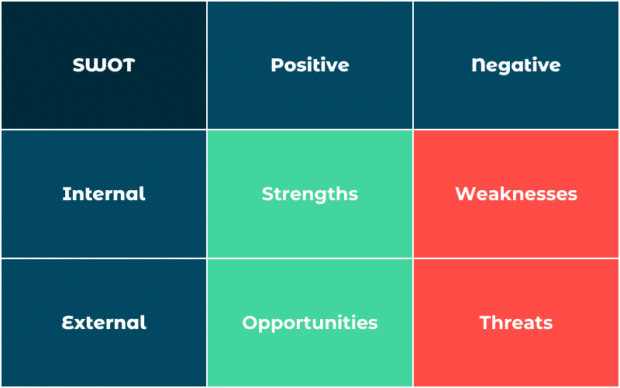
Here are some items to list in each quadrant of the SWOT template.
Strengths
List metrics for which your numbers are higher than the competition. This is your competitive advantage!
Make sure to use your strengths as differentiators when shaping your future content and unique value proposition.
Weaknesses
List metrics for which your numbers are lagging behind the competition. These are areas you’ll want to focus on improving through testing and tweaks to your social media strategic plans.
Keep in mind: you could have both strengths and weaknesses for each social network.
For example, maybe your LinkedIn follower count is higher than your competitors, but they have better follower growth. Or maybe you have fewer Instagram followers but higher engagement metrics.
That’s totally normal. Be as specific as possible, because these distinctions will help you identify your opportunities and threats.
Opportunities
Now that you can see where you stand compared to the competition, what gaps can you fill? Opportunities often come from shifts in the competitive landscape.
Maybe a competitor ignores TikTok. Maybe no one is speaking to a specific demographic or persona. Or maybe your content marketing mix is strong, but your posting frequency could be taken to the next level.
Look for areas where competitors’ products fall short, or where no one is addressing a specific audience need.
These are areas you’ll want to improve through testing and tweaks to your marketing efforts. The result? A stronger marketing strategy.
Threats
Now it’s time to look for anything happening outside your brand that could shake things up.
A new competitor — especially a fast-moving startup — is an obvious threat. But others can be more subtle.
For example, a competitor might:
- Launch new products or product lines
- Expand into a new market
- Update their offerings with new product features
- Shift their pricing strategy
Keep an eye on these signals so you can shift your social strategy in real time instead of getting caught off-guard.
A competitor analysis isn’t something you check off once and forget. It needs to live in your workflow, whether you revisit it quarterly or a couple times a year.
And to do that well, you need a steady stream of fresh data.
That’s where ongoing social monitoring comes in. Keeping an eye on what competitors post, how people react, and what’s popping in your industry helps you spot opportunities early and catch potential threats before they sneak up on you.
We’ll walk through tools you can use below, but the goal is simple: stay aware of conversations happening around your brand, your competitors, and your space. When something important pops up, jot it down in the Notes column of your competitor analysis template so you can fold it into your next SWOT refresh.
It’s a small habit that makes your future reviews way smarter and way easier.

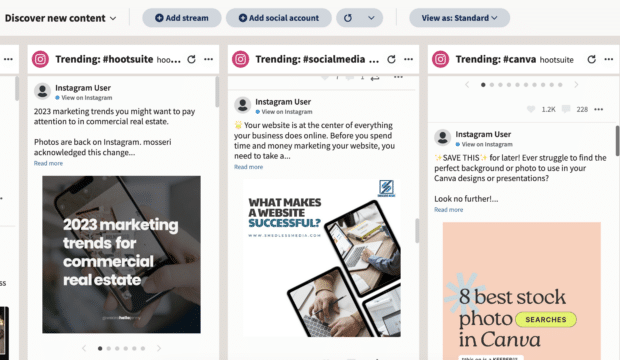
1. Hootsuite Analytics
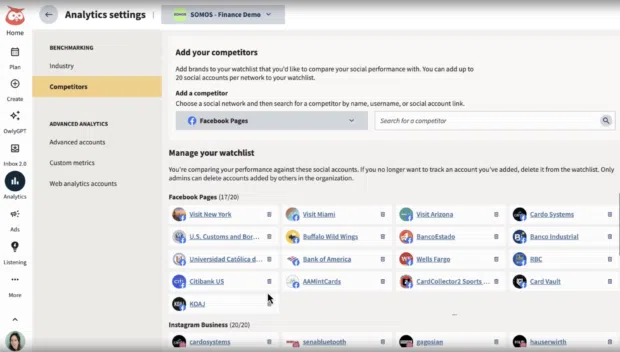
Hootsuite Analytics gives you a real-time look at how your brand stacks up against competitors on Instagram, Facebook, and X.
You can track up to 20 profiles per network and benchmark things like follower growth, engagement, and content mix without doing any manual digging.

It also surfaces patterns that actually move the needle in your category, from top-performing posts to trending hashtags to the types of content everyone’s responding to.
And because it all lives inside Hootsuite, you can take action on those insights instantly. Plan, optimize, and publish your next round of content without hopping between tools.

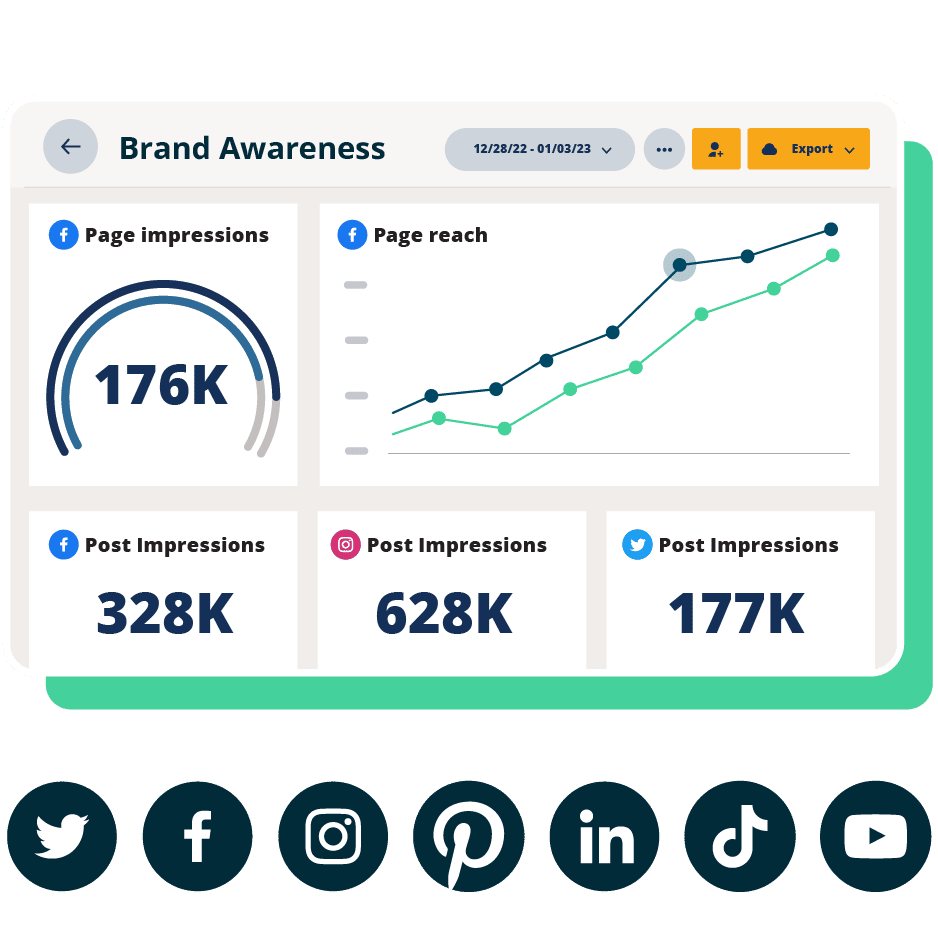
#1 Analytics Tool for Growth
Beautiful reports. Clear data. Actionable insights to help you grow faster.
Start free 30-day trial
2. Synapview
Ready to go beyond social media competitor analysis? Synapview is an app that lets you monitor competitors and hashtags on Reddit and blogs, helping you deep dive into your competition across multiple platforms.


3. Mentionlytics
Mentionlytics is a social media monitoring tool for conducting a social media competitive analysis. You can discover everything being said about your brand, your competitors, or any keyword on X, Instagram, Facebook, YouTube, Pinterest, and web sources (news, blogs, etc.).
Plus, with it’s handy “sentiment analysis” feature, you can see not only what is being said about your competitors but how it’s being said. This can help refine your messaging to better match what audiences are responding to.

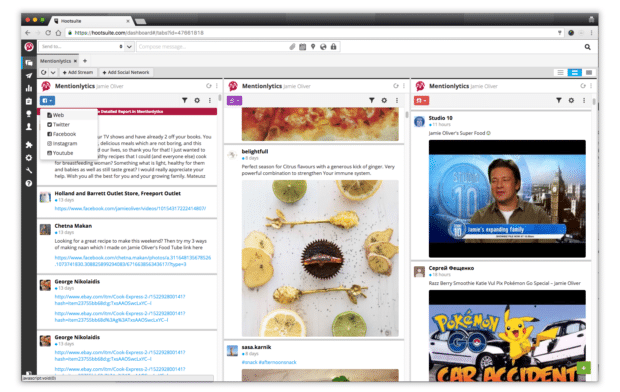
PSA: Mentionlytics integrates with Hootsuite so you can see everything it pulls in your Streams.
4. Sprout Social
Sprout Social is a comprehensive social media management tool that offers some competitive analysis features.
Sprout’s tools help users track and measure growth across competitors’ social accounts and easily check how those stats compare to their own. A word cloud solution that surfaces trending topics and keywords is also available.

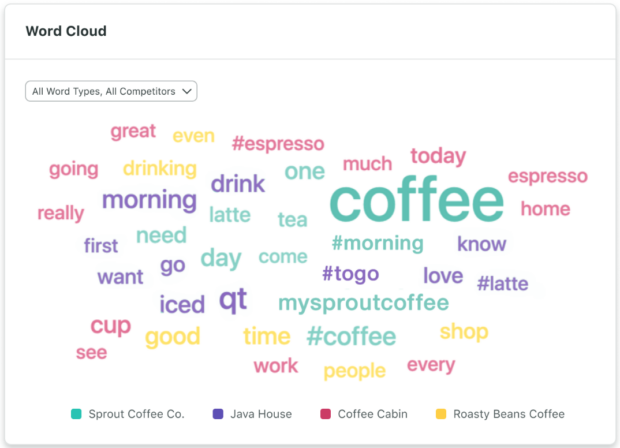
Source: Sprout Social
Check out our detailed side-by-side comparison to see how Sprout Social stacks up against Hootsuite.
FAQ: Social media competitor analysis
Most social media teams rely on a SWOT framework because it keeps the work practical. It helps you quickly see what you’re doing well, where you can improve, and how to turn those insights into better content, smarter resourcing, and clearer priorities across your digital marketing channels.
Platforms like Hootsuite and Talkwalker give enterprise teams the freshest and most complete competitor data. They pull engagement metrics, in-depth audience insights, and industry benchmarks into one place so you can get a real read on how you stack up, without spreadsheets or manual sleuthing.
Social listening fills in the “why” behind the data. It shows what people are actually saying about you and your competitors, in real time. That means sentiment shifts, early trends, and potential threats show up faster, which helps large teams adjust messaging, content, and marketing tactics before anyone else catches on.
Start by narrowing your true competitors based on shared audiences, overlapping keywords, and product similarities. Then look closely at their content, engagement patterns, and posting habits to see where they outperform you and where you have an edge.
Most enterprise teams also layer in trend data, paid performance signals, and cross-channel comparisons so insights tie back to bigger marketing objectives.
Use tools that automatically pull competitor metrics so you can compare engagement, follower growth, posting cadence, and content mix at a glance. Once your benchmarks are set, check them quarterly to spot shifts, wins, and weak spots before they become bigger issues.
Use Hootsuite to crush the competition on social media. Manage all your profiles, track competitors and relevant conversations, improve performance, and much more — all from one simple dashboard. Try it free today.