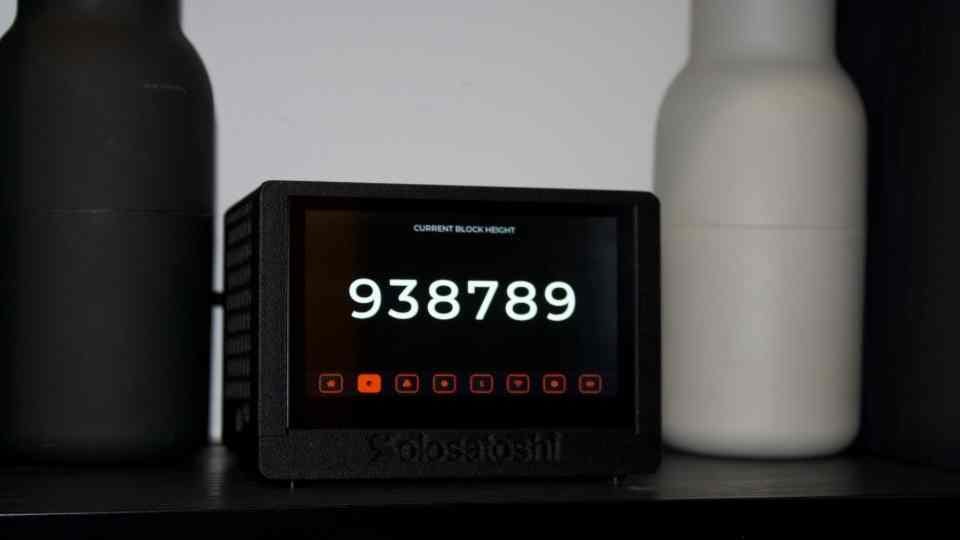
A small Houston, Texas business just did something no mining company, no venture-backed startup, and no publicly traded hardware manufacturer has done: they brought a fully open-source touchscreen Bitcoin miner to market that outperforms every competitor in its class by a factor of two.
The Bitaxe Turbo Touch. Dual BM1370 ASIC chips. 2.15 TH/s at stock. Over 3.06 TH/s overclocked. Eight dynamic displays. Every line of firmware, from the ASIC driver to the touchscreen renderer, is open source and on GitHub.
And the company behind it? A small home based business that has shipped 40,000+ open-source Bitcoin miners to 70+ countries in under two years.
This is the Solo Satoshi story, and the hardware world should be paying attention.
The Numbers That Don’t Make Sense
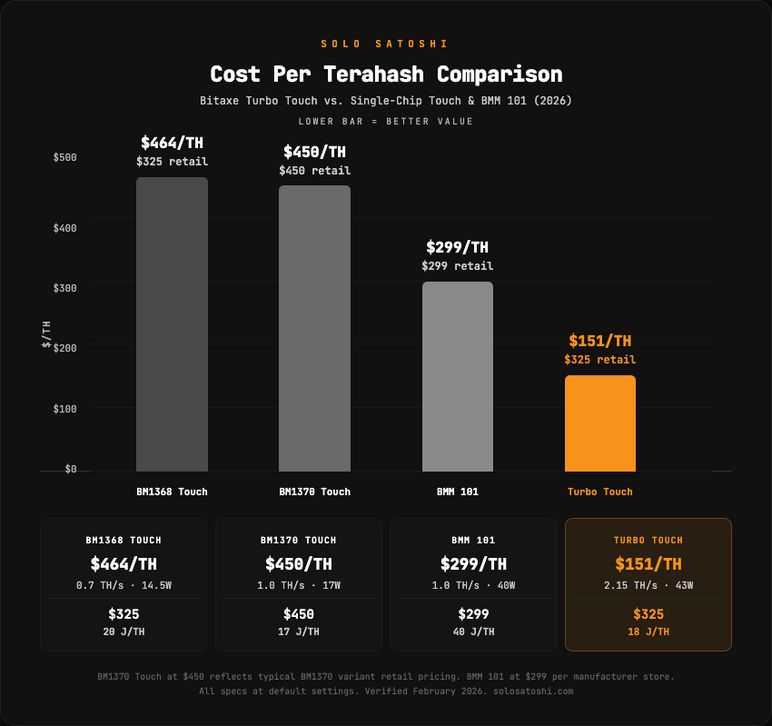
Here’s the competitive landscape for touchscreen Bitcoin miners in 2026:
| Device | Hashrate | Efficiency | Price | Cost per TH/s | Firmware |
|—-|—-|—-|—-|—-|—-|
| Bitaxe Touch Turbo Edition | 2.15 TH/s | 18 J/TH | $325 | $151 | Fully open source |
| Bitaxe Touch (BM1370) | 1.0 TH/s | 17-20 J/TH | $450 | $450 | Proprietary screen |
| Bitaxe Touch (BM1368) | 0.7 TH/s | 20 J/TH | $325 | $464 | Proprietary screen |
| Braiins BMM 101 | 1.0 TH/s | 40 J/TH | $299 | $299 | Proprietary |
Read that again. The Turbo Edition delivers more than double the hashrate of the next closest device, at less than half the cost per terahash, with better energy efficiency, and it’s the only one with a fully open firmware stack.
The Braiins BMM 101 draws 40 watts to produce 1.0 TH/s. The Turbo Edition draws 43 watts to produce 2.15 TH/s. Nearly the same power bill. Double the output. That’s not an incremental improvement. That’s a generational gap.

The Origin Story Nobody Expected
Solo Satoshi didn’t set out to build hardware. We set out to get people mining Bitcoin.
We founded Solo Satoshi in 2024 and the mission was simple: make Bitcoin mining accessible to anyone, anywhere in the world. We started selling open-source Bitaxe miners, built by .
Then the touchscreen idea happened.
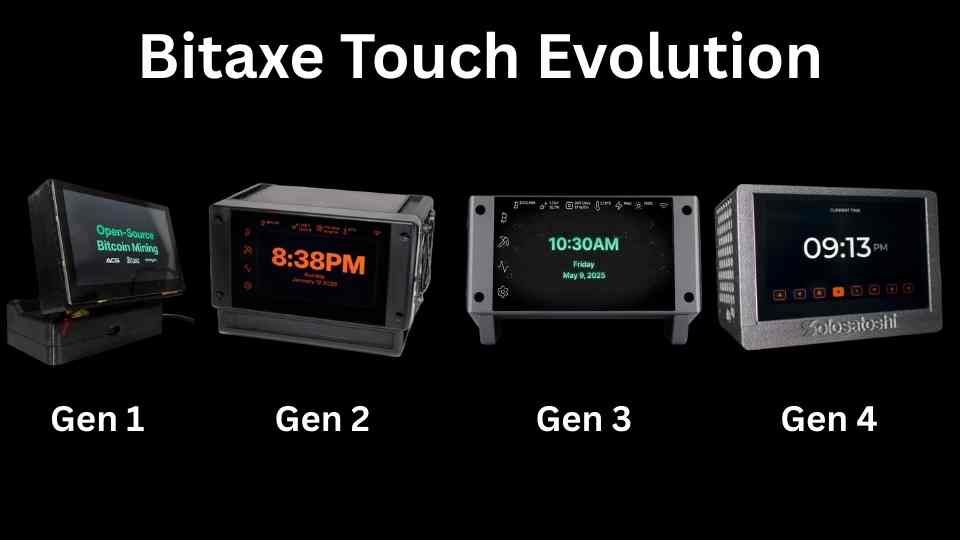
In late 2024, Solo Satoshi collaborated with a business in Dallas, Texas to develop the world’s first touchscreen Bitcoin miner. This business created the product concept, while Solo Satoshi helped define the user experience, and came up with the name: Bitaxe Touch.
In January 2025, Solo Satoshi published the world-exclusive unveiling. Solo Satoshi became the first retailer to ship a touchscreen miner. The market responded immediately. People didn’t just want to mine Bitcoin at home. They wanted to watch it happen on a screen they could touch.
Then the team behind the original Bitaxe Touch made a decision Solo Satoshi couldn’t support: they closed the source on the screen firmware.
The mining firmware stayed open (AxeOS, same as every Bitaxe). But the touchscreen layer, the part you interact with every day, the part that handles your Wi-Fi credentials and displays your mining data, became a black box
For a product built on the back of Bitcoin’s open-source ethos, that was a dealbreaker.
“We didn’t have a fight about it,” Matt says. “We just had a different vision. In Bitcoin, you verify. You don’t trust. If I can’t read the code running on the screen our customers are tapping every day, we can’t ship it with our name on it.”
So we set out to build the version we always envisioned.

What’s Actually Under the Hood
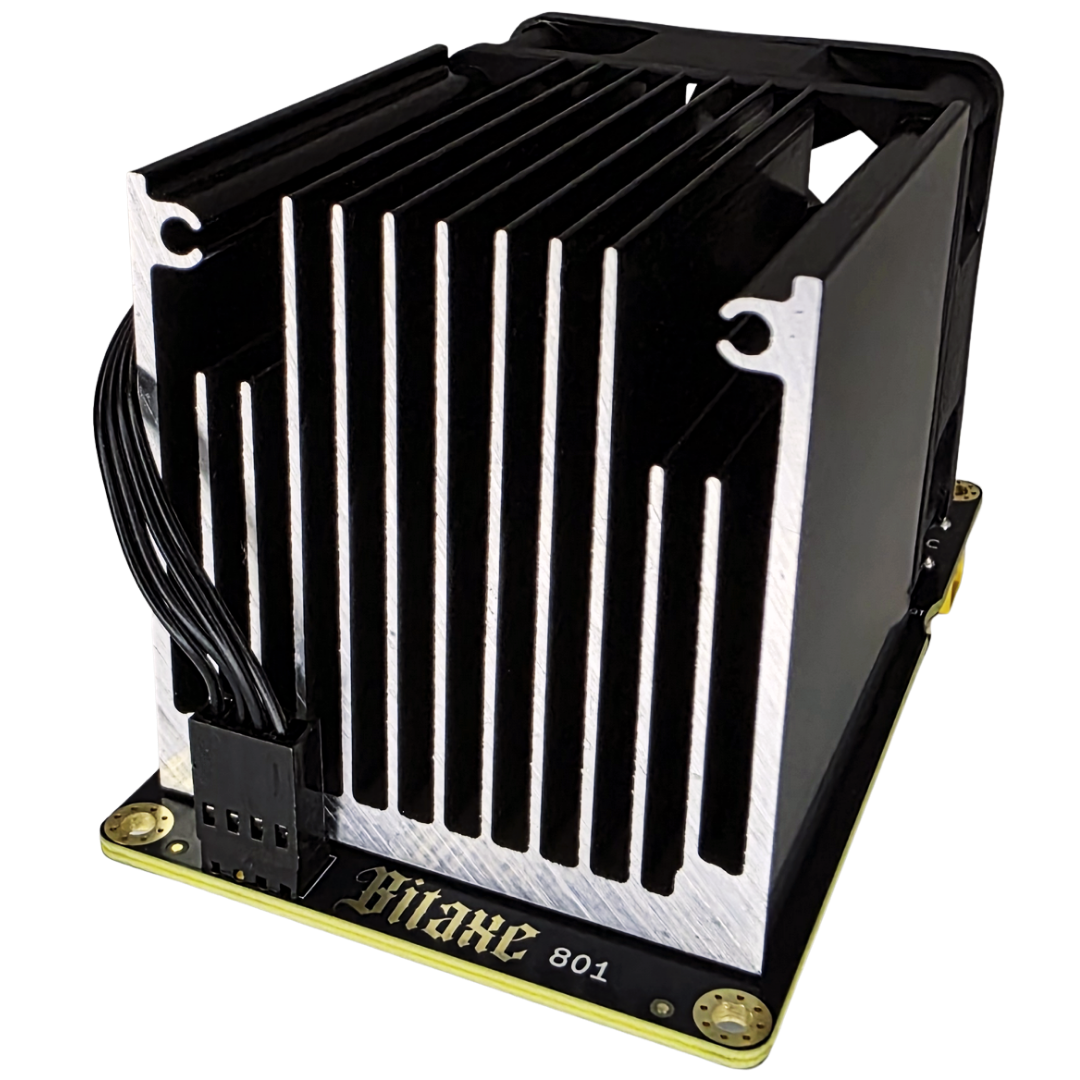
Solo Satoshi designed the Bitaxe Touch Turbo Edition around the Bitaxe GT 801 platform and worked with their manufacturing partner to bring it to production. Two BM1370 ASIC chips, the same silicon inside Bitmain’s Antminer S21 Pro. The hardware design files, schematics, PCB layouts, and BOM are all public on the Bitaxe GT GitHub repository.
The device runs two independent firmware layers:
The mining brain: Mainline AxeOS (esp-miner) on an ESP32-S3. Same firmware running on every Bitaxe on earth. Pool connectivity, ASIC communication, stratum protocol, nonce rolling, web dashboard. All open source.
The touchscreen brain: BAP-GT-TOUCH on a separate ESP32, communicating with the mining layer through the Bitaxe Accessory Port (BAP) via a 115200 baud NMEA-style protocol. Handles all screen rendering, mempool.space data pulls, Wi-Fi management, and user controls. All open source.
If the screen crashes, the miner keeps hashing. If you want to build a completely different UI, fork the repo and flash your own. The architecture treats the touchscreen as a true accessory, not a dependency.
Eight screens, all accessible with a single tap: mining dashboard, block clock, latest blocks with pool attribution, BTC price ticker, hashrate graph, clock, Wi-Fi settings, and full device controls with three power modes. The full breakdown of all eight screens is worth a look.
Every unit is assembled 100% in the USA from bare PCB, bench tested and verified hashing before it ships, and backed by a manufacturer warranty.

The Block Wins Are Real
This isn’t theoretical. Open-source Bitcoin miners have found real blocks on the real Bitcoin network. The verified track record:
$200,000: A Bitaxe cluster at ~3.3 TH/s found block #887,212 in March 2025. Solo. 3.125 BTC.
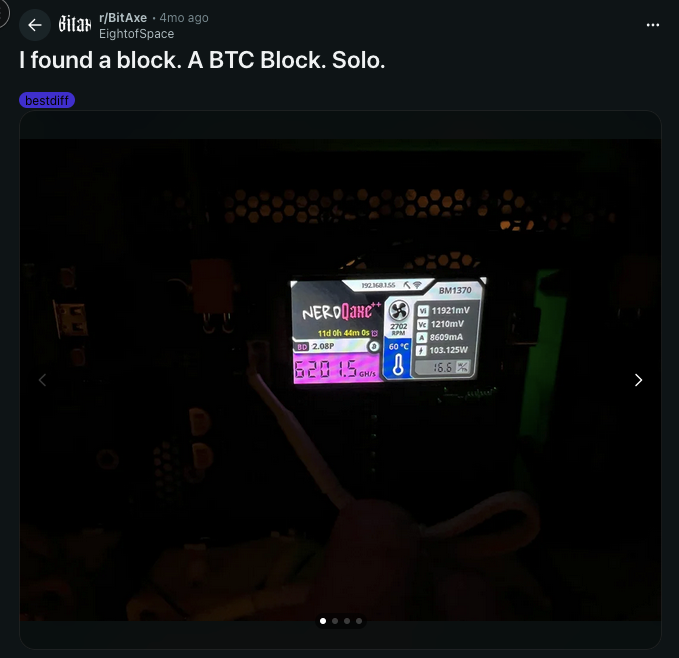
$347,000: A Solo Satoshi customer running NerdQaxe++ miners on a self-hosted Public Pool node found block #920,440 in October 2025 worth 3.141 BTC. He used the reward to pay off his mortgage. This was the largest confirmed payout to an open-source home miner in Bitcoin’s history.
$310,000: Six Bitaxe Gamma 602 units at ~6.6 TH/s found block #924,569 in November 2025 on CKPool. 3.08 BTC at a record network difficulty of 221.39 T.
Total documented rewards: over $1 million. All verifiable on-chain.
The intervals between confirmed wins are shrinking: 229 days, 179 days, 52 days, 25 days. Open-source miner adoption is accelerating faster than the network difficulty is rising.
A single Bitaxe Touch Turbo Edition at 2.15 TH/s running against a 900+ EH/s network? The odds per block are tiny. But the electricity cost is $3.70 per month. And the next block is always closer than you think.

Why the Hacker Community Should Care
Forget the mining economics debate for a second. Here’s what matters from an engineering and decentralization perspective.
40,000+ independently operated miners across 70+ countries. Every one of them is contributing to the geographic and political decentralization of Bitcoin’s hash rate. In a world where industrial mining is consolidating into a handful of publicly traded companies in a handful of jurisdictions, that’s not trivial.
A fully open firmware stack on a consumer mining device. Not “open source except the bootloader.” Not “open hardware but proprietary firmware.” Fully open. Mining layer, screen layer, hardware design, BOM, schematics, PCB layouts. Everything. Fork it, audit it, build your own.
A $325 price point that makes deployment trivial. You don’t need a warehouse, a power purchase agreement, or a cooling infrastructure. You need a Wi-Fi connection and a desk.
An accessory port protocol (BAP) that’s extensible. The BAP specification is public. If you want to build a different display, a notification module, a hardware wallet integration, or something nobody has thought of yet, the protocol is there.
The Bitaxe project is the most important open-source hardware project in Bitcoin right now. The Touch Turbo Edition is the most polished, most powerful consumer product to come out of it.
The Bitaxe Project Needs Hackers & Developers
Shipping hardware is only half the mission. The BAP protocol is open. The screen firmware is open. The hardware files are open. The community is actively looking for developers, designers, and builders who want to push the Bitaxe platform further: custom screen interfaces, new BAP accessories, alternative dashboards, Home Assistant integrations, notification modules, whatever you can think of.
If you want to join the community building the future of open-source Bitcoin mining, the OSMU Discord is where it happens.
Matt Howard is the founder and CEO of Solo Satoshi, a family-owned Bitcoin home mining hardware company based in Houston, Texas. Follow @SoloSatoshi on X.