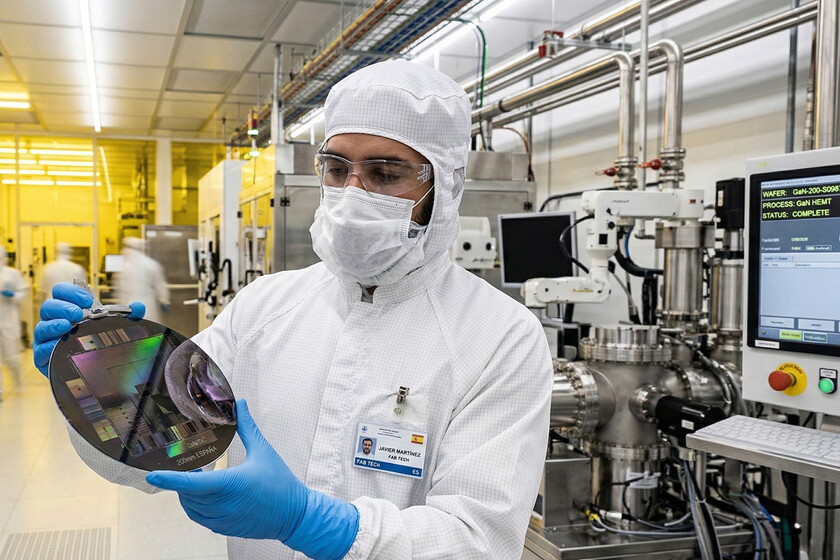
SPARC Foundry is one of the best assets that Spain can cling to to get on a train, that of semiconductors, currently guided with a firm hand by the US, South Korea, Taiwan, China and Japan. This Galician company, however, does not pursue producing silicon chips. In this area, competing with the five powers I just mentioned is essentially impossible.
SPARC’s plan involves building a next-generation photonic semiconductor factory in the Valadares Technology Park, in Vigo. The interesting thing is that these chips will not be silicon; They will be manufactured using gallium arsenide (GaAs), indium phosphide (InP) or gallium nitride (GaN), and will most likely have a leading role in the telecommunications, defense, automotive, consumer electronics, quantum computing or aerospace sectors.
Be that as it may, SPARC will not tackle the GIGaNTE project alone. Indra leads it with a 37% stake in SPARC Foundry, which places the latter group as the majority partner of the company specialized in the production of chips. According to SPARC and Indra, the Vigo semiconductor plant will be operational during the first half of 2027 and will have the capacity to manufacture up to 20,000 wafers per year when it is able to work at full capacity. An interesting note: GIGaNTE, the name of this project, has been designed around the chemical formula of gallium nitride (GaN).
Gallium aspires to be the protagonist of the next generation of chips
Photonic integrated circuits use photons to process and transmit information. Photons are the elementary particles responsible for forms of electromagnetic radiation, including the manifestation of visible light. They have no mass and are capable of traveling in a vacuum at a constant speed: the speed of light. However, something worth not overlooking is that although we are referring to them as particles, they also manifest as waves, hence the existence of the quantum phenomenon known as ‘wave-particle duality’ to identify the wave nature of light.
Although, as we have seen, SPARC will produce photonic chips, the core of its business will revolve around gallium arsenide and gallium nitride. Unlike silicon, They are not elementary semiconductors. And they are not because the latter are characterized by being made up of a single chemical element, while gallium arsenide (GaAs) is composed of gallium (Ga) and arsenic (As), and gallium nitride (GaN) is composed of gallium (Ga) and nitrogen (N).
SPARC is going to produce photonic chips and the core of its business will revolve around gallium arsenide and gallium nitride
The term semiconductor is appearing many times in this article, so it is a good idea that we review what it is about before moving forward. A semiconductor is an element or compound that, under certain conditions of pressure, temperature, or when exposed to radiation or an electromagnetic field, behaves like a conductor, and, therefore, offers little resistance to the movement of electrical charges. And when it is found in other different conditions it behaves like an insulator. In this last state it offers great resistance to the displacement of electrical charges.
In elements with electrical conduction capacity, some of the electrons in their atoms, known as free electrons, can pass from one atom to another when we apply a potential difference at the ends of the conductor. Precisely, this electron displacement capacity is what we know as electric currentand we all know intuitively that metals are good conductors of electricity. Curiously, they are because they have many free electrons that can move from one atom to another and, thus, they manage to transport the electrical charge.
Gallium nitride and gallium arsenide are semiconductors, and this implies that under certain circumstances they are capable of transporting electrical charge. When the appropriate conditions exist, the mobility of its electrons is much greater than in semiconductors such as silicon or germanium. And this means that its capacity to transport electrical charge is also superior.
Another very interesting property of these compounds is their high saturation rate. It is not necessary for us to delve into this parameter to the point of excessively complicating the article, but it is interesting that we know that it reflects the maximum speed at which electrons can move. through the crystal structure of these compounds. This maximum speed is limited by the dispersion suffered by the electrons during their movement.
Gallium arsenide transistors can work at frequencies above 250 GHz
This property has very important repercussions. One of them is that gallium arsenide transistors can work at frequencies above 250 GHz, which is a quite impressive figure. In addition, they are relatively immune to overheating and produce less noise in electronic circuits than silicon devices, especially when it is necessary to work at high frequencies.
On the other hand, gallium nitride can work at very high voltages and reach extreme temperatures without its performance or stability being compromised. Besides, allows manufacturing compact and efficient transformers Because it dissipates little energy in the form of heat, it will most likely play a fundamental role in the charging infrastructure of electric cars and base stations for 5G communications.
Image | Generated by WorldOfSoftware with Gemini
More information | SPARC Foundry
In WorldOfSoftware | Spain steps on the accelerator in its particular chip race. And it does so with a total commitment to integrated photonics