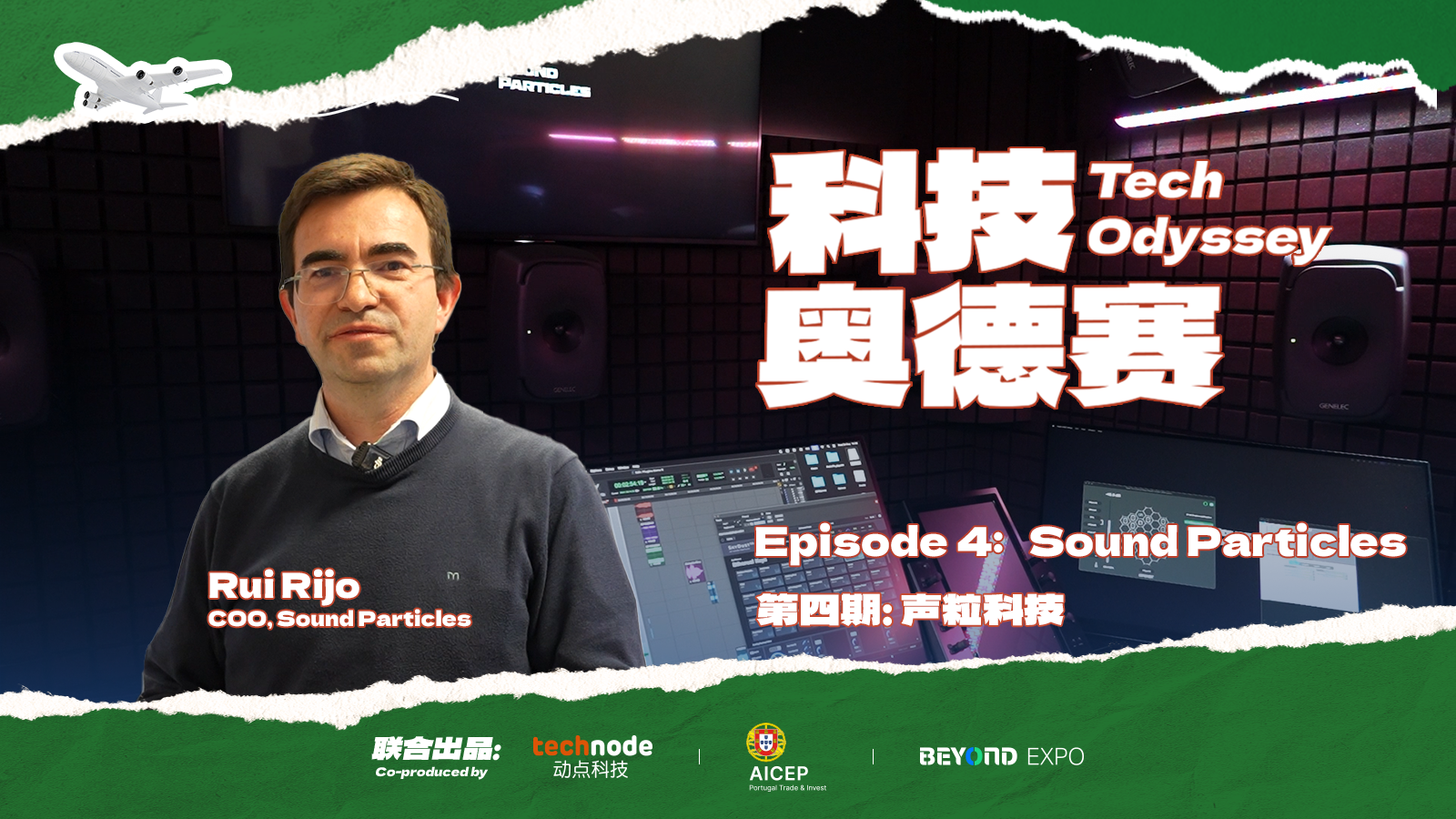
In the previous episode, we looked at how Bhout turned one founder’s dream into a business. This time, we turn to a lower-profile but technically rigorous company: Sound Particles.
When audiences hear the roar of a sandworm in Dune or feel the force of a blast wave in Oppenheimer, few would imagine that part of the technology behind those immersive soundscapes comes from a 17-person company based in Lisbon, Portugal. Founded in 2016, Sound Particles has earned its place in the high-end film, game, and music production pipeline by bringing a core idea from computer graphics into audio.

Its core, genre-redefining concept is to treat individual sounds like particles in a 3D environment. Instead of building complex soundscapes one layer at a time, creators can place sounds in virtual space, give them defined position and movement, and shape the final listening perspective through virtual microphones. That fundamentally changes how immersive audio is made. During our visit, the team showed how a small number of base samples could be adjusted into thousands of distinct variations, making dense, complex scenes feel far more natural, while reducing the need for endless manual edits.
What stood out to us most during our visit, even more than the core technology itself, was the team’s focus on acoustic realism. In its office, rows of 3D-printed ears, heads, and torsos—all modeled on the company’s employees—are used for granular acoustic testing. The logic is simple: every person’s ears are structurally unique, and sound is shaped not only by where it comes from, but also by how it interacts with each listener’s ears and body. That is why the team has gone beyond printing ears alone, and started recreating full heads and torsos to capture even more nuanced acoustic details.


This work connects directly to the company’s biggest next ambition. Traditional immersive audio depends heavily on multi-speaker theater setups, but most people listen to audio through everyday headphones. Sound Particles has spent years developing personalized binaural audio technology, using the unique shape of a listener’s head and ears to simulate how sound travels and interacts with the body. The goal is to bring a more convincing, theater-quality 3D audio experience to ordinary users, no room full of speakers required.
The company has also expanded far beyond professional audio tools. Its product lineup now includes plugins for digital audio workstations, industry-first immersive synthesizers, and a dedicated 3D sound library. At the same time, it has started applying the same spatial audio technology to artificial intelligence, generating audio datasets with precise spatial labels and realistic environmental noise to train neural networks for speech recognition, smart vehicle environment detection, and related systems.


What makes Sound Particles interesting is not just the market it has entered, but the way it has grown. It started with one difficult, foundational question—how sound should exist in 3D space—and kept pushing that question further, from film production to consumer headphones, and even into AI training. For a small team based in Lisbon, that quiet, consistent focus on a single core question has already taken them a long way.